
IBM Patents a System That Catches AI Summaries Making Up Facts
AI summarization tools can confidently state things that were never in the original document. IBM has filed a patent for a system that mathematically checks each sentence an AI writes against the source text to catch those fabrications before they cause problems.
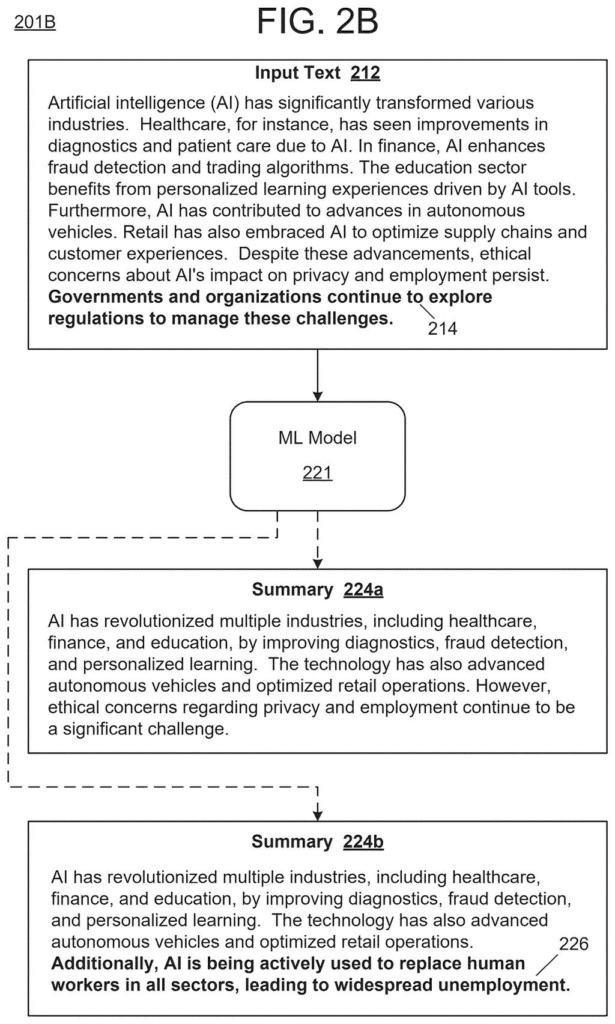
How IBM's hallucination detector checks AI-written summaries
An AI tool churns through a long contract and hands a lawyer a tidy summary. The summary looks clean, but two of its sentences describe terms that were never in the contract. Nobody catches it.
That's the problem IBM's patent is trying to solve. The idea is to automatically check every sentence in an AI-generated summary and flag anything that can't be traced back to the original text. Think of it as a spell-checker, but instead of spotting typos it spots invented facts.
If a flagged sentence is too far from anything in the original document, the system marks it as a hallucination and logs the mistake. That log can then be used to train the AI model to stop making the same error. The whole loop, from generating the summary to catching the problem to feeding that back, is designed to run automatically.
… identifying a hallucination within the output text based on a distance between the target embedding and the plurality of embeddings in the vector space …
Translation: The system detects fake information by measuring how far the summary's meaning drifts from the original source material.
How the vector-distance check flags fabricated sentences
The patent describes a pipeline with several connected steps. An AI model reads a body of text and writes a summary. Then a separate checking process goes to work on that summary.
The checking process works by converting text into numbers. Both the original document and the AI's summary are translated into lists of numbers called embeddings (each embedding is a kind of coordinate that places a sentence in a mathematical space where similar sentences land close together). The system generates a large set of embeddings from every possible combination of sentences in the original document, so it covers not just individual sentences but multi-sentence ideas.
Each sentence from the AI's summary is then embedded in the same mathematical space. If that sentence's coordinates are far away from all the embeddings derived from the source text, it's a signal that the AI wrote something the original never said. The patent also covers the reverse case: source sentences that the AI entirely omitted from the summary, which it calls missing context.
- Run the AI model to produce a summary
- Embed all source-sentence combinations in vector space
- Embed each summary sentence and measure the distance to source embeddings
- Flag sentences that are too distant as hallucinations
- Log the input, the output, and the flagged sentences for model retraining
… generating different possible combinations of sentences from the first group of sentences and embedding the different possible combinations of sentences to generate a plurality of embeddings in vector space …
Translation: The software creates a map of all possible sentence groupings from the original text to use as a reference point.
What this means for AI tools used in legal and enterprise work
Hallucination is one of the main reasons businesses hesitate to trust AI summarization for anything high-stakes, like legal documents, medical records, or financial filings. A system that automatically produces a feedback log of errors is directly useful for retraining models, which is the practical path to making them more reliable over time. The patent doesn't require new hardware; it's a software process that could sit on top of existing large language models.
The shortest route to a shippable version of this is an API-layer wrapper that enterprise customers plug in around whatever summarization model they already use. IBM already sells AI tools to large enterprises through its watsonx platform, and this kind of reliability layer fits that market directly. The AI hallucination problem is drawing attention across the industry, and the latest Big Tech patents in the enterprise AI space show IBM is far from the only company racing to build guardrails around language model outputs.
That makes this IBM's 42nd filing we've tracked since May in the AI guardrails race, adding to work like blocking restricted users and pitting models against each other.
This patent is closer to a shippable feature than most AI filings. It doesn't require new chips, specialized sensors, or a model architecture that doesn't exist yet. The core idea, measuring the distance between summary sentences and source sentences in a shared mathematical space, is built on tools that are already standard in natural language processing.
The main engineering work left is tuning the distance threshold: deciding how far is too far before calling something a hallucination. Set it too tight and you'll flag legitimate paraphrasing; set it too loose and real fabrications slip through. That calibration problem is real but not exotic.
For IBM specifically, this fits cleanly into its pitch to regulated industries. Banks, law firms, and hospitals all need audit trails when AI touches important documents, and the feedback record this patent generates is exactly that kind of trail.
Get our take in your Top Stories
Liked this breakdown? Add Patentlyze as a preferred source on Google, and our plain-English take shows up more often in your Top Stories the next time IBM patent news breaks.
There are more where this came from
We read every patent application Big Tech publishes and send you the ones worth knowing. Plain English, free, every week.
The drawings
14 drawing sheets from US 2026/0252614 A1 · click any drawing to enlarge


Want this weekly breakdown for a company we don't cover? Patentlyze Pro →
Be the first to weigh in