
Adobe Patents a Tool That Turns Plain-English Questions Into Data Queries
Most data tools make you speak their language. Adobe is filing a patent for one that speaks yours, and figures out which slice of a massive dataset to search so you get a real answer fast.
What Adobe's natural-language data tool actually does
You're staring at a massive spreadsheet or database and you need answers, but you're not a data engineer. You type a question in plain English, like "which products sold best in the northeast last quarter," and a system translates it into the technical query language the database actually understands.
Adobe's patent goes a step further. Rather than running your question against the entire dataset, which can take a very long time when tables have millions of rows, the system picks a representative sample of the data. The tricky part is choosing the right sample. A random slice might miss the exact customer segment you're asking about. So the system reads your question, figures out your underlying goal, and selects a sample most likely to give you an accurate result.
It also tracks what you've been asking throughout your whole session, building a running picture of your intent, and uses that to suggest follow-up questions you might want to ask next.
… encoding, by a second machine learning model including a neural network encoder, the natural language query and prior queries of the data exploration session into a latent intent representation including embeddings in a multi-dimensional vector space …
Translation: The system translates your current and past questions into mathematical coordinates to understand what you want.
How the system picks the right data slice for your question
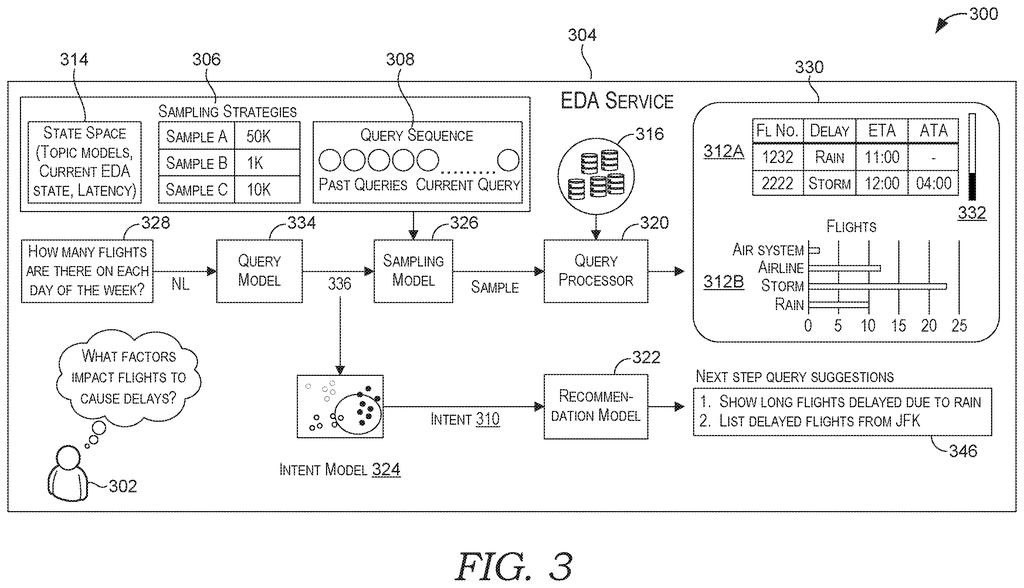
The patent describes a two-model pipeline sitting between a user and a large dataset.
The first model handles query translation: it takes a natural-language question and converts it into a structured query (think SQL, the standard language databases use). That part is increasingly common in analytics software.
The more interesting piece is the second model, which handles intent tracking. It uses a neural network encoder to turn your current question, plus every prior question in the session, into a compact mathematical representation called a latent intent representation (essentially a point in multi-dimensional space that captures the "meaning" of your line of inquiry). Those representations are chained together into a session-level intent state, a running summary of what you appear to be trying to learn overall.
A third component, the sampling model, uses that intent state to choose among several pre-generated candidate samples of the dataset. It picks whichever sample is most likely to produce query results that match what the full dataset would return, if you had time to scan all of it. The technical measure it optimizes is called divergence (how different the sample's answer would be from the full dataset's answer). Lower divergence means a more trustworthy fast result.
Finally, the system can surface recommended follow-up queries in the interface, drawn from its model of your session-level intent.
… an exploratory data analytics tool obtains a natural language query and generates a structured data query for execution on a sample of a dataset based on the natural language query …
Translation: The software takes plain English questions and turns them into formal data commands applied to a subset of information.
What this means for non-technical data analysts
For anyone who works with data but doesn't write code, this kind of tool closes a real gap. Plain-English querying already exists in some products, but running those queries on giant datasets is slow. The sampling approach is meant to make results appear in seconds instead of minutes, without requiring you to manually define what "a good sample" looks like for your specific question.
The session-level intent tracking is the more ambitious bet. If it works reliably, the tool stops feeling like a search box and starts feeling like a conversation with someone who remembers what you've already asked. That could matter most in exploratory analysis, where you're not sure exactly what you're looking for yet and want the tool to help you figure it out.
Adobe's new application is the 31st filing we've tracked under our Language AI coverage since May, joining work like tracing AI text to source data and one writing email subject lines.
The core gamble here is speed over completeness. Instead of searching the full dataset, the system picks a slice of the data that matches what it thinks you're asking, then answers from that slice. That's fast, but if it misreads your question and picks the wrong slice, you get a confident wrong answer, which is harder to catch than a slow right one.
The session design adds another fragile point. Your early questions shape how the system interprets your later ones, so a few wandering warm-up questions can tilt the whole session toward the wrong focus without any visible warning.
For casual exploration, where you're poking around and a rough answer is enough to know whether to dig deeper, this trade reads as reasonable. For anything where precision actually matters, like a number going into a report or a business decision, the same design becomes a liability the user may not know they're carrying.
There are more where this came from
We read every patent application Big Tech publishes and send you the ones worth knowing. Plain English, free, every week.
The drawings
9 drawing sheets from US 2026/0288717 A1 · click any drawing to enlarge


Want this weekly breakdown for a company we don't cover? Patentlyze Pro →
Be the first to weigh in