
Google Patents an AI That Decorates Your Documents Around What You Type
Every time you type into a document, most of that page is empty space. Google has filed a patent for an AI that reads what you write and automatically fills that surrounding space with visuals, decorations, or context that matches your content.
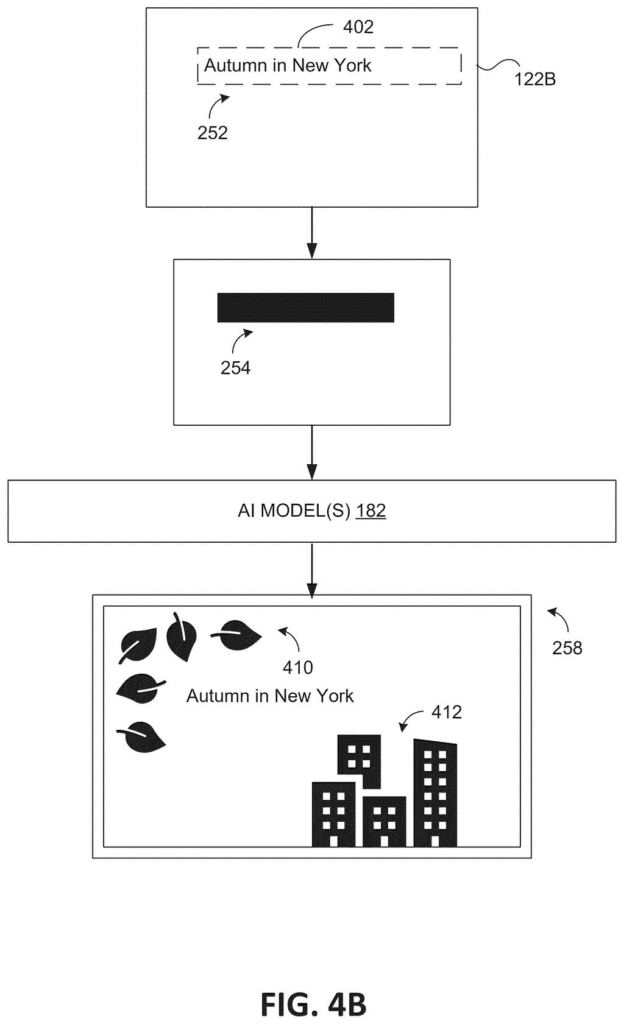
How Google's AI fills in the space around your text
Today, if you want a document to look polished, someone has to manually pick backgrounds, add design elements, or drop in relevant images alongside the text. That takes time most people don't spend, so documents end up plain white with black text, or a mess of mismatched clip art. Google wants to change that with an AI that does the decorating for you.
Here's how it would work for you: as you type your main text into a document, the AI reads it and generates what the patent calls secondary content. That could be a background image or pattern sitting behind your words, or decorative or contextual material placed right next to your text in a side region. The secondary content is matched to the style, format, or meaning of whatever you wrote.
So a party invitation might get a festive background, a business report might get a clean graphic border, and a recipe might get a food-themed illustration alongside it, all without you lifting a finger beyond typing.
… obtaining one or more outputs of the AI model, wherein the one or more outputs comprise secondary content corresponding to at least one of a style, a format, or a context of the primary content …
Translation: The system uses an artificial intelligence model to generate decorative or contextual elements based on your writing.
How the AI reads your content and places secondary material
The patent describes a system with two moving parts: a primary content region (where your text or main content lives) and one or more areas where AI-generated secondary content gets placed.
When you write something in a document, that text is fed as an input into an AI model (a system trained to recognize patterns in language, images, or both). The model analyzes three things about your content:
- Style, the tone or aesthetic of what you wrote (formal, casual, celebratory)
- Format, the structure of the document (invoice, flyer, letter)
- Context, the subject matter (a birthday, a legal matter, a recipe)
Based on that analysis, the AI generates secondary content and places it in one of two spots: directly in the background of the region where your text sits (think a watermark-style design behind your words), or in a neighboring region adjacent to your text (like a sidebar or margin area).
The whole system runs on a client device, meaning the final composed document, primary and secondary content together, is what gets displayed to you. The patent does not limit itself to any specific document type or AI architecture, which makes the claim intentionally broad.
What this means for Google Docs and Workspace users
For everyday users, this could make Google Docs, Slides, or a future Workspace product feel much more like a professional design tool without any design skill required. Instead of opening a separate app to find a matching background or header graphic, the document would style itself based on your words.
The claim as written is quite broad: it covers any AI model, any secondary content type (visual, textual, or otherwise), and any document, as long as the secondary content reflects the style, format, or context of what you typed. a growing pile of Google AI-in-productivity filings signals that this fits a larger pattern of embedding AI into document creation tools, though whether any specific product ships with this feature is another question entirely.
Google's 90th filing in our Language AI coverage since May connects ideas like skipping already-understood words and breaking messy questions into focused ones.
Claim 1 covers any system that reads what a user types into a document, feeds that text into any AI model, and then places the resulting visuals into the background of the writing or in a neighboring section of the same document. The claim names no specific AI model, no specific document type, and no specific visual style, only that the output reflects the style, format, or context of what the user wrote.
That description fits a word processor, a slide tool, and an email composer equally well, because all three involve user-typed content, an AI step, and decorative output placed near or behind that content.
If granted as written, this claim would give Google legal reach over a basic workflow already appearing across mainstream writing tools, and anyone building that feature would need to weigh this patent before shipping.
There are more where this came from
We read every patent application Big Tech publishes and send you the ones worth knowing. Plain English, free, every week.
Want this weekly breakdown for a company we don't cover? Patentlyze Pro →
Be the first to weigh in