
Apple Patents a Thinner System for Tracking Eyes in Its Headsets
Apple is rethinking how the tiny lights that follow your eyes fit inside a headset, flipping the circuit board on its edge to reclaim space behind the display.
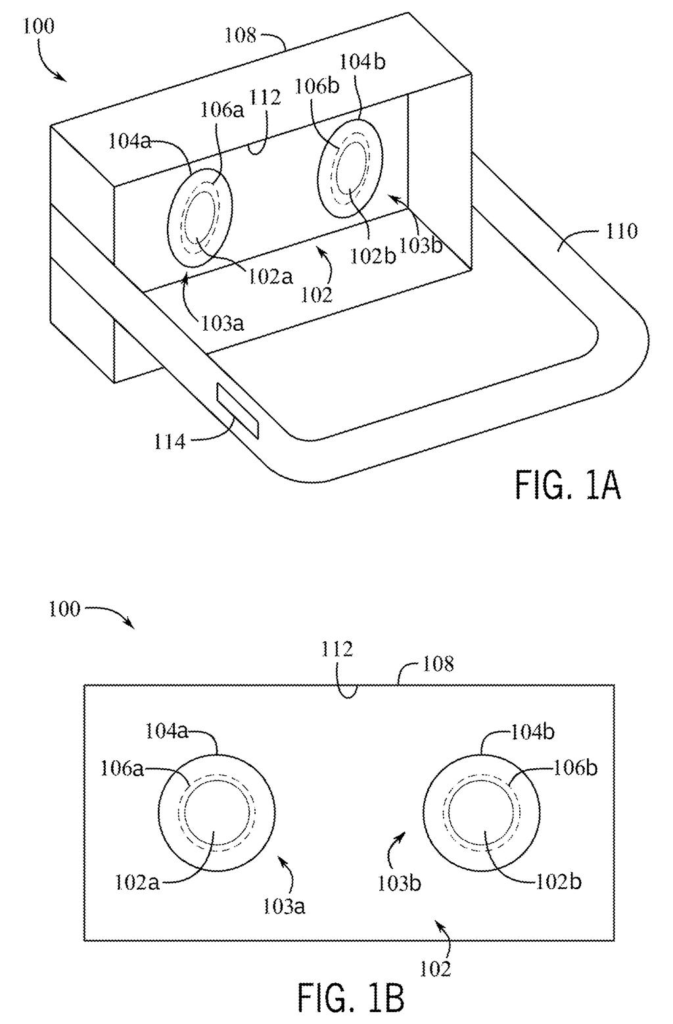
What Apple's edge-mounted eye-tracking actually does
You're wearing a mixed-reality headset and the software is tracking exactly where your eyes are looking, in real time. That tracking depends on small infrared LEDs aimed at your eyes from around the edge of the screen. The problem is that fitting those lights, and the wiring that powers them, inside an already cramped headset is an engineering puzzle.
Apple's patent describes a solution: instead of laying the circuit board flat (which eats into the depth of the device), stand it up on its edge around the perimeter of the display. The LEDs are then mounted to face inward toward your eye, not outward away from the screen. This "side-firing" arrangement keeps the assembly thin and tucks it neatly around the display without adding bulk behind it.
The result, if it works as described, is a headset that can pack reliable eye-tracking into a slimmer body, which matters a lot when something is sitting on your face for hours.
The eye-tracking assembly includes a flat electrical cable, for example a flexible printed circuit (FPC), coupled to the optical module frame and disposed about a perimeter of the display, and a light emitting diode (LED) electrically coupled to the flat electrical cable and configured to direct light away from the display.
Translation: A flexible ribbon cable frames the display and powers the LEDs that watch your eyes.
How the sideways circuit board aims the LEDs
The patent covers a head-mountable electronic device (a headset) that uses eye-tracking to know where you're looking. Eye-tracking in headsets relies on small LEDs that bathe your eye in near-invisible infrared light, plus sensors that read the reflection to figure out your gaze direction.
The key engineering claim here involves the flexible printed circuit (FPC), the thin ribbon of wiring that carries electricity to those LEDs. Normally, circuit boards and flat cables lie in the same plane as whatever they're attached to. Apple's design instead orients the FPC's major plane (the broad, flat face of the cable) at a 90-degree angle to the display, essentially standing it up on its edge like a wall running around the inside rim of the screen.
The side-firing LED is then mounted on the face of that upright cable that points away from the display glass, so its light shoots inward toward the wearer's eye rather than back into the display hardware.
- Circuit board stands perpendicular (orthogonal) to the display surface
- LEDs face toward the eye, not toward the display's back panel
- The arrangement wraps around the display perimeter, covering the full eye-tracking field
The net effect is that the eye-tracking hardware occupies the thin edge space around the display rather than the deeper space behind it.
What this means for the next generation of Apple headsets
For anyone who has worn Apple Vision Pro or a competing headset, weight and thickness are constant complaints. Eye-tracking is one of the features that makes spatial computing actually useful (it lets the device respond to where you look, not just where you point), but the hardware to pull it off takes up room that industrial designers desperately want back.
This patent targets that exact tension. By standing the wiring on its edge, Apple's interest in shrinking headset internals shows up in a concrete engineering choice rather than a marketing claim. A slimmer, lighter headset with accurate eye-tracking would be noticeable the moment you put it on, and is the kind of incremental improvement that separates a device people wear for an hour from one they wear all day.
Apple's 66th filing we've tracked in our AR glasses work since May builds on earlier applications like hiding private content and context-aware widgets.
The person who notices this patent's payoff won't know it happened. They'll just find that the headset sits more naturally against their face, with less bulk pressing forward, and they'll wear it for an hour instead of twenty minutes.
What Apple is solving here is a packing problem inside the part of the headset that tracks where your eyes are looking. By rotating a flat circuit ribbon so it runs along the edge of the screen rather than stacking behind it, the whole assembly gets thinner. That saved space is what eventually becomes comfort.
Eye-tracking is already table stakes for this category of device. The reason this filing matters is that even a well-designed feature fails if the hardware carrying it becomes something people take off and leave on the desk. Shaving depth from the interior is how a device crosses from impressive to livable.
There are more where this came from
We read every patent application Big Tech publishes and send you the ones worth knowing. Plain English, free, every week.
The drawings
5 drawing sheets from US 2026/0288239 A1 · click any drawing to enlarge


Want this weekly breakdown for a company we don't cover? Patentlyze Pro →
Be the first to weigh in