
AMD Patents a Header System That Trims Wasted Space in AI Math Data
AI models crunch through enormous grids of numbers, and right now most systems waste storage by treating every number as if it were the same size. AMD's new patent describes a header system that records exactly how large each number actually is, so nothing gets padded unnecessarily.
What AMD's matrix header compression actually does
Every AI model works by multiplying huge tables of numbers together millions of times per second. Today, those numbers are often stored with a fixed amount of space reserved for each one, even when many of them are small enough to need far less room. That wasted space adds up fast.
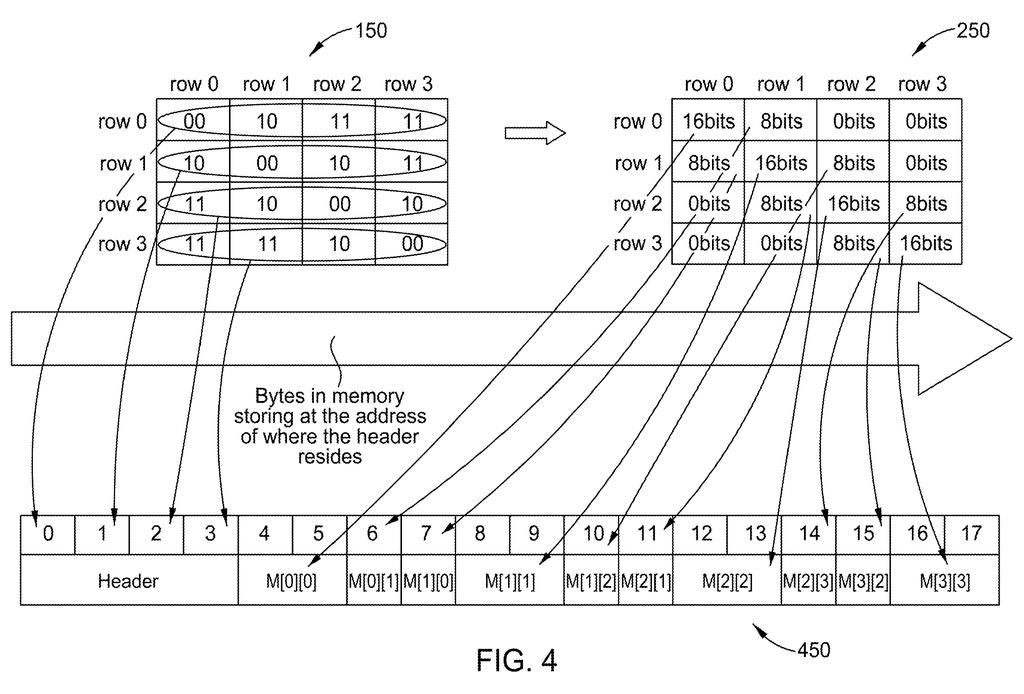
AMD's patent describes a smarter bookkeeping method. Before each block of numbers, the chip stores a small "header" that records how many bits of storage each number in that block actually uses. Because the header uses compact, uniform-size codes for each entry, the chip can quickly look up the right size and read each number correctly without guessing.
The idea is essentially a tight index card clipped to a stack of papers, telling you exactly how long each page is so you never have to flip through blank space. For AI workloads, that translates to more numbers fitting in the same memory and potentially faster processing.
… a block header for the matrix that stores encoded values for representing bit widths of the at least two entries, wherein the encoded values are different.
Translation: A special label tracks the exact size of each piece of data to save storage space.
How the encoded header tracks each entry's bit-width
The patent addresses a specific challenge in quantized AI models. Quantization is the process of shrinking the numbers inside an AI model from large, precise floating-point values down to smaller integers, which lets the model run faster and fit into tighter memory budgets. The problem is that different parts of the model end up needing different number sizes, some entries might need 4 bits while others need 8.
The invention stores a block header alongside each matrix (a grid of numbers representing part of the AI model). Inside that header, each entry's bit-width (how many bits it occupies) is recorded as a compact encoded value. Critically, all of these encoded values take up the same fixed amount of space within the header, so the hardware can scan through them at a predictable, constant rate.
The key components are:
- Matrix entries with variable bit-widths: at least two entries in a block can use different amounts of storage
- Encoded values in the header: each entry's size is represented by a short code rather than the raw bit count
- Fixed-width encoding: every code occupies the same number of bits, keeping header parsing simple and fast
When the processor needs to read a matrix block, it first reads the header to learn each entry's size, then reads the entries at exactly the right widths. Nothing extra gets allocated, and nothing gets misread.
… each number of bits included in a matrix is represented by an encoded value, and the encoded value is stored in a header.
Translation: The system uses a header to record how many bits each value actually needs.
What this means for AI chips running quantized models
AI models are getting larger, but the chips running them have fixed memory budgets. Quantization is already the standard industry answer to that squeeze, and AMD's track record in AI hardware patents shows this is an area the company keeps refining. The missing piece has been efficiently describing which size each number uses without burning extra storage on the description itself. This header approach tackles exactly that bookkeeping gap.
For everyday users, the downstream effect would be AI features that run on devices with less memory, or models that run faster on the same hardware. It's an incremental gain, not a leap, but at the scale AI workloads operate, incremental gains in memory efficiency translate directly into real cost and speed differences.
AMD's 40th filing we've tracked since May in our AI chip wars watchlist extends its work on shared memory layouts, building on one on neighbor chip memory and one on grouped processor memory.
The problem this patent attacks is real and expensive. When you mix different bit-widths inside a single AI matrix block and have no compact way to describe the layout, you either waste memory on padding or you burn processing cycles decoding variable-length fields on the fly. Both hurt, especially in datacenter AI inference where you're running the same operations billions of times.
The solution is tidy and the logic is sound. A fixed-width encoding for variable bit-widths is a classic data-structure trade-off: you add a small, predictable header cost and get back the ability to pack entries tightly without confusion. The engineering is careful rather than flashy.
The honest caveat is that this is a building block, not a finished product feature. Its value depends entirely on whether the surrounding memory subsystem and compiler toolchain are also designed to use variable-width matrix entries. On its own, it's a narrow but well-targeted fix for a problem that matters more as quantized AI models become the norm.
There are more where this came from
We read every patent application Big Tech publishes and send you the ones worth knowing. Plain English, free, every week.
The drawings
7 drawing sheets from US 2026/0303119 A1 · click any drawing to enlarge


Want this weekly breakdown for a company we don't cover? Patentlyze Pro →
Be the first to weigh in