
Apple Patents a Head-Tracking System That Clears Up Grainy See-Through Footage
When you wear a headset and look at the real world through its cameras, the image can look grainy and a little rough. Apple has filed a patent for a system that stacks multiple video frames together to scrub away that grain, using where your head is pointed and how far away things are to make sure the blend lands cleanly.
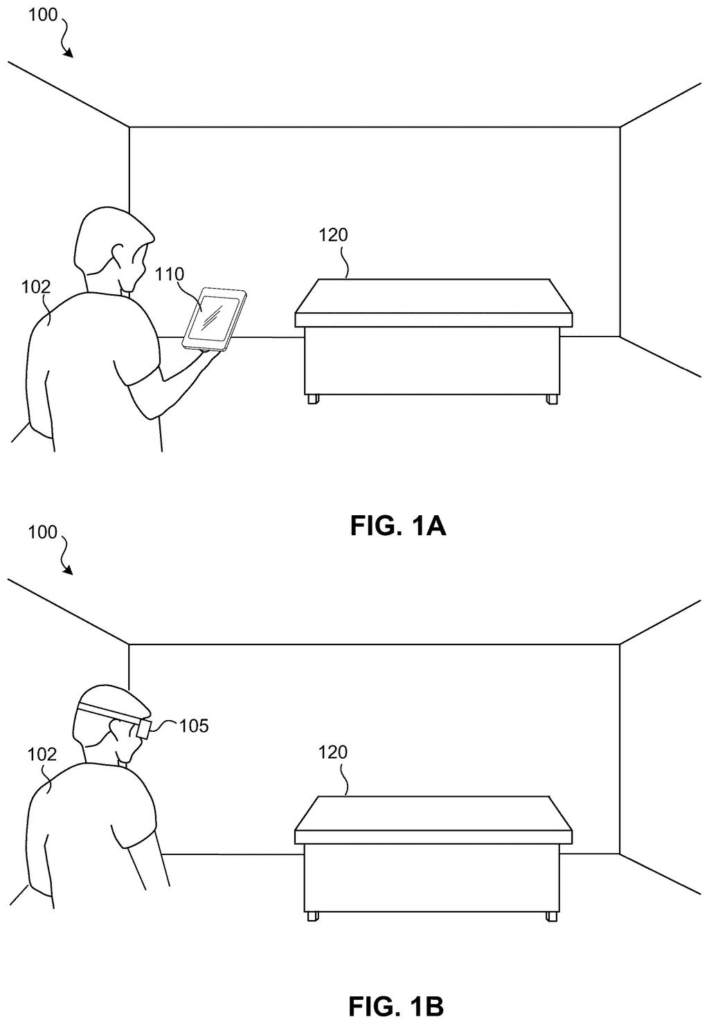
What Apple's passthrough noise fix actually does for your eyes
Imagine slipping on a mixed-reality headset and looking across the room. The cameras capturing that view produce a slightly noisy, imperfect image, and the faster you move your head, the worse it gets. That grain is one of the more annoying gaps between wearing a headset and just, you know, seeing normally.
Apple's approach is to layer several recent camera frames on top of each other and average out the noise. The tricky part is that if your head moved even slightly between frames, a naive blend will smear the image instead of sharpening it. So the system tracks where your head was pointing at each moment, then uses depth estimates (how far away different objects in the scene are) to warp the older frames so they line up precisely with the current one before blending.
The result, according to the patent, is a temporally enhanced frame, a single, cleaner image built from multiple snapshots but without the blur or ghosting you'd expect from stacking moving video. Your gaze direction also feeds into the process, so the system can prioritize quality where you're actually looking.
… predicting a user head pose based on sensor data obtained via one or more sensors, the user head pose corresponding to a viewpoint of the image sensor with respect to the 3D environment during capture of the current frame; …
Translation: The system guesses where your head was pointing when the camera took the picture.
How head pose and depth estimates align stacked frames
The patent describes a hardware-based temporal noise reduction pipeline for passthrough video, the live camera feed that mixed-reality headsets like Vision Pro use to show you the world around you.
Here's the basic loop:
- The headset's image sensor captures a stream of frames of the surrounding 3D environment.
- The system predicts your exact head pose (the position and angle of your head in space) at the moment each frame was taken, using onboard sensors like accelerometers and gyroscopes.
- It also estimates depth attributes for the scene, basically a per-pixel map of how far away every visible object is. This matters because nearby and distant objects shift differently when your head moves, so a single geometric correction isn't enough.
- Using both the head-pose prediction and the depth map, earlier frames are warped and aligned to match the current frame, then combined with it to reduce noise.
The word temporal here just means the system is working across time, pulling information from past frames rather than processing each frame in isolation. That's a well-established technique in video processing, but doing it correctly in a headset requires compensating for constant head movement, which is what the pose-and-depth step accomplishes.
Gaze tracking (where your eyes are actually pointed inside the display) is also referenced as an input, suggesting the system can weight quality improvements toward the part of the image you're focused on at any given moment.
… generate an enhanced frame by combining the current frame with the previously-captured frames. Combining the frames may be based on aligning the previously-captured frames with the current frame based on the predicted user head pose and the estimated depth attributes.
Translation: It cleans up grainy video by blending multiple past and present frames together based on depth and head position.
What this means for the Vision Pro's real-world video quality
Passthrough video quality is one of the main reasons mixed-reality headsets still feel like a compromise. The cameras and displays have improved, but sensor noise, especially in lower light, makes the feed look artificial rather than transparent. A system that stacks frames intelligently, without blurring moving edges or creating ghost images, could make a real difference in how natural the experience feels to you.
a growing pile of Apple AR and Vision Pro display-quality filings suggests the company is investing seriously in closing that gap. For everyday users, the practical test is simple: does the world look like the world, or does it look like a slightly bad YouTube stream? This patent is Apple's attempt to move that needle without requiring a major leap in camera hardware.
Apple's 76th filing we've tracked since May in our AR glasses work builds on filling gaps in 3D tracking and switching flat and depth views.
Apple's approach here trades physical camera quality for computational cleverness, using predictions about where your head is pointing and how far away objects are to stitch together a sharper picture from recent frames. That saves space and battery, which matters enormously on a device you wear on your face.
The cost is that the system is always working from slightly old information. If your head moves suddenly and unpredictably, the prediction slips, and instead of a cleaner image you get a smeared one.
Whether that trade holds up depends on how rarely the prediction slips in real use. The patent describes a careful solution to a genuine problem, but the moments that would break it are exactly the moments when clear vision matters most.
There are more where this came from
We read every patent application Big Tech publishes and send you the ones worth knowing. Plain English, free, every week.
The drawings
6 drawing sheets from US 2026/0301133 A1 · click any drawing to enlarge


Want this weekly breakdown for a company we don't cover? Patentlyze Pro →
Be the first to weigh in