
Apple Patents a System That Keeps AR Labels Stuck to Real Objects as You Move
Apple has filed a patent for a system that can spot a specific feature on a real-world object through a headset's cameras and keep a digital label stuck to it even as your head moves around. It's the kind of precise, persistent AR annotation that could make spatial computing feel less like a novelty and more like a tool.
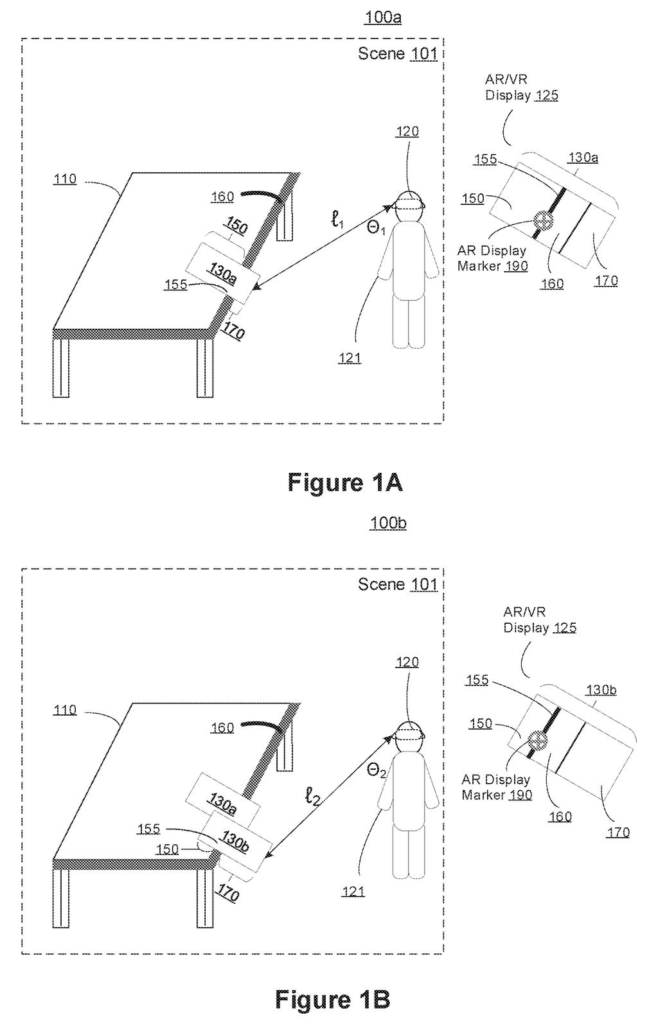
What Apple's AR object-tracking system actually does
Imagine you're wearing an AR headset and you point it at a circuit breaker panel on a wall. The headset's cameras look at what's in front of you and figure out not just that there's a wall, but that one particular section of it is a labeled switch worth highlighting. A digital tag pops up over that switch.
Then you step to the left. Instead of the tag drifting or disappearing, the system recalculates where the tag should sit based on your new position and angle, and keeps it locked precisely where it belongs on the physical object.
Apple's patent describes the underlying logic for making that work: analyzing groups of pixels, checking whether they belong to the same flat surface, and building enough confidence that they represent a meaningful feature before slapping a label on it. The goal is AR annotations that feel physically attached to real things, not floating in midair.
… fitting a first plane to the first set of pixels according to a determination that the first set of pixels satisfy a planar criterion; obtaining pixel characterization vectors for pixels in the pass-through image data, wherein each of the pixel characterization vectors includes one or more labels; …
Translation: The system maps flat surfaces in the camera view and assigns data labels to individual pixels.
How the pixel-plane method locks markers to surfaces
The patent describes a multi-step computer vision pipeline running on a device with cameras feeding live "pass-through" image data (the raw camera feed displayed to the wearer as their view of the real world).
The system starts by finding a cluster of pixels that appear to form a distinct, recognizable feature. It then runs a planar fit (a calculation checking whether those pixels all lie on the same flat surface, like a wall or a tabletop) to confirm they belong to the same physical plane. Each pixel is also assigned a pixel characterization vector, which is essentially a short list of labels describing what that pixel looks like (its color, texture, and semantic category).
Once an anchor cluster passes the planar test, the system looks at neighboring pixels and asks whether their characterization vectors are similar enough to belong to the same object. A confidence score called the object confidence threshold determines whether the expanded group is worth treating as a coherent, labelable feature.
- A digital AR marker is placed over the confirmed feature in the live camera view.
- As the user's head moves and the camera captures a new frame at a new angle, the system transforms the marker's position to match the new viewpoint.
- The marker stays visually locked to the physical feature across frames.
The whole loop runs continuously so the label tracks the object as the wearer walks around it.
… transforming the AR display marker to a position associated with the second pose in order to track the feature. The method includes displaying the second pass-through image data and maintaining display of the AR display marker that corresponds to the feature of the object based on the transformation.
Translation: It shifts the augmented reality label as you move so it stays anchored to the correct physical object.
What this means for Vision Pro and AR headsets
Persistent, surface-locked AR labels are one of the hardest problems in spatial computing. Most AR systems today can overlay text or icons on a scene, but keeping those overlays physically attached to a specific part of a real object as the user moves freely is where things break down. This patent addresses that gap at a fairly low level of the imaging stack.
For a product like Apple Vision Pro, this kind of capability would matter most in professional or industrial settings: a technician looking at equipment and seeing labeled components stay labeled as they circle the machine, or a surgeon seeing a highlighted region maintain its exact position through natural head movement. The approach described here doesn't require special markers on the physical objects, which is a meaningful practical advantage.
Apple's 63rd filing we've tracked since May on Apple's AR glasses applications adds to earlier work like cutting headset camera lag and combining cameras for face models.
The hardware Apple needs for this already exists: the headset cameras, the processing power, the pass-through video. What this patent describes is software logic sitting on top of equipment that is already shipping. That makes the path to a real feature meaningfully shorter than most.
The harder part is reliability. The detection method described works cleanest on flat, well-defined surfaces, which is a narrower slice of the real world than most people's actual environments. Getting from "works in testing" to "works in a cluttered garage or a busy kitchen" is the gap that will determine whether this becomes something people actually use.
If Apple clears that bar, what they would have is a foundation layer, a way for the headset to spot, label, and keep track of objects as you move around, that other useful tools could be built on top of over time.
There are more where this came from
We read every patent application Big Tech publishes and send you the ones worth knowing. Plain English, free, every week.
The drawings
32 drawing sheets from US 2026/0289814 A1 · click any drawing to enlarge


Want this weekly breakdown for a company we don't cover? Patentlyze Pro →
Be the first to weigh in