
Apple Patents a Lens-Holding Frame Design for Clearer Smart Glasses Views
Fitting a tiny display system inside a pair of glasses-style headset frames is a mechanical puzzle. This Apple patent solves a small but load-bearing piece of it: how you physically lock the lenses in place without the image going blurry.
What Apple's front-and-rear lens setup actually does
Ever tried to hang a picture perfectly level on a wall with no tools? A millimeter off and the whole thing looks wrong. The same problem exists inside a headset like the Apple Vision Pro, where lenses have to sit at an exact position or the image you see will be distorted.
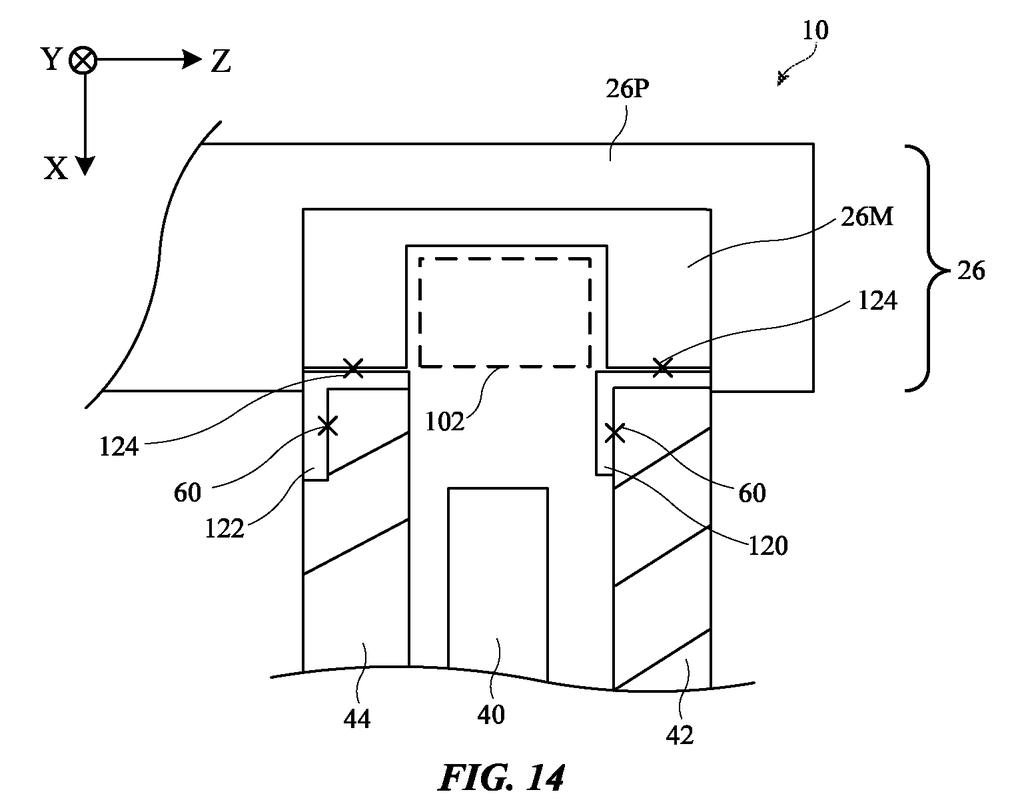
Apple's patent describes a mounting system that holds two lenses, one on the front of the frame and one on the rear, with a light-guiding layer called a waveguide sandwiched between them. The frame itself has small built-in shelves that the lenses rest against, giving each lens a precise, repeatable position. Some lenses snap in from the front; others slide in from the back. Either way, the shelf does the alignment work for you.
Apple has been filing around head-mounted display hardware since at least 2020, and this patent is a detailed look at one of the less glamorous but very necessary parts of building optics into a wearable frame.
… a head-mounted support structure comprising a front shelf that forms a first front-facing surface that faces a given direction and a rear shelf that forms a second front-facing surface that faces the given direction …
Translation: The glasses frame has built in shelves that hold the lenses in place.
How Apple's alignment shelves hold the waveguide in place
The patent covers the mechanical architecture that holds lenses inside a head-mounted display (a device you wear on your face to see digital images, like the Apple Vision Pro).
The core idea is a layered optical stack: a front lens, a waveguide (a thin sheet of glass or plastic that carries light from a tiny display to your eye, the way a fiber-optic cable carries data), and a rear lens. These three layers sit between your eye and the outside world.
To keep all three precisely aligned, the patent introduces alignment shelves built directly into the headset's support frame. Think of them as tiny ledges machined into the plastic or metal structure. The shelves have either front-facing surfaces (for lenses installed from the front) or rear-facing surfaces (for lenses installed from the back). The direction the surface faces determines which way the lens is pushed against it, and therefore how it is held in place under normal forces like gravity or a bump to the frame.
The two mounting directions, front-mounted and rear-mounted, let engineers choose the best installation method for each lens depending on which side of the frame it sits on and how the assembly line puts the headset together. The waveguide lives in the gap between the two lenses, protected and positioned by the frame on both sides.
The waveguides may be supported by head-mounted support structures between front and rear lenses on the left of the device and between front and rear lenses on the right of the device.
Translation: The display glass is safely sandwiched between two lenses on both sides.
What this means for the future of Apple headset optics
For a headset display to work well, the optics have to stay put. Even a small shift in lens position can blur the image or throw off the alignment between what you see in your left eye and your right eye, causing eye strain or a flat, unconvincing sense of depth. A reliable mechanical mount is what makes the display trustworthy over time, through temperature changes, drops, and daily use.
This patent does not describe a new display technology; it describes the structure that keeps existing display technology working. If Apple is iterating on how lenses are physically installed into a headset frame, that suggests ongoing engineering work on headset assembly, whether for a future Vision Pro revision, a lighter pair of AR glasses, or both.
The 67th Apple filing we've tracked since May on AR glasses work builds on thinner eye tracking and hiding private content.
The tradeoff built into this design is assembly complexity versus optical precision. Using alignment shelves in two directions, front-facing and rear-facing, gives engineers tight control over where each lens ends up. But it also means the frame has to be machined or molded to very tight tolerances, and any defect in those shelves propagates directly into the display quality.
That tradeoff reads as worth it for a high-end device where display performance is a selling point. A shelf that positions the lens automatically is better than one that relies on adhesive alone, which can creep over time or vary batch to batch.
The filing is narrow in scope. It is an internal assembly method, not a new type of lens or a new display mode. If you were hoping for a hint about what the next Apple headset will look like from the outside, this patent will not help you. It is infrastructure.
There are more where this came from
We read every patent application Big Tech publishes and send you the ones worth knowing. Plain English, free, every week.
The drawings
17 drawing sheets from US 2026/0287908 A1 · click any drawing to enlarge


Want this weekly breakdown for a company we don't cover? Patentlyze Pro →
Be the first to weigh in