
OpenAI Wins a Patent for Voice Chat That Starts Thinking Before You Stop Talking
Everyone has been cut off by a voice assistant or left waiting in awkward silence. OpenAI now holds a patent on a fix for both: judge whether your sentence is actually finished, and prepare an answer before you stop talking.
What OpenAI's turn-detection voice patent does
Ever paused mid-sentence to find the right word, only for a voice assistant to jump in and answer half a question? Or finished talking and then waited, wondering whether it heard you?
OpenAI's newly granted patent goes after both problems. Instead of waiting for a fixed stretch of quiet, the system listens to what you said. If a pause follows a complete thought, like too expensive, it decides your turn is over. If the pause follows a dangling because, it keeps waiting.
It also gets a head start. While you talk, your words are already being fed to the AI so it can begin working. If you keep going, it throws that early work away and starts over with the full picture. The filing aims for a reply in around 300 milliseconds, roughly the gap people leave in everyday conversation.
… transmit the first portion of the digital audio frames that includes the speech to a generative response engine while the digital audio frames are being received …
Translation: The system sends your voice to the AI brain while you are still speaking.
How the system tells a pause from a finished turn
Your device slices what it hears into short chunks called audio frames, for example 100 milliseconds each (a tenth of a second). A small speech detector labels each chunk as speech or not speech. Speech chunks go to a cloud server, which streams them on to the AI model while you are still talking.
When a silent chunk arrives, a conversation classifier (a program or trained model that judges the words so far) checks whether you have said an independent clause, meaning an idea that stands on its own even if it isn't a full sentence. The first claim covers exactly this: one silent frame plus a complete clause triggers a start signal telling the AI to begin its answer.
The filing describes several supporting behaviors:
- Incomplete thought: the server sends a cancel signal, discards any early reply, and waits for more speech.
- Long silence: a maximum wait ends your turn anyway. A 5-second limit is one example; the filing calls 2 seconds too short and 15 too long.
- Interruption: the server tracks which pieces of a reply were actually played to you, then tells the AI to forget the rest.
The filing also describes an optional extra: a trickle of selected camera frames, around one per second, so video does not overload the model.
What this means for talking to ChatGPT-style AI
If you talk to AI by voice, the annoying moments are the cutoffs and the dead air. This filing targets both. Its 300-millisecond reply target matches the gap in ordinary human conversation, and the interruption handling means the AI forgets the part of its answer you never heard instead of acting as if you had.
The filing names ChatGPT only as one example of the AI behind the voice, but the design applies to any voice assistant. Because the judging of finished thoughts happens in the cloud and the speech detector is small enough to run on your device, it could fit phones, laptops or watches.
This one is already granted. The patent office approved it in September, so OpenAI holds it now. The final granted claims may read a little differently from the published version described here.
OpenAI's second voice and speech AI application we've tracked since October follows keeping voice and text in sync.
Nothing here needs new hardware. A microphone, a phone or laptop, a cloud server and an AI model are the whole parts list, plus one small program that listens for quiet. That makes it much closer to a software update than a gadget.
The shortest route to a product is a change on the server side of an existing voice chat service. The pieces the filing describes are modest: a tiny detector on your device and a classifier that judges whether your sentence is finished. The harder requirement is an AI model that can start work on half a sentence, stop cleanly, and reuse some of its earlier effort.
Whether it feels better in practice depends on how often the classifier guesses wrong. The filing gives no accuracy numbers, so how often it cuts someone off is still an open question.
Get our take in your Top Stories
Liked this breakdown? Add Patentlyze as a preferred source on Google, and our plain-English take shows up more often in your Top Stories the next time OpenAI patent news breaks.
There are more where this came from
We read every patent application Big Tech publishes and send you the ones worth knowing. Plain English, free, every week.
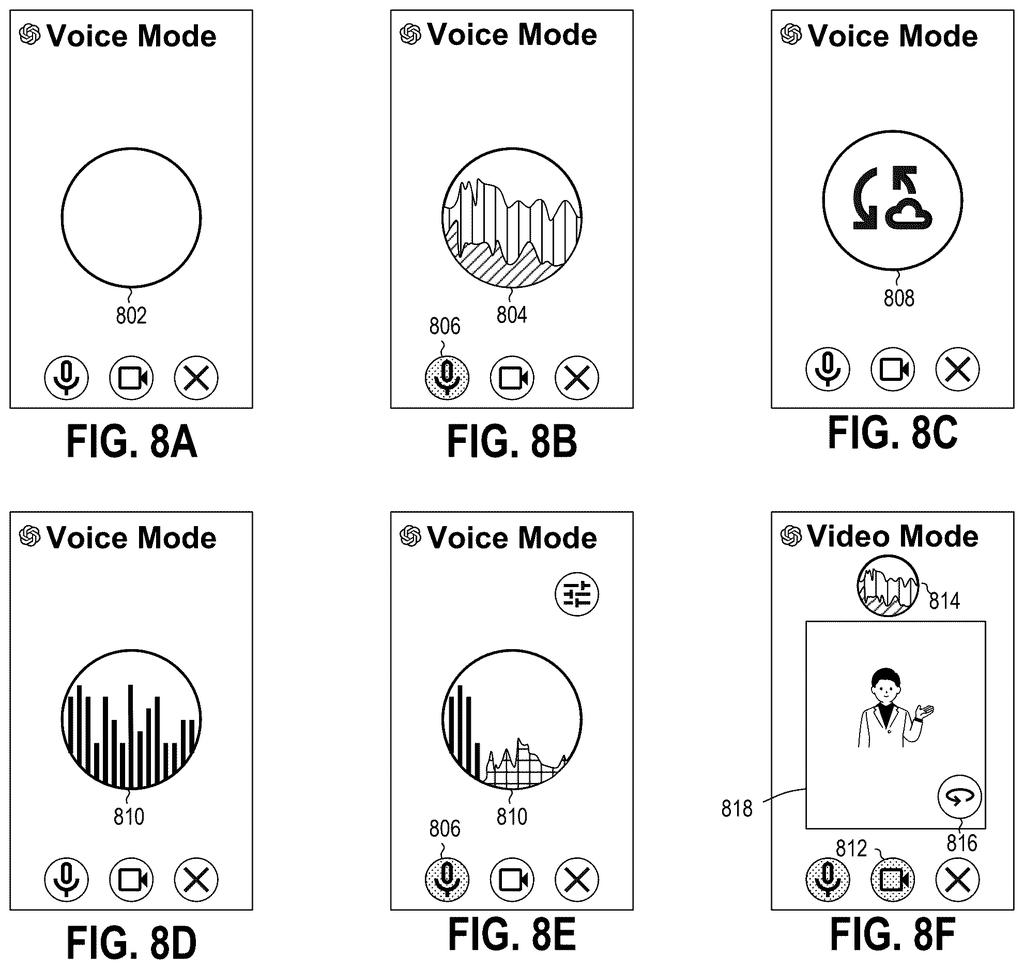
The drawings
17 drawing sheets from US 2026/0311720 A1 · click any drawing to enlarge


Want this weekly breakdown for a company we don't cover? Patentlyze Pro →
Be the first to weigh in