
Google Patents a Voice AI System That Knows When You've Finished Talking
One of the most frustrating things about talking to an AI assistant is the awkward pause before it responds, or worse, it cutting you off mid-sentence. Google has filed a patent for a system designed to fix exactly that, by teaching an AI to recognize the moment you've stopped talking without having to transcribe your words first.
How Google's AI listens for the end of your sentence
A voice assistant is speaking with you. When you finish your sentence, it just... waits. Or it interrupts. That half-second of uncertainty is a real engineering problem, and it gets more complicated when the AI is supposed to respond in real time.
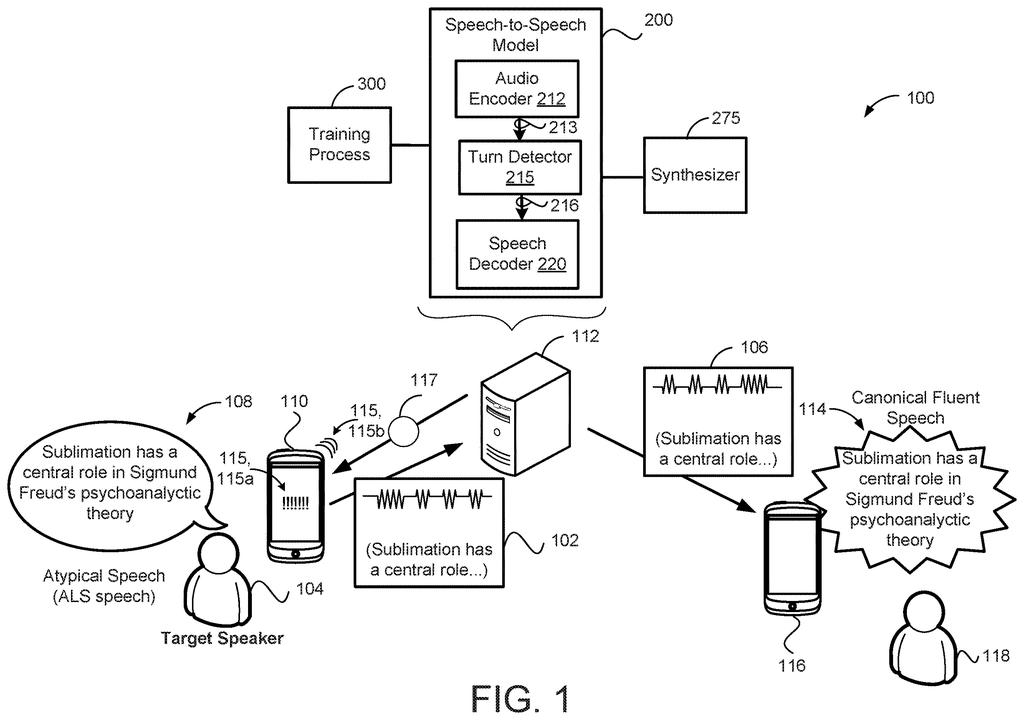
Google's patent describes a system where the AI listens to your voice as a continuous stream of tiny audio snapshots, and at each snapshot, a small built-in detector asks one question: "Is this person done talking?" When the answer is yes, the system immediately starts generating its spoken reply. No typing your words out into text, no separate recognition step in the middle.
The goal is a voice conversation that flows more like talking to a person, where the other party can sense when you've handed over the floor. This is aimed squarely at making spoken AI interactions feel less robotic and more natural.
… convert output acoustic frames corresponding to synthesized speech directly from input acoustic frames without performing any intermediate speech recognition on the input acoustic frames …
Translation: The system translates voice inputs straight into voice outputs without turning them into text first.
How the turn detector reads audio frames in real time
The patent describes what Google calls a speech-to-speech (S2S) model, a system that takes your voice as input and produces a spoken voice response as output, without ever converting your words into written text along the way. That "no transcription" step is deliberate: removing it cuts latency (the delay before you hear a reply) and avoids errors that come from misheard words.
The model processes your audio as a sequence of short acoustic frames (tiny slices of sound, each a few milliseconds long). An audio encoder reads each frame and produces what the patent calls a "higher order feature representation" -- essentially a compressed mathematical fingerprint of the audio that captures meaning beyond raw sound.
A separate component called the turn detector runs alongside the encoder at every step. After each frame, it outputs a probability score: how likely is it that the speaker has just finished their thought? This is the "breakpoint" the patent refers to. When that probability crosses a threshold, the system treats it as a speaker turn ending.
At that moment, a speech decoder takes everything the encoder has learned about your utterance up to that point and synthesizes a spoken audio response directly, producing an actual audio waveform rather than text that would then need to be read aloud separately.
… determining, by a turn detector of the S2S model, based on the higher order feature representation generated by the audio encoder at the corresponding output step, whether the utterance is at a breakpoint at the corresponding output step.
Translation: A built in detector figures out the exact moment you have stopped speaking.
What this means for real-time AI voice assistants
For anyone who has used a voice assistant, the gap between speaking and getting a reply is one of the most noticeable friction points. A system that decides in real time, frame by frame, when you've finished talking can shave meaningful time off that gap. It also avoids the double-error problem where a transcription mistake corrupts both the understanding of your question and the quality of the response.
Google keeps filing on real-time speech AI in ways that suggest the company sees voice as a primary interface, not just a bolt-on. Whether this specific architecture makes it into a consumer product is unknown, but the design direction is clear: faster, more natural voice conversations where the AI behaves less like a form you're filling out and more like an attentive listener.
Google's 46th filing in Voice & speech AI we've tracked since May follows earlier applications on remembering user intent and extracting meeting action items.
Skipping the step where speech becomes written text is the central sacrifice here. When the system makes a mistake, there is no transcript to read back and diagnose, only audio calculations buried inside the model that most people cannot inspect.
The other fragile piece is the moment-by-moment judgment about whether a speaker has finished talking. Pause too briefly mid-thought and the system jumps in; hold a beat too long and it feels like talking to someone who never quite pays attention. People who trail off and then pick up again will expose whatever threshold the designers settled on.
Both costs look manageable rather than fatal. Faster, more natural conversation is a real gain for everyday users, and judging each moment of speech individually is more principled than simply waiting for silence. The trade reads as worth it, so long as the team is clear-eyed about where it will occasionally go wrong.
There are more where this came from
We read every patent application Big Tech publishes and send you the ones worth knowing. Plain English, free, every week.
The drawings
5 drawing sheets from US 2026/0290315 A1 · click any drawing to enlarge


Want this weekly breakdown for a company we don't cover? Patentlyze Pro →
Be the first to weigh in