
Microsoft Files Patent for Trimming Web Pages Before an AI Reads Them
Before an AI assistant reads a web page, a new Microsoft patent application would strip out the colors, fonts and footers and keep only what a screen reader would announce.
What Microsoft's web page cleanup does for AI
Imagine you're writing software and ask an AI assistant how to use a particular tool. To answer well, the assistant pulls up the tool's documentation page in the background. But a web page is cluttered with menus, footers, ads and instructions for how everything should look, and all of that is noise to an AI trying to find your answer.
Microsoft's patent application describes a cleanup step. It starts with the information a page already carries to help screen readers (the software that reads pages aloud for blind users), such as headings, link names and image descriptions. It throws away styling details like colors, fonts and text size, then rewrites what's left in Markdown, a simple plain-text format. The assistant gets a short, tidy version of the page instead of the full pile of code.
extracting accessibility data by extracting structure data or content data, or both, from accessibility information of a web page, the extracting comprising filtering such that the extracted accessibility data is free of text display data which specifies a visual display characteristic of a text string …
Translation: The system grabs the page layout and words while stripping out font styles and colors to save space.
How screen reader data becomes a prompt
Every web page carries accessibility information: a structured layer that tells assistive tools what is a heading, a link, an image or a form field. The patent starts from that layer instead of the page's raw code.
The core method has three steps:
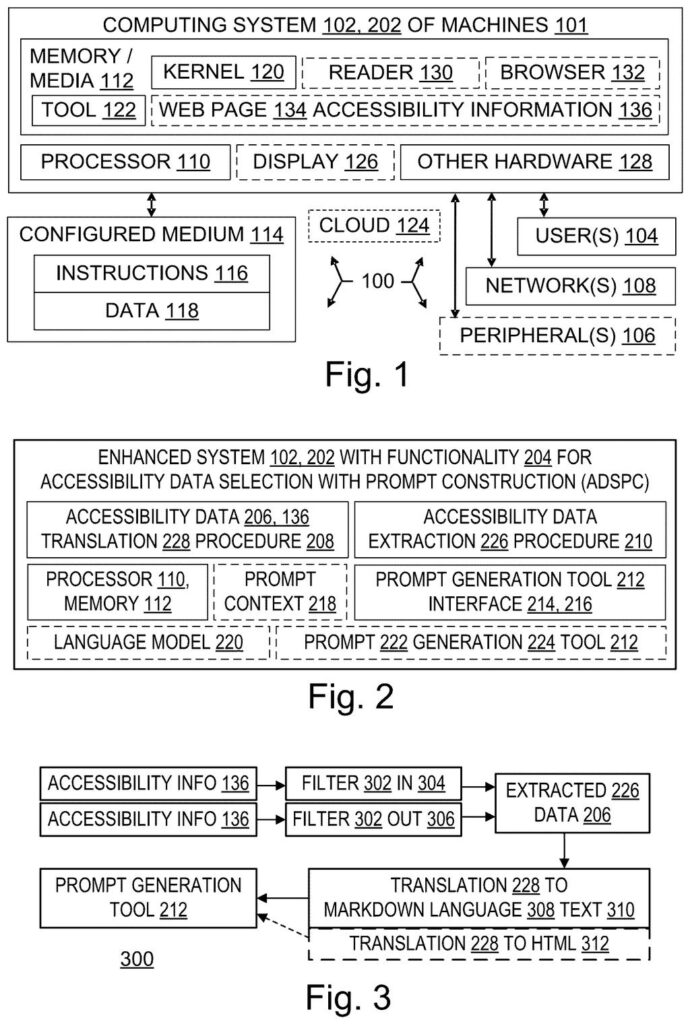
- Extract and filter: keep structure and content data (headings, link names, image descriptions, captions, transcripts, form labels) and leave out text display data such as colors, fonts, text size, style sheets, headers, footers and the small browser-tab icon.
- Translate: convert what's left into Markdown by mapping each page element (heading, paragraph, list, link, image, table) to its Markdown equivalent. A heading becomes a line starting with # symbols. Multiple links, such as those in menus and footers, can be merged into a single reference link.
- Supply: hand some or all of that Markdown to a language model as background for the user's question.
The filing also describes options. A script can run in the browser first to alter or create accessibility data, such as when a page changes itself as it loads. Hidden text can be read too. To shrink the result further, the system can compare a vector (a numeric fingerprint of meaning) of the page text against one for the user's question and keep the closest match, or pick the section tied to an anchor link or skip-to link. The accessibility data can come from a screen reader tool, a command-line download tool, or a browser reader mode.
A version of the context data is provided to a language model in a prompt, or along with a prompt, to influence computation of a response of the language model.
Translation: The cleaned webpage details are fed into the AI to help it generate a better answer.
Why cleaner web pages help AI coding tools
If you use an AI assistant that looks things up online, the quality of its answer depends partly on what it is handed to read. The filing's own example is a coding assistant inside a developer's workspace that loads documentation pages in the background. A short, labeled version of the page means fewer wasted tokens (the chunks of text a model has to process) and less clutter between the assistant and the answer.
The filing says the idea is not tied to Microsoft's own tools, and its list of possible models includes ones from several other companies. It also builds on screen reader data, so pages made well for people who use assistive tools could double as better reading material for AI. The filing itself calls this a new use for accessibility data.
Microsoft's 19th filing we've tracked since July on agents that act for you adds to earlier work on reading your screen unprompted and auto-deploying network defenses.
Anyone who has pasted a long web page into a chatbot knows the problem: the page is mostly packaging. Behind every article sits a pile of code for menus, colors, fonts and footers, and an AI assistant has to read all of it. That costs processing time and can pull its attention away from the answer you wanted.
The fix Microsoft describes fits that problem at about the right size. It is a cleanup step in front of the model, built on labels that web designers already write for screen readers. A modest problem gets a modest, sensible tool.
The limit is that results depend on how well a page was labeled in the first place. A page with poor image descriptions gives the assistant less to work with. Even so, trimming the waste is a reasonable place to start.
Get our take in your Top Stories
Liked this breakdown? Add Patentlyze as a preferred source on Google, and our plain-English take shows up more often in your Top Stories the next time Microsoft patent news breaks.
There are more where this came from
We read every patent application Big Tech publishes and send you the ones worth knowing. Plain English, free, every week.
The drawings
4 drawing sheets from US 2026/0310743 A1 · click any drawing to enlarge


Want this weekly breakdown for a company we don't cover? Patentlyze Pro →
Be the first to weigh in