
Microsoft Patents an AI That Reads Threat Alerts and Deploys Network Defenses Automatically
Every day, security teams receive dozens of threat advisories written in plain text, and someone has to manually translate them into firewall rules. Microsoft's new patent describes a system that does that translation automatically, in seconds.
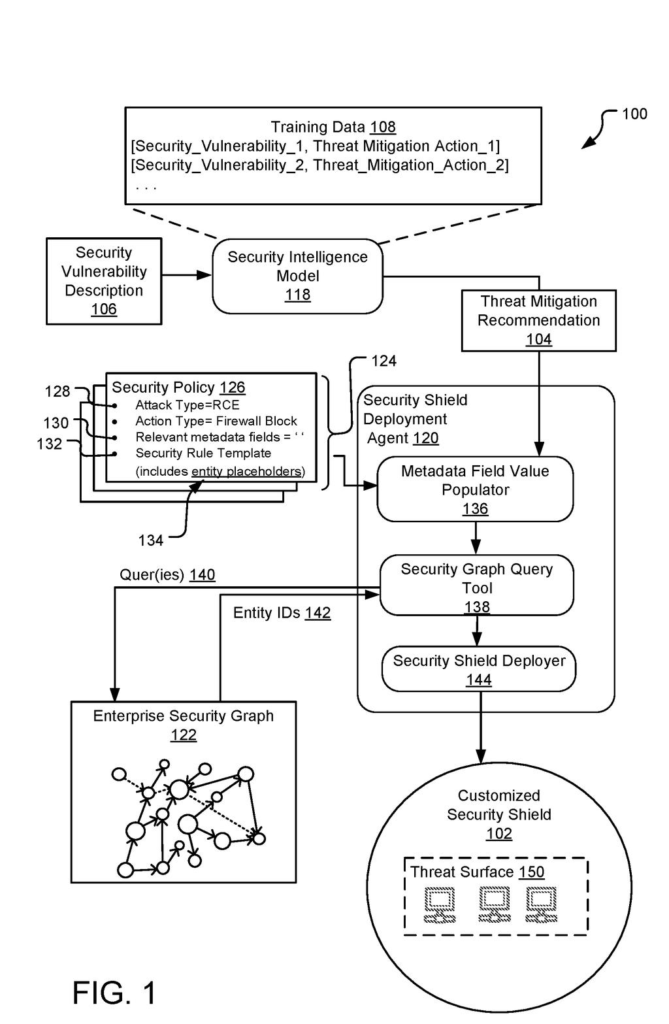
What Microsoft's auto-deploy security shield actually does
Imagine your company's IT team gets an alert: a hacker group is actively exploiting a flaw in a specific type of software. Right now, a human analyst has to read that alert, figure out which computers on the network run that software, and then write rules to block the attack. That process can take hours.
Microsoft's patent describes a system that automates the whole chain. An AI agent reads the threat advisory (written in plain English), figures out which devices or accounts on your company's network are at risk, and then automatically pushes a protection rule to block the attack on exactly those targets. No one has to write a rule by hand.
The key idea is that the system doesn't apply a one-size-fits-all block. It consults a map of your organization's specific network (called an enterprise security graph) to find precisely which resources are exposed, and it builds a customized shield for those targets only.
… analyze text of the threat mitigation recommendation to determine a value for at least one metadata field of the set of metadata fields defined in the security policy …
Translation: The system reads security advice to pull out key details like affected software or systems.
How the AI reads alerts and builds targeted firewall rules
The system centers on a security shield deployment agent, a software process that takes a threat mitigation recommendation as its input. That recommendation could come from a security vendor, a government advisory, or an internal analyst note.
Here is how it works step by step:
- Policy matching: The agent identifies a pre-set security policy relevant to the threat. Each policy defines what fields matter (for example, which software version or port number is involved) and includes a template for the rule that will eventually be deployed.
- Text analysis: The agent parses the advisory text to pull out specific values for those fields. Think of it like filling out a form by reading a memo rather than having a human type the answers in.
- Graph query: Those values are sent as a query to the enterprise security graph, which is a structured database mapping every device, account, and resource in the organization. The graph returns the identifiers of exactly which assets match.
- Shield deployment: The agent fills the rule template with those specific identifiers and pushes the completed rule to the network, blocking the attack path only for the affected assets.
The design avoids broad, blunt blocks (like shutting down a whole service) by targeting only the specific machines or accounts that the graph confirms are exposed.
… autonomously generates and deploys a customized security shield to protect specific network entities from an attack exploiting a security vulnerability …
Translation: It automatically builds and activates tailored defenses to block active cyber threats.
What this means for corporate IT security teams
For corporate IT and security operations teams, the bottleneck today is not knowing that a threat exists. It is the time between knowing and doing something about it. An automated system that can go from alert to deployed firewall rule in seconds, without human intervention, shrinks what the industry calls the exposure window to near zero.
If this system reaches products, you might see it show up in Microsoft's existing security platforms like Defender or Sentinel. a growing pile of Microsoft security-automation filings suggests the company is betting that AI agents will eventually run most routine defense tasks, shifting human analysts toward higher-level decisions rather than rule-writing.
Microsoft's 17th filing we've tracked since July in our AI agents that work for you watchlist builds on agents from plain English and one letting businesses automate without code.
Claim 1 is broad enough to matter. It covers the full chain: reading a threat description, querying a network graph, populating a rule template, and deploying a shield. That scope would, if granted, potentially cover any system that automates this particular workflow end to end, regardless of what the underlying AI model is or how the graph is structured.
The narrowest defensible part of the claim is the enterprise security graph itself. The patent ties protection to the identifiers stored in that graph, which is a meaningful anchor. Without it, the claim risks being too abstract. The practical question is whether prior systems already automate this loop, even partially.
For security teams drowning in advisories they can barely keep up with, the promise here is real. The legal question of how well this claim survives a prior-art challenge is a different matter entirely, but as a description of a problem worth solving, this filing is on point.
There are more where this came from
We read every patent application Big Tech publishes and send you the ones worth knowing. Plain English, free, every week.
The drawings
5 drawing sheets from US 2026/0300478 A1 · click any drawing to enlarge


Want this weekly breakdown for a company we don't cover? Patentlyze Pro →
Be the first to weigh in