
Samsung Patents an AI That Reads Your Phone and Writes Your Journal for You
Samsung has patented a system that reads information already stored on your device and uses it to write a personal journal on your behalf, choosing both the topic and the layout without you lifting a finger.
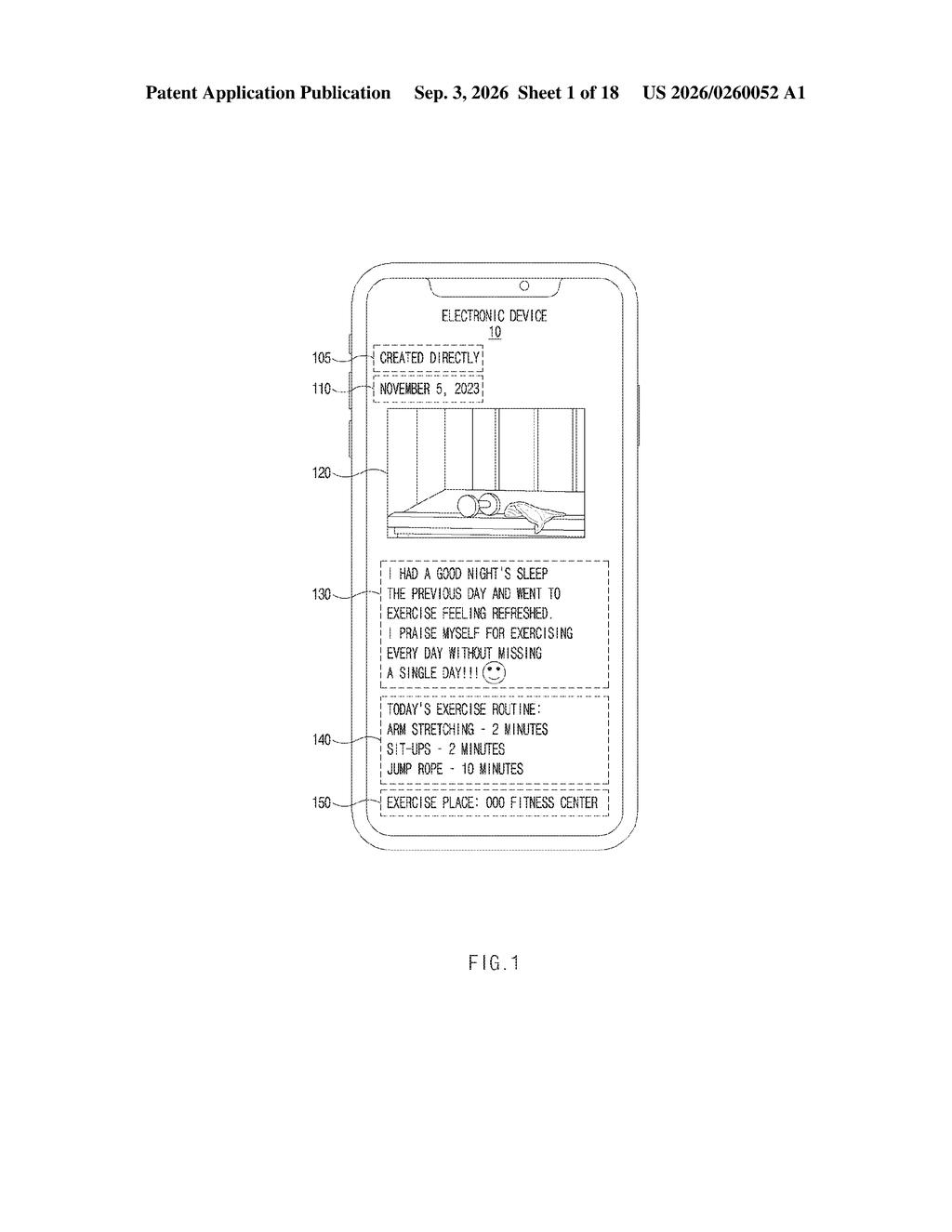
What Samsung's auto-journal system actually does for you
Ever tried to look back at what you were doing six months ago and come up blank? Most people don't keep a journal, not because they don't want one, but because sitting down to write every day just doesn't happen.
Samsung's patent describes a device that handles that for you. It looks at information already stored on your phone, figures out what kind of journal entry fits your day (a mood log, an activity recap, a travel note), and then picks the right layout before generating the actual entry. You don't type anything.
Think of it as a personal assistant that turns the digital footprints you leave every day into something readable. Your photos, app activity, calendar events, and other stored data become the raw material, and the device assembles them into a formatted journal entry automatically.
determine, based on user information stored in the memory, a journal category and at least one journal component for generating a user journal …
Translation: The device figures out what kind of diary entry to make by looking at your saved personal data.
How the device picks a format and writes your entry
The patent describes a three-step process running on the device itself.
- Step 1 - Category selection: The device reads "user information" already in memory (think calendar entries, photos, location data, or health stats) and decides what kind of journal entry to make. Samsung calls this the "journal category," which could mean things like a daily summary, a travel diary entry, or a fitness log.
- Step 2 - Component selection: Once a category is chosen, the system picks the individual building blocks for the entry. These "journal components" are the specific pieces of content to include, such as a map snippet, a photo grid, a mood rating, or a text paragraph.
- Step 3 - Format and generation: The category and components together determine a "journal format," essentially a template. The device then generates the finished journal entry inside that template.
The claim is intentionally broad. It doesn't specify which user data gets used or exactly how the category is chosen, which leaves room for on-device AI models to make those calls. The whole process is described as running on "at least one processor" with instructions stored in memory, language that fits a standard smartphone or tablet chip.
… obtain, based on the journal category and the at least one journal component, a user journal format …
Translation: It then picks a layout for the diary entry that matches the topic and pieces it chose.
What this means for AI assistants and personal data
If Samsung ships something like this, it fits squarely into the broader push by phone makers to turn AI assistants into proactive tools rather than reactive ones. Instead of asking your phone to do something, your phone notices what happened in your day and does something with it.
Samsung's run of AI-assistant filings The privacy angle is the obvious tension. A system that reads your stored data to write about your life requires a lot of trust. Whether this runs entirely on-device or involves any cloud processing will matter a great deal to users, and the patent doesn't settle that question. For now, it's a framework, not a finished feature.
Samsung's ninth filing we've tracked since July in our AI agents that act for you watchlist builds on earlier applications like one that reads your screen and one that filters casual talk.
Most people abandon journaling not because they lose interest in their own lives but because the daily act of starting a blank page is exhausting. That friction compounds over time into a complete habit collapse, and the record of a life goes unwritten.
Samsung's patent targets exactly that collapse point. The phone already knows where you went, what you did, and roughly how your day was shaped, so the system uses that information to decide what to capture and how to organize it, sparing the user the part that was always the hardest.
The real test will be whether entries assembled this way feel true to a moment years down the line. A journal earns its keep by holding something that still resonates when you return to it, and whether automated assembly can meet that standard is an honest open question about the limits of what a device can notice.
Get our take in your Top Stories
Liked this breakdown? Add Patentlyze as a preferred source on Google, and our plain-English take shows up more often in your Top Stories the next time Samsung patent news breaks.
There are more where this came from
We read every patent application Big Tech publishes and send you the ones worth knowing. Plain English, free, every week.
The drawings
18 drawing sheets from US 2026/0260052 A1 · click any drawing to enlarge


Show the other 10 sheets


Want this weekly breakdown for a company we don't cover? Patentlyze Pro →
Be the first to weigh in