
Google Files Patent for Letting an AI Add Search Words You Never Typed
A search engine can only match the words you give it, and short searches don't give it much. Google's filing has an AI brainstorm related terms first, then adds them to your search before it runs.
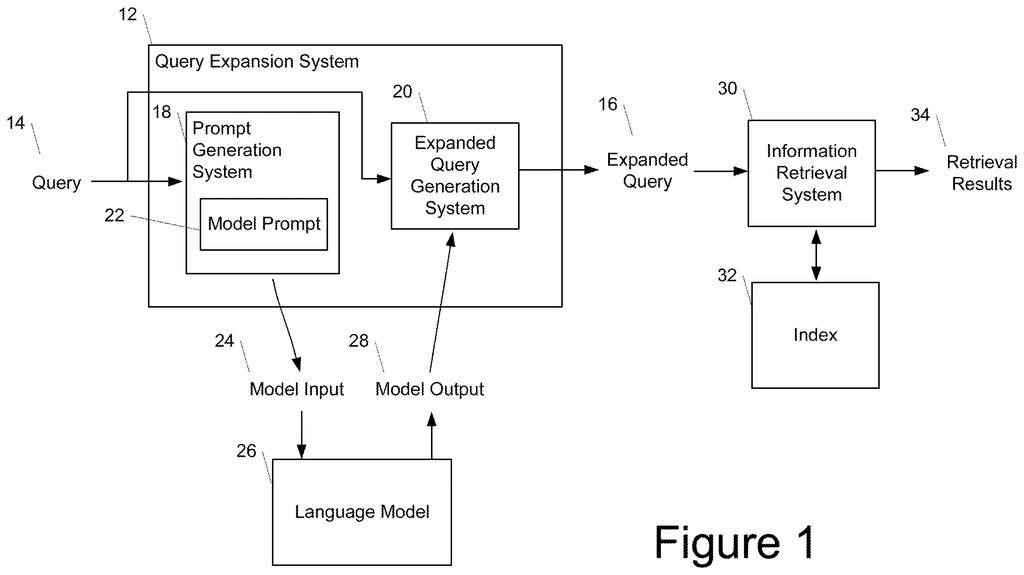
What Google's AI search-rewriting patent does
Search engines mostly work by matching the words you type to the words on a page. If your search is short or vague, and a great page uses different words for the same idea, it can slip right past you. The usual fix is to run your search once, assume the top results are good, and borrow words from them. That falls apart when those first results are off.
Google's patent application takes a different route. An AI language model, the same family of technology behind chatbots, brainstorms related words first. Search for "best restaurants in New York" and it might add "Michelin-starred," "outdoor dining," or "delivery options." Your search then runs with those extra words attached, so it can find pages that never used your exact phrasing.
The filing says an off-the-shelf AI model can do this job, with no special training.
… generating, by the computing system, an expanded query based on the query and the model output; and providing, by the computing system, the expanded query as an input to an information retrieval system to receive a set of results …
Translation: The system combines your search with AI output to find better results.
How the AI turns your query into a keyword list
The method has four steps. The system takes your query, attaches a written instruction (the prompt) to it, and feeds both to a language model. The model's reply is added to your original query, and the longer query goes to an ordinary search system, which returns the results.
The claims cover three styles of instruction:
- Chain of thought: the AI is told to give its reasoning before answering, which gets it to spell out many related terms.
- Zero-shot: the AI gets a plain task with no worked examples, such as "Write a list of keywords for the following query."
- Keyword list: the AI is told to produce keywords instead of a full passage that answers the query.
The simplest way to combine everything is concatenation (sticking the text together end to end). The description gives a formula that repeats your original query five times before adding the AI's output, so the model's long reply doesn't drown out your own words.
The filing also says the AI can be shown a few top-ranked results as context (called pseudo-relevance feedback, meaning the search's first guesses are used as hints). A general-purpose model, not one fine-tuned for this job, can do the work. One dependent claim says the search system can be sparse retrieval, the older style that matches literal words.
… systems and methods for query expansion that utilize the generative abilities of machine-learned language models, such as, for example, so-called Large Language Models (LLMs).
Translation: This technology uses AI to automatically expand what you search for.
Why Google would skip training a special model
If you tend to type short, fuzzy searches, this idea is aimed at you. Your search gets padded with related words before it runs, so pages that describe your topic in different language can still show up. The filing says this works without training a custom model, which it says saves computing power and the work of preparing training data, and that it can run on smaller models.
The description says the query could come from a search bar or a voice command, and the results could feed a search engine or a recommendation engine. Keep in mind this is a patent application. The examiner's first review rejected the claims as filed, which is routine at this stage and usually followed by amendments. Nothing in the filing says a Google product works this way today.
Google files its 109th entry in the Language AI patents we've tracked since May, building on work like a shortcut for faster AI text and a guess-your-taste image search.
Every search now waits on an AI model before results can load, and that wait costs real time and real computing power. The filing trims that cost by asking the AI for a short list of related words rather than a full written answer, which is a sensible compromise but still an added step that was never there before.
The sharper risk is that the AI can be confidently wrong. A bad suggested word sends the search chasing something you never meant, and the filing's fix, repeating your original words several times to keep them weighted heavily, is a blunt instrument for a subtle problem.
The trade reads as worth making for short, vague searches where a single word gives the engine almost nothing to work with. Whether it holds up depends entirely on how gracefully the system fails when the AI guesses badly, and that is the one thing no filing can guarantee in advance.
Get our take in your Top Stories
Liked this breakdown? Add Patentlyze as a preferred source on Google, and our plain-English take shows up more often in your Top Stories the next time Google patent news breaks.
There are more where this came from
We read every patent application Big Tech publishes and send you the ones worth knowing. Plain English, free, every week.
The drawings
5 drawing sheets from US 2026/0320084 A1 · click any drawing to enlarge


Want this weekly breakdown for a company we don't cover? Patentlyze Pro →
Be the first to weigh in