
Meta Patents a Search System That Matches Queries to Learning Goals Before Fetching Results
Most search engines find pages that contain your words. Meta's new patent describes a system that first figures out what you're trying to learn, then finds content built around that goal.
What Meta's learning-objective search actually does
Ever typed a question into a search bar and gotten back a wall of loosely related pages, none of which actually taught you anything? Meta's patent is designed to fix that specific frustration.
The idea is to add a middle step. When you search for something, the system doesn't immediately hunt for content. Instead, it figures out which learning objectives your question is really about: the specific skills or concepts a good teacher would set out to cover. Only then does it go find content that addresses those objectives.
The result is meant to be more like getting a curated reading list from a knowledgeable person than getting a ranked list of documents that happen to share your keywords. The system can serve a human user, another piece of software, or an automated machine, so the applications stretch well beyond a simple search box.
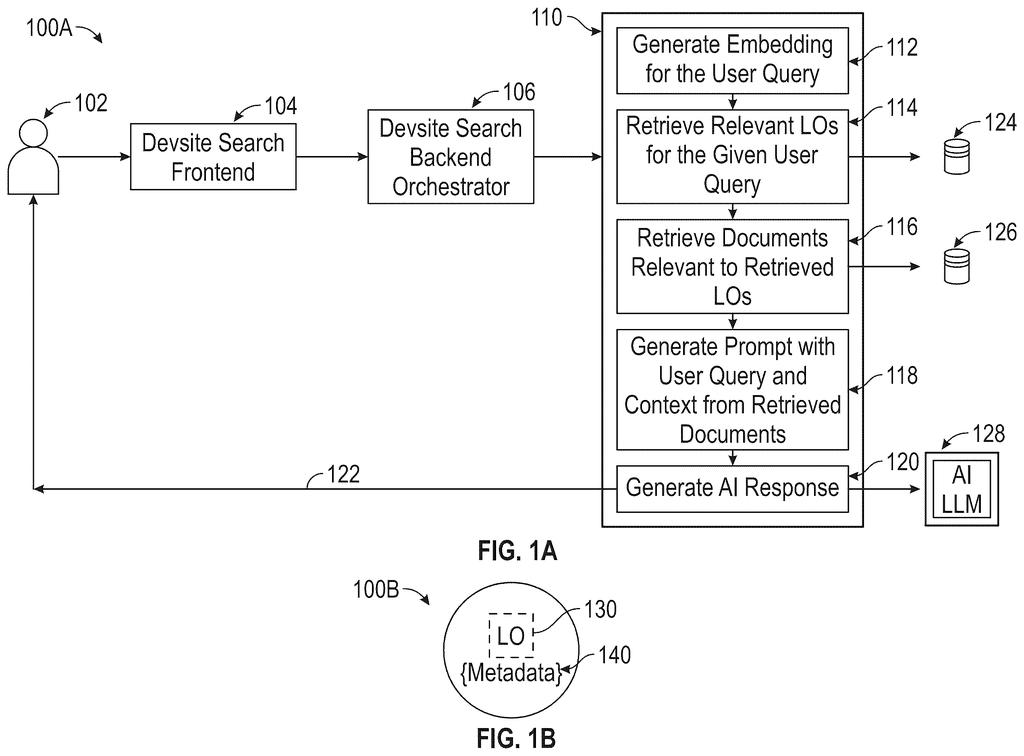
generating embedding for the query; retrieving a plurality of learning objectives (LOs) relevant to the query based on the generated embeddings; retrieving content relevant to the plurality of LOs; and providing the content relevant to the plurality of LOs for display to the knowledge consumer.
Translation: The system turns your search into educational goals before it finally shows you the matching study materials.
How the system maps a query to learning objectives
The patent describes a pipeline with three main stages.
- Embedding generation: When a query arrives, the system converts it into a numerical representation (an "embedding") that captures its meaning rather than just its exact words. This is standard AI-era search infrastructure.
- Learning-objective retrieval: The system compares that embedding against a stored library of learning objectives (LOs), which are structured descriptions of what a learner should know or be able to do after studying a topic. The closest-matching LOs are pulled out.
- Content retrieval: Finally, the system finds content that is tagged or associated with those LOs, and returns that content to the user.
The architecture is intentionally general. The "knowledge consumer" receiving results can be a person typing into a search box, a computer program calling an API, or an automated machine, which hints that this could feed AI assistants or recommendation engines just as easily as a human-facing search page.
The patent doesn't specify what the LO library looks like or how it gets built, which leaves a significant open question about how well the system works in practice.
What this means for educational search on Meta's platforms
If this system were built into a platform like Meta AI or a future educational product, it could meaningfully change what search results look like. Instead of returning the most-linked or most-clicked page on a topic, the system would prioritize content that is structured to teach something. For people trying to learn a skill rather than just look up a fact, that's a different category of usefulness.
The broader implication is for where Meta's AI search work is heading. A system that reasons about learning goals rather than keywords fits naturally with AI assistants that need to explain things, not just locate them. Whether this shows up in a consumer product or stays in infrastructure is an open question.
Meta's second Language AI filing we've tracked since June follows one about video summary texts.
On the ship-path question, this patent is a long way from a button you can click. The core concept, routing queries through a library of learning objectives before fetching content, requires that library to already exist and be well-maintained. Building and curating a comprehensive LO index at the scale Meta operates is a substantial project on its own, and the patent says nothing about how that gets done.
The software architecture described here is relatively lightweight: embeddings, a retrieval step, another retrieval step. No new hardware is required, and the approach builds on techniques that are already deployed across the industry. That means the barrier is less about engineering difficulty and more about data infrastructure and editorial decisions about what counts as a learning objective.
For a company positioning AI assistants as educational tools, the concept has a clear purpose. But as filed, this reads more like a design sketch than a blueprint for something about to ship.
There are more where this came from
We read every patent application Big Tech publishes and send you the ones worth knowing. Plain English, free, every week.
The drawings
16 drawing sheets from US 2026/0300351 A1 · click any drawing to enlarge


Want this weekly breakdown for a company we don't cover? Patentlyze Pro →
Be the first to weigh in