
Verily Files Patent for a Contact Lens That Changes Focus to Slow Nearsightedness
Standard glasses fix your blurry view but do nothing to stop the eye from stretching. Verily's patent covers a contact lens that changes its focus for short stretches to send the eye a different signal.
What Verily's focus-switching contact lens does
Ever wonder why a child's glasses prescription keeps creeping up even though the glasses work fine? The filing's answer is that regular lenses sharpen what you see in the center but leave the edges of your retina out of focus. That blur at the edges likely tells the eye to keep growing longer, and a longer eye means worse nearsightedness.
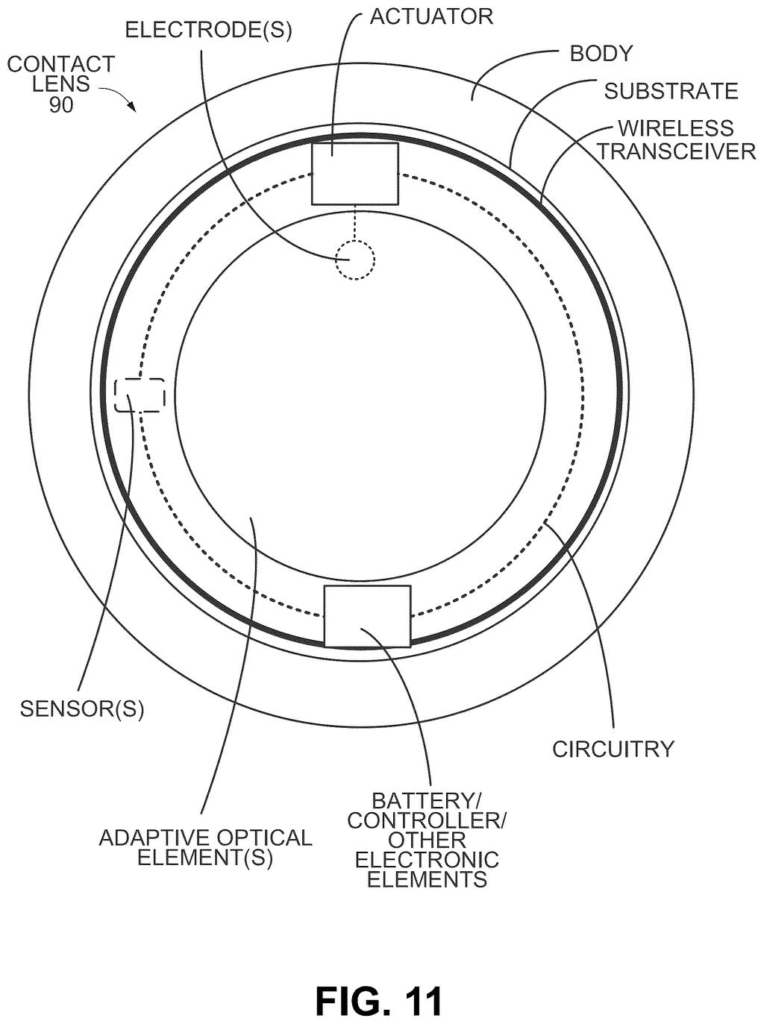
Verily's patent describes a contact lens that can change its focus on command. Tiny optical parts sit inside a breathable lens, and a small circuit switches them between two states. Most of the day the lens corrects your vision normally. For a few minutes to a few hours, it switches to a different focus that gives the edges of your retina a different signal.
The switch could follow a schedule, such as an evening session when you aren't reading or driving. It could also respond to a squint, a tap on your phone, or a sensor that notices what your eyes are doing.
… one or more adaptive optical elements embedded in the gas-permeable material and each of the one or more adaptive optical elements configured to switch between an optical state and at least another optical state …
Translation: Tiny focus-changing parts are built into the breathable lens material.
How the lens decides when to switch focus
The core device is a contact lens with a gas-permeable body (a material that lets oxygen reach your eye). Embedded in that material are adaptive optical elements, which are parts that change how they bend light when they get an electrical signal. The filing names liquid crystal layers and a boundary between two fluids with different refractive indices (different abilities to bend light) as examples. An electrical circuit or actuator (the part that makes the change happen) flips the elements between one optical state and another.
The claims cover three things: the lens itself, a system that adds an outside source of signals, and a method for adjusting the lens. The outside source can be a sensor or a phone app that a patient or doctor uses. The filing also describes eyeglass frames carrying sensors that track pupil size, gaze direction and time of day.
- Zones: the lens can have a central zone and a peripheral zone that change differently, so the edges get a different focus than the center.
- Dose and timing: a pre-programmed duty cycle (an on/off schedule) can deliver a set amount of added focusing power, timed to the eye's daily rhythm.
- Sensors: the lens can react to the eye's focusing effort, a squint, or the light around you.
The filing says the added power could differ from your normal prescription by 1 to 2 diopters (a unit of lens strength), or even 3 to 4 or more, since sessions are short.
… present visual stimuli to a peripheral retina to slow axial growth of the eye in order to treat and/or prevent myopia …
Translation: It flashes light patterns to the side of the eye to keep it from lengthening.
Why Verily is aiming at the eye's growth itself
If this works as described, the practical change is that myopia treatment could happen in short, scheduled windows while your normal vision is corrected the rest of the time. The filing says that matters because today's multifocal contact lenses are static, so the stronger focus is there all day. It says choosing when the effect switches on could reduce headaches, nausea and eye strain, and allow stronger settings than people would tolerate full-time.
The filing also pitches this as cheaper and safer than other approaches it lists, such as drug-based or light-based treatments. It is a patent application with no test data attached, so what it offers is a design idea. For parents of nearsighted kids, and for anyone whose prescription keeps rising, it shows a lens that could someday be on the table.
Google's 910th filing in our Google coverage since May follows patents like the coffee-cup spill warning and the chat history reopener.
Nearsightedness is common, and the filing says it is becoming more common worldwide, possibly because of more phone and computer time. Ordinary glasses fix the blur but, by the filing's account, do nothing to slow the eye's growth. Higher myopia has also been linked to glaucoma, retinal detachment and macular degeneration. That is a large, costly problem, and a lens that goes after the cause makes sense.
The approach is ambitious in proportion. Packing a battery, sensors and switching optics into something that sits on your eye is a hard engineering job. The filing offers no test results showing that the stimulus actually slows eye growth, which is the claim everything else depends on.
The smartest part is the scheduling. Short therapy windows, such as evenings, allow stronger focus changes while your daytime sight stays normal. If that holds up in real eyes, the design fits the size of the problem well.
Get our take in your Top Stories
Liked this breakdown? Add Patentlyze as a preferred source on Google, and our plain-English take shows up more often in your Top Stories the next time Google patent news breaks.
There are more where this came from
We read every patent application Big Tech publishes and send you the ones worth knowing. Plain English, free, every week.
The drawings
15 drawing sheets from US 2026/0319270 A1 · click any drawing to enlarge


Show the other 7 sheets


Want this weekly breakdown for a company we don't cover? Patentlyze Pro →
Be the first to weigh in