
Sony Files Patent for Zooming Through Giant Tissue Scans Without the Lag
Sony's filing keeps one master set of cell labels on a tissue scan and rebuilds every other zoom level on the fly. The goal is a pathology viewer that doesn't choke when you zoom.
What Sony's zoomable tissue-scan labels do
A pathologist zooms out on a tissue scan marked with thousands of labeled cells, and the screen stutters. Every label has to be redrawn at the new zoom level, and the computer is doing it all at once. If you've ever watched a huge photo crawl while you pinch to zoom, you know the feeling.
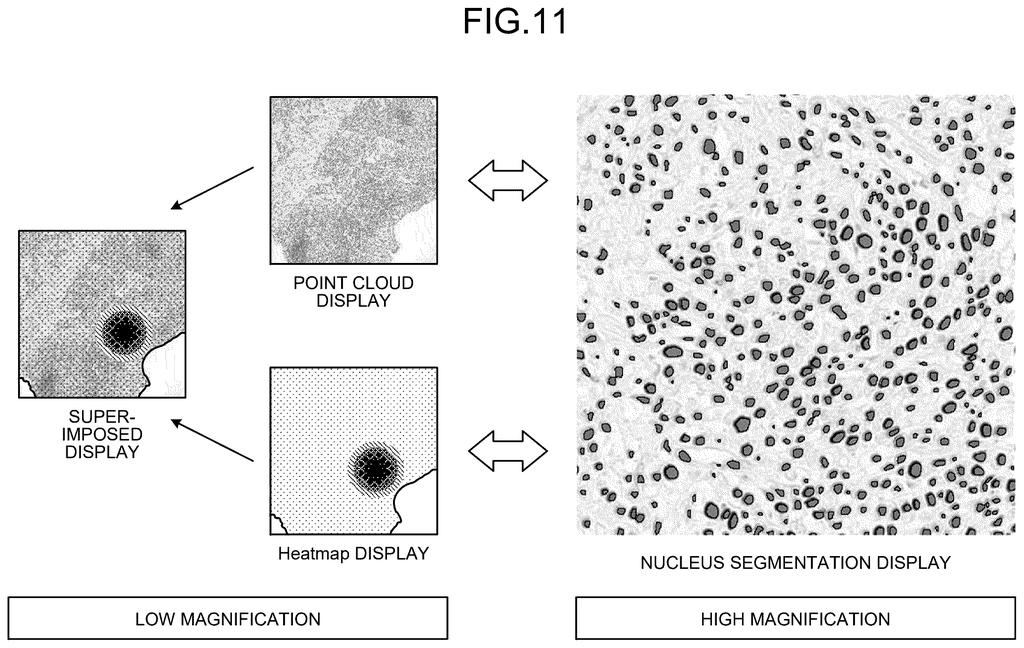
Sony's patent application takes a different route. It saves only one master set of labels, plus a small set of instructions for turning it into other zoom levels. When you zoom, the software builds the version you need on the spot. Zoomed out, it can swap detailed cell outlines for simple dots or a color-shaded heat map, so the overall pattern is easy to read.
Edits carry across, too. If a doctor corrects a label in one view, the change shows up in the others, so nobody fixes the same cell twice.
… convert, using the conversion processing information, the first annotation data into second annotation data incidental to the first annotation data, and output the first annotation data or the second annotation data, wherein the first annotation data and the second annotation data are displayed at different display magnifications.
Translation: The system transforms image markers to fit different zoom levels so you can view them smoothly.
How Sony rebuilds each zoom level on demand
The patent covers software that handles annotation data: labels (outlines, tags, diagnosis notes) attached to regions of a digital scan of cells or tissue. It stores one reference set at a single zoom level, along with conversion processing information, which is a formula for turning that set into other versions. The labels can be kept as point cloud coordinates, meaning lists of dots that trace outlines.
The conversion runs in two directions, and the claims cover both:
- Higher to lower zoom: the data is shrunk with compression processing (the same family of tricks behind JPEG files).
- Lower to higher zoom: the data is stretched with linear expansion (simple enlargement). The filing also describes fitting processing, which snaps outlines to the real cell edges in the image, to fill in the sparse result.
The display form can change as well. A view showing each cell nucleus outlined can become a point cloud (dots) or a heat map (shading by density) for zoomed-out views, where fine outlines are just clutter.
When a user edits any version, the system stores editing processing information and applies the change to the remaining versions. Several pieces can also be connected into one large image on request.
… a conversion unit that converts, using the conversion processing information, the first annotation data into a plurality of second annotation data incidental to the first annotation data, and an output unit that outputs the first annotation data or the second annotation data.
Translation: A built-in processor preps multiple sizes of image notes in advance for faster zooming.
Why faster slide viewing matters to labs
For the people who review these scans, the practical payoff is a viewer that keeps up with them. Labeled slides can carry thousands to hundreds of thousands of annotations, and the filing says the usual fixes fall short: storing a finished image at every zoom level is huge and can't be edited, while storing only dots makes display slow.
The approach trades storage for computing. The filing says you pick the reference zoom level to balance the two against your hardware and use. That matters because these labels also serve as training examples for diagnostic AI, so being able to fix them easily affects how good that software can get. The patent describes the technique for lab and hospital imaging systems, not any specific product.
Sony's 592nd filing in our Sony coverage since May adds to a run that includes cutting upload data during AI training and catching glitches in sharpened game video.
The problem is real for the people who live with it. A single slide can carry thousands to hundreds of thousands of labels, and a screen that stutters on every zoom turns careful review into a waiting game.
The fix matches the size of that problem. Keeping one master copy and rebuilding the other views on demand cuts storage, and it keeps every view editable, which the pre-made image approach described in the filing cannot do. Trading extra computing for less data is an old engineering bargain, and the filing says openly that you tune it to your hardware.
Few readers will ever touch this software. For the labs that do, a faster, lighter slide viewer is a daily-use gain, and it reads as sensible housekeeping for a narrow field.
Get our take in your Top Stories
Liked this breakdown? Add Patentlyze as a preferred source on Google, and our plain-English take shows up more often in your Top Stories the next time Sony patent news breaks.
There are more where this came from
We read every patent application Big Tech publishes and send you the ones worth knowing. Plain English, free, every week.
The drawings
11 drawing sheets from US 2026/0310886 A1 · click any drawing to enlarge


Show the other 3 sheets


Want this weekly breakdown for a company we don't cover? Patentlyze Pro →
Be the first to weigh in