
Samsung Files Patent for Devices That Skim Resumes and ID Cards for Key Words
Before an AI reads your resume or ID card, Samsung's patent application has it throw out most of the page. Only the important words and the few around them get through.
What Samsung's skim-the-keywords scanner does
You snap a photo of a resume, or scan a business card, and your phone has to work out what it's looking at. Most systems hand every word on the page to the AI, including page numbers, footers and stray labels. That clutter can slow things down and muddy the answer.
Samsung's patent application describes a shortcut. The device first works out what type of document it has, such as a resume, an ID card or a form. It then checks a pre-built list of words that matter for that type, each with an importance score, and pulls out only the top matches.
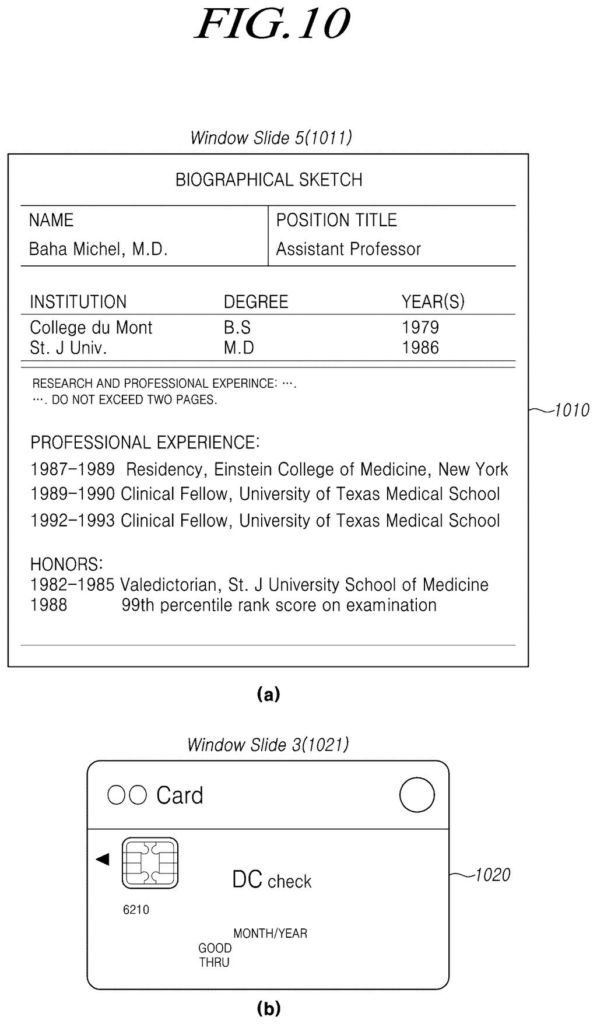
It also grabs a few words on either side of each match for context. On a dense, paragraph-style page it grabs more neighbors, and on a sparse card it grabs fewer. The AI then reads that trimmed version instead of the whole page.
… obtain at least one adjacent word for the at least one keyword from the input document using a window slide, wherein the window slide has a length set based on document density information of the input document; …
Translation: It reads words next to the keywords using a sliding window adjusted for text density.
How the dictionary and sliding window pick words
The claims cover a device that does three things in order. First, it pulls keywords out of a document using dictionary information tied to the document's category. That dictionary lists keywords for the category and gives each one a keyword weight, a score for how important the word is.
Second, it collects adjacent words (the words just before and after each keyword) using a window slide, a sliding span measured in words. The span's length depends on document density: the total number of characters divided by the total area they cover. In the description, a dense, sentence-heavy page gets a window of 5 words, while a card-style page gets a shorter one, such as 3.
Third, the device runs a task such as classifying the document or pulling out fields like a name, using only the keywords and neighbors. The description builds the dictionary ahead of time from sample documents:
- Visual weight: the area a word takes up divided by its number of characters, so big titles score high.
- Frequency weight: how often a word appears in one category of document compared with all the others.
- Keyword weight: those two scores multiplied together.
The claims also cover keeping only the top K matches, with K set by the AI model's size, its input limit or the device's memory. The filing also describes feeding the weights into an attention-based model (a type of AI that decides which words to focus on).
Why trimming a document helps small on-device AI
Small AI models that run on the device itself have tight limits on memory and on how much text they can take in. Trimming a page down to its important words helps with both. In the filing's own examples, the amount of input data shrank by about 8%, and classification and field-extraction performance rose about 5% with keywords alone and about 8% once the neighboring words were added.
For you, that could mean faster and more accurate scanning of cards, resumes and forms on your own phone. Those figures come from Samsung's own examples, and the filing describes a technique with no product attached.
Samsung's 29th filing we've tracked since June in our on-device AI privacy push watchlist follows earlier applications like the paramedic medical screen and a custom appliance wake word.
Claim 1 is wide on the hardware side: any device with a processor and memory counts. Nothing in it names a phone, a scanner or a particular AI model. The task is simply a "designated task," which could mean sorting a document, pulling out fields or summarizing it.
What narrows the claim is the combination. The device needs a keyword list for the document's category with a weight on every word, and it needs to size its context window by how crowded the page is. Take away either piece and the claim no longer describes the same setup.
If granted, that would cover a fairly specific recipe: a category-matched word list plus a window that grows on text-heavy pages. The resume and ID card examples, the multiplied scores and the top-K cutoff all sit in later claims, so claim 1 leaves room for other designs. It is modest, sensible engineering, and the density rule is the one concrete idea in it.
Get our take in your Top Stories
Liked this breakdown? Add Patentlyze as a preferred source on Google, and our plain-English take shows up more often in your Top Stories the next time Samsung patent news breaks.
There are more where this came from
We read every patent application Big Tech publishes and send you the ones worth knowing. Plain English, free, every week.
The drawings
19 drawing sheets from US 2026/0320293 A1 · click any drawing to enlarge


Show the other 11 sheets


Want this weekly breakdown for a company we don't cover? Patentlyze Pro →
Be the first to weigh in