
Samsung Patents a Small AI Model That Rates How Detailed a Video Frame Is
Compression is what turns hair and textures into blur on your TV. Samsung's patent application describes a tiny AI model that scores how much detail each frame holds, so extra sharpening could be aimed where it is needed.
What Samsung's frame-detail scoring AI does
Streaming video gets squeezed so it can travel over the internet and play on your TV, and the squeezing has a cost. Fine details like strands of hair and rough textures are the first things to turn smooth and blurry.
Samsung's patent application describes a small AI model that looks at a single video frame and scores how much detail and texture it holds. A frame packed with fine detail gets a high score, and a smooth, plain one gets a low score. The filing's own examples are 0.57 for a detailed image and 0.16 for a smooth one.
The score is built to mean the same thing whether the video is low or high resolution. According to the filing, a low score could trigger AI upscaling (a process that boosts a picture's sharpness and resolution), while a high score might skip it or use it lightly.
… estimating, using the CNN model, encoding intra-frame (I-frame) bits per pixel for the image; measuring, using a defined metric based on the estimated encoding I-frame bits per pixel, a spatial complexity of the image independent from a resolution of the image; …
Translation: The system calculates how much data a single frame needs to figure out how visually detailed it is.
How the tiny model guesses bits per pixel
The model takes one video frame and predicts a single number: I-frame bits per pixel. An I-frame is a frame compressed entirely on its own, without borrowing from neighboring frames, so the bits it needs reflect how much detail and texture the picture has. Dividing by the image's height and width gives an average per pixel, which keeps the score comparable across resolutions.
Normally you would get that number by running a video tool such as FFmpeg, and most videos are not stored as I-frames anyway. The model skips that step. It reads only the Y-channel (the brightness part of the picture) and outputs the estimate directly. It is trained against real FFmpeg numbers, using hundreds of clips compressed at five random quality settings, with every 30th frame kept.
The model is tiny, at about 2,000 weight parameters (the adjustable numbers inside a model), so it can fit on a TV's neural processing unit. If that is still too big, the filing describes shrinking it to about 500:
- Knowledge distillation: a full-size teacher version helps train the smaller student version.
- Pruning: removing channels (internal processing lanes) that carry low-value weights.
- Finetuning: a short round of retraining to win back lost accuracy.
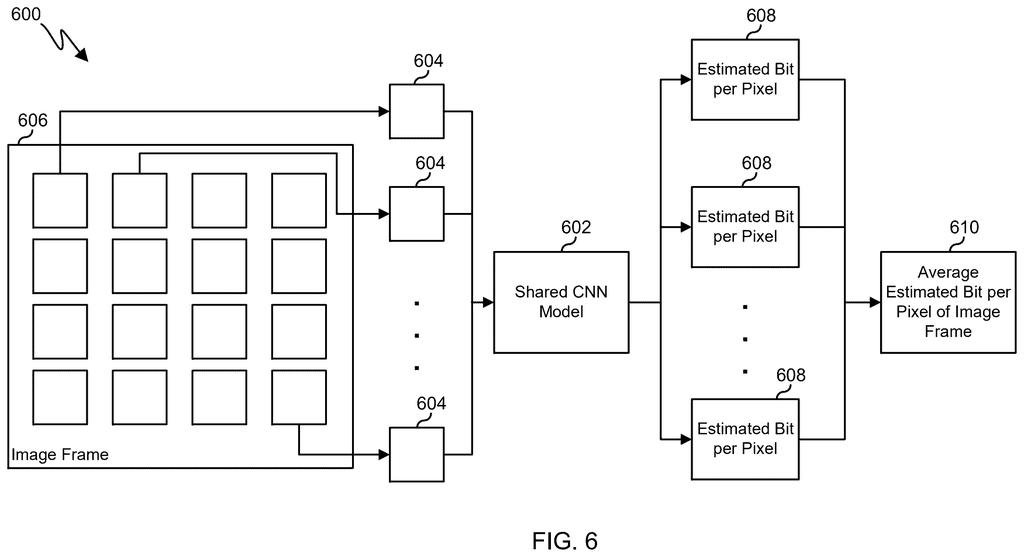
Some chips cannot handle different image sizes, so the filing also describes cutting a frame into patches, scoring each one, and averaging the results.
… inputting an image into a convolutional neural network (CNN) model. The method also includes estimating, using the CNN model, encoding I-frame bits per pixel for the image.
Translation: A compact neural network first processes a single video frame to analyze its data footprint.
Why TV makers care about frame detail
Your TV is always working with compressed video, and it has to decide where extra effort will improve the picture. A fast score for how detailed each frame is gives it something to go on. Per the filing, low-detail frames could get AI upscaling while detailed ones get less or none. The score is also described as a way to predict video encoding time and judge frame quality.
The small size matters as much as the score. A model with about 2,000 parameters can run on the chip inside the device itself instead of relying on a heavy video tool or a server. The filing names TVs and smartphones as example devices, though it lists many others. Nothing here says when, or whether, a product will use it.
Samsung's 148th filing we've tracked in our camera sensor push since May follows ideas like the slimmer base design and the motion blur fix with yet another camera application.
Claim 1 is short, which makes it wide in one direction. It says to feed an image into a neural network, have it estimate how many bits an encoder would spend per pixel, turn that into a detail score that does not depend on resolution, and output the score. Nothing in it mentions TVs, upscaling, or even video, only an image.
The tight part is the recipe. The score must come from a neural network's estimate of that specific bit count, so a different way of rating detail would fall outside the wording. The shrinking steps (distillation, pruning, finetuning) show up only in dependent claims, so claim 1 does not require them.
My verdict: a useful, modest measuring tool. If granted, it would cover any device that predicts that particular number with a neural network, and everything else about how a TV uses the score is left open.
Get our take in your Top Stories
Liked this breakdown? Add Patentlyze as a preferred source on Google, and our plain-English take shows up more often in your Top Stories the next time Samsung patent news breaks.
There are more where this came from
We read every patent application Big Tech publishes and send you the ones worth knowing. Plain English, free, every week.
The drawings
7 drawing sheets from US 2026/0311311 A1 · click any drawing to enlarge


Want this weekly breakdown for a company we don't cover? Patentlyze Pro →
Be the first to weigh in