
Samsung Files Patent for a Camera Design That Keeps Magnets Away From the Camera Next Door
Every phone camera has magnets inside, and magnets tug on their neighbors. Samsung's patent application gives one whole side of the camera module no magnet at all, so another camera can sit right up against it.
What Samsung's shared-magnet camera actually does
Every time you take a photo with a shaky hand, tiny magnets inside your phone's camera shove parts around to keep the picture sharp. Those same magnets can also tug on the cameras sitting next to them, which can force designers to leave extra space between lenses.
Samsung's patent application rearranges the parts so that one magnet does two jobs: it helps focus the camera, and it helps cancel shake in one direction. A second magnet handles shake in the other direction. With only two magnets in the module, one whole side ends up with none.
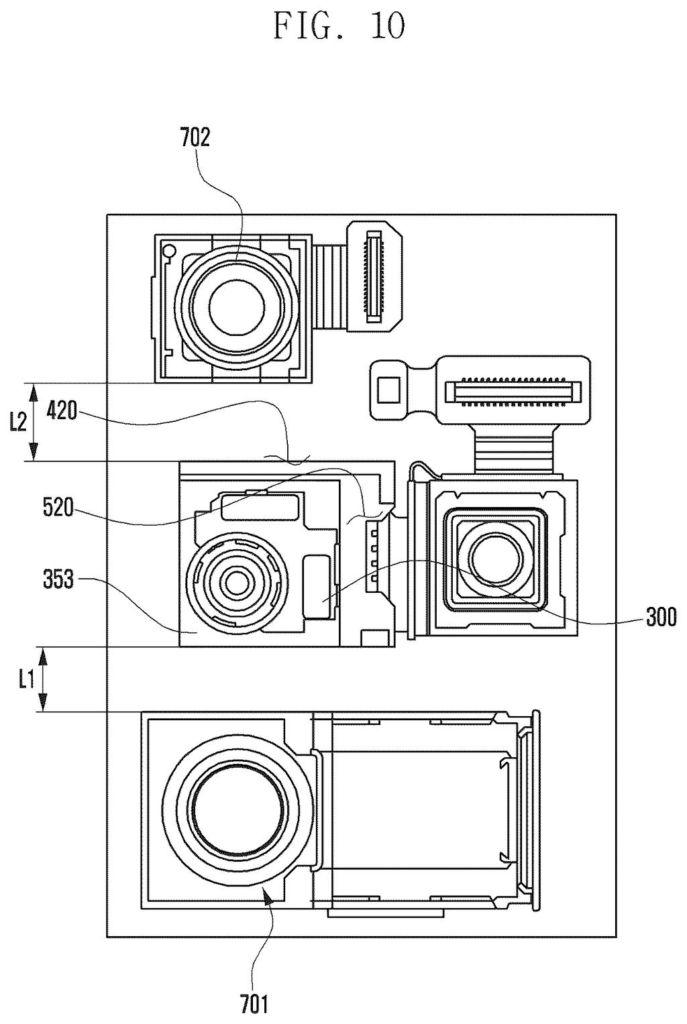
A second camera can then face that magnet-free side. According to Samsung's description, the two cameras can sit closer together and take up less room inside the phone.
… a coil configured to move in a direction perpendicular to an optical axis (OA) of the lens unit and including a first OIS guide and a second OIS guide …
Translation: This internal coil shifts sideways to steady the image.
How one magnet handles focus and stabilization
A phone camera does two physical jobs. Autofocus (AF) slides parts forward or back along the line the light travels, called the optical axis, to sharpen the subject. Optical image stabilization (OIS) shifts parts sideways, opposite to your hand shake, to cancel blur. Both run on electromagnetism: current through a coil pushes against a magnet.
The filing describes an older approach that mounts the focus part on a spring or wire with several focus actuators (magnet and coil pairs) placed symmetrically so it doesn't tilt. That takes up room and spreads magnetic fields toward neighboring parts.
Samsung's layout nests two frames. An inner focus frame carries the image sensor and the infrared filter (which blocks light your eye can't see). It sits partly inside an outer stabilization frame that carries both magnets. In the described design the lens stays fixed to the housing, so the sensor does the moving. Ball bearings guide each movement:
- Focus balls sit between the inner and outer frames and guide forward-and-back motion.
- Stabilization balls sit between the housing and the outer frame, rolling in grooves to guide sideways motion.
The first magnet faces a stabilization coil on the housing and a focus coil on the inner frame, so it serves both jobs. The second magnet faces its own coil and handles the other sideways direction. Because focusing happens inside the outer frame, the gap between each magnet and its stabilization coil stays constant while the camera focuses.
… an AF coil, fixed to the AF guide unit and allowing the AF to move along the optical axis …
Translation: This specific coil drives the lens back and forth to handle focusing.
Why a magnet-free side helps phone camera layouts
If you've looked at the back of a recent phone, you've seen how many lenses are packed into a small space. Samsung's filing says that when the magnet-free side of one camera faces another camera, magnetic interference drops. The two can then sit closer together and use less room inside the device, and designers get more freedom in where they place neighboring parts.
There is a thickness angle too. The filing mounts the infrared filter directly on the focus frame instead of on a separate bracket, which it says makes the module thinner. It lists phones, tablets, watches and foldable devices as possible hosts but names no product, so treat it as a hardware layout idea with no launch date attached.
Samsung's 84th filing we've tracked in our foldable phone race since May adds to earlier applications like one on edge coatings and one on app repositioning.
Claim 1 is a long parts list. It names a lens, two moving frames, a housing, two magnets, three coils and two kinds of ball bearings, and it spells out which magnet faces which coil. That level of detail makes the claim narrow.
The heart of it is the shared magnet: the first magnet sits between a stabilization coil and a focus coil, so one magnet serves two jobs. Claim 1 says nothing about a neighboring camera. That benefit shows up only in claim 15, which builds on claim 3 and adds a second camera facing the magnet-free side.
If granted, the claim would cover cameras built with this exact arrangement of magnets, coils and bearings, and it would leave other ways of calming magnetic interference untouched. It reads as routine, sensible hardware tinkering for a crowded corner of phone design, and whether you ever notice it depends on whether Samsung's engineers adopt it.
Get our take in your Top Stories
Liked this breakdown? Add Patentlyze as a preferred source on Google, and our plain-English take shows up more often in your Top Stories the next time Samsung patent news breaks.
There are more where this came from
We read every patent application Big Tech publishes and send you the ones worth knowing. Plain English, free, every week.
The drawings
14 drawing sheets from US 2026/0319331 A1 · click any drawing to enlarge


Show the other 6 sheets


Want this weekly breakdown for a company we don't cover? Patentlyze Pro →
Be the first to weigh in