
Samsung Patents Internal Wiring That Keeps Expanding Phone Screens Powered
A phone whose screen physically grows when you slide it open sounds elegant from the outside. The wiring nightmare hiding inside is another story, and Samsung has filed a patent addressing exactly that.
How Samsung keeps a sliding phone's guts connected
Every time you pull a sliding phone open, every wire and circuit inside has to stretch, flex, or reroute to keep up. For a phone where the screen itself grows larger as you slide, that challenge is much harder to solve than on a normal handset.
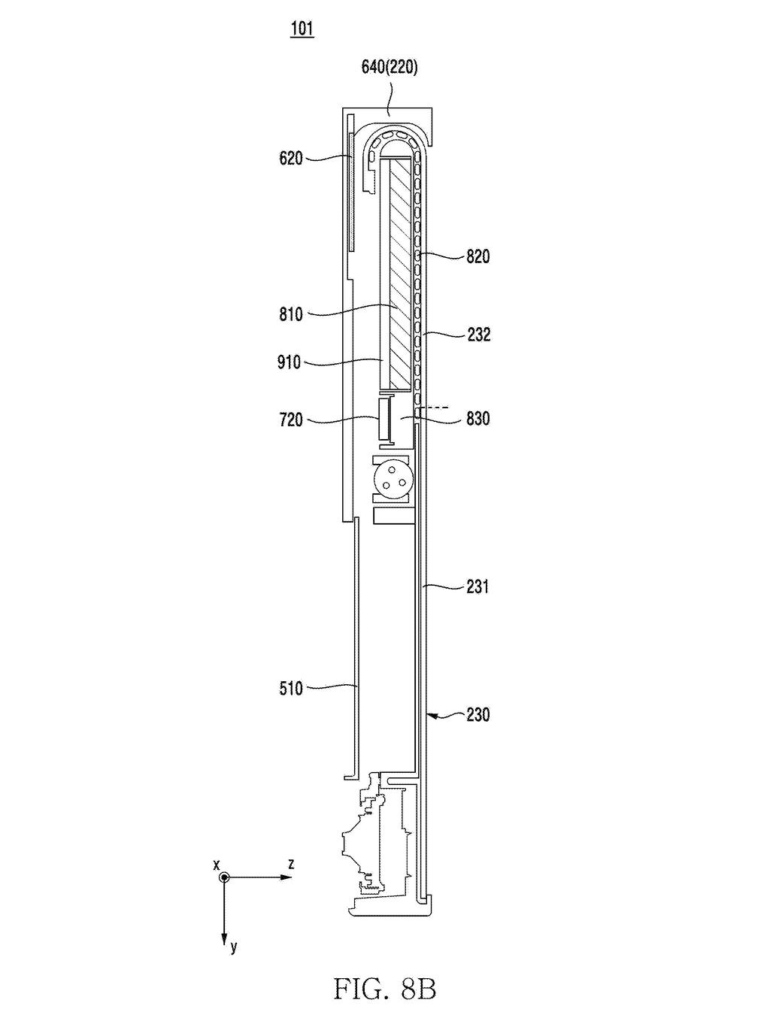
Samsung's patent describes splitting the phone's internal electronics across three separate circuit boards rather than cramming everything onto one. Two of those boards live in the sliding half of the phone, and one lives in the fixed half. A flexible cable connects across the gap as the phone extends, and the connection between two of the boards runs along the thin gap at the side of the sliding frame, keeping it out of the way of the screen.
The clever part is where the rolled-up portion of the flexible screen goes when the phone is closed: it tucks into the narrow space between two of those circuit boards, so nothing gets pinched or damaged. It's a tight spatial puzzle, and this patent is Samsung's proposed solution to fitting it all together.
… the connecting member including a flexible portion at least partially deformable in response to a movement of the second housing part with respect to the first housing part …
Translation: A flexible internal connector bends as the phone body pulls in and out.
How the three PCBs route power around the sliding frame
The patent covers an electronic device with two housing parts: a fixed section and a second section that slides out to extend the phone's visible screen area. Because the flexible display wraps around the inside of the sliding portion when retracted, there's very little room for the wiring that has to run between the two halves.
Samsung's approach uses three printed circuit boards (PCBs), each assigned to a specific structural zone:
- The first PCB sits in the fixed housing half and handles main processing functions.
- The second PCB sits on the outer sliding cover (the part you see and hold).
- The third PCB sits on the inner frame inside the sliding half, which also houses the battery.
The second and third PCBs talk to each other through a gap along the lateral side of the frame, essentially threading the electrical connection through the thin channel between the inner frame and the outer cover. That keeps the connection path away from the display.
A flexible connecting member (think of a ribbon cable that can bend without breaking) links the third PCB back to the first PCB in the fixed half, stretching and compressing as the phone slides. When the phone is closed, the second portion of the flexible screen folds into the space between the second and third PCBs, which are positioned specifically to accept it without crushing the display.
… an electrical path extending from the second PCB, across a lateral side of the flexible display, to the third PCB …
Translation: Wiring runs right past the edge of the screen to keep power flowing.
What this means for phones with physically bigger screens
Sliding phones with expanding screens are one of the few genuinely new form factors in mobile hardware right now. The biggest engineering barrier isn't the screen material itself; it's fitting a full set of electronics into a body that physically changes shape. Boards that can't move, cables that snap under repeated flexing, and screens that get pinched by their own housing are real failure points.
If Samsung brings a device built around this layout to market, it would directly address the durability concerns that have made many consumers cautious about foldable and rollable phones. A design that routes connections around the screen rather than through it, and that gives the folded display a safe resting place, could be the difference between a gadget that breaks in a year and one that holds up to daily use.
Samsung's 81st filing we've tracked since May in our foldable phone patents watchlist follows work like self-retuning speakers and slimmer sealed edges.
The problem this patent attacks is real and genuinely difficult. Sliding-screen phones have shown up as prototypes from several manufacturers, but reliable, mass-market versions have stayed out of reach partly because of exactly the internal routing challenges described here.
Samsung's three-board approach is less a single invention and more a careful spatial negotiation: every component is placed where it is because the screen needs somewhere to go. That kind of constraint-driven engineering is hard to patent cleanly, and the claim language reflects that, describing positions and relationships more than any novel component.
The filing reads like a document that exists because Samsung has a real device in development and needs protection around its specific physical layout. Whether that layout turns out to be the one that makes sliding phones reliable enough for mainstream buyers is a much bigger question than any single patent can answer.
There are more where this came from
We read every patent application Big Tech publishes and send you the ones worth knowing. Plain English, free, every week.
The drawings
25 drawing sheets from US 2026/0299651 A1 · click any drawing to enlarge


Want this weekly breakdown for a company we don't cover? Patentlyze Pro →
Be the first to weigh in