
Disney Files Patent for an AI Character That Invents Memories to Match Yours
When Disney's AI character has no memory that matches yours, it makes one up. That invented memory, built from details you just shared, is how the patent tries to make a robot or chatbot feel like a friend.
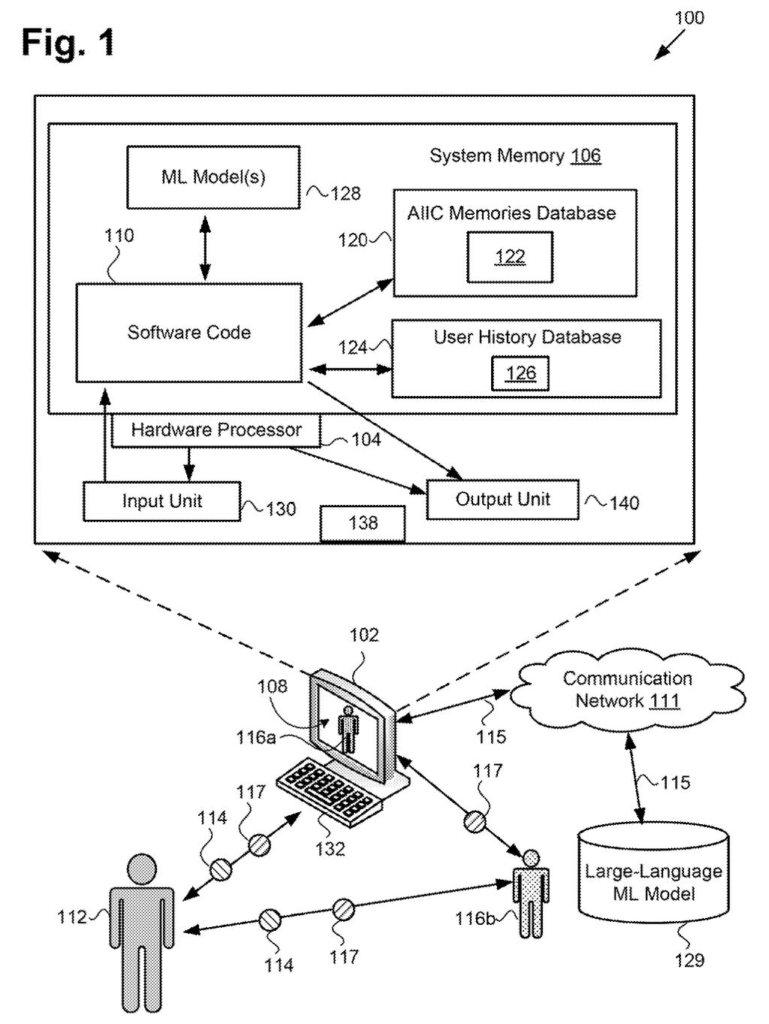
What Disney's memory-sharing AI character does
Imagine you tell a robot companion about a beach trip with your cousin, and it answers with a story about the time it went to the beach with a friend. You suddenly feel you have something in common. That small feeling is what Disney is chasing.
The patent describes an AI character with its own bank of stored memories, each one made of details like people, places, activities and emotions. When you share a memory, the character checks how closely each of its own memories matches yours. If none is close enough, it invents a new one from the details you just gave it, then uses that memory to shape its reply.
The character could be a robot, an animated figure on a screen, or a chatbot. Disney's reasoning is that sharing memories makes people feel close, and today's AI characters only mimic human emotion in a crude way.
updating the memory data structure by inserting a new memory node storing the predicted at least one user memory feature in the memory data structure; and generating, using the updated memory data structure, an interactive communication for execution by the AIIC.
Translation: When no existing memory matches, the system saves the new detail into its database to shape how the character talks back.
How the character scores memories against yours
The system starts by getting you to talk. The AI character asks you to recall something (the patent calls this a reminiscence), and a trained machine learning model reads your answer and pulls out the key details, such as who was there, where it happened, what you were doing and how you felt.
Those details are compared against the character's memory data structure. This is a web of memory nodes (one per remembered event) joined by edges that show how events relate to each other. Each node holds features like a person, a location, an activity and an emotional state.
The comparison produces a bond factor, a score for how close an emotional bond the shared memory is expected to create. It is calculated one dimension at a time (people, place, concepts, emotion), and each dimension can be weighted before the scores are combined. The match does not have to be exact. A beach trip with a cousin can score well against a beach trip with a friend, because the two relationships are close.
- If a stored memory scores high enough, the character uses it.
- If none clears the threshold, the system adds a new memory node built from your details, and links it to related memories.
The character then builds its reply from the updated memories, in some versions by writing several candidate replies and picking the best one. The reply can be speech, a gesture or a facial expression.
What invented memories mean for AI companions
If you have ever talked to a stiff virtual assistant, you know the gap: it answers, but it doesn't feel like it knows you. This patent aims at that gap for robots, on-screen characters and chatbots, by making the character seem to share your experiences instead of just replying to them.
The catch is that the memories are manufactured. The filing says the character's memory bank can even hold memories that contradict each other, and that it adds new ones to match yours. The description also says stored user history leaves out personally identifying details such as age, gender or race, and that running the software on your own phone can keep personal information on that device.
Disney's second filing we've tracked in AI assistants that remember you since August follows flagging rides guests may dislike.
Anyone who has chatted with a stiff virtual character knows the problem: it responds, but nothing about it feels like it knows you. For a company that sells characters people are meant to love, that hollow feeling is a real and costly flaw, because affection is the whole product.
The fix matches that problem well. Scoring a conversation on people, places and feelings is a sensible way to find common ground, and adding a new memory when nothing fits keeps the character from going quiet.
The weak spot is the foundation. A bond built on a shared story the character invented on the spot may feel warm for an afternoon and hollow after a month, and you would be the only one in the friendship who remembers anything real.
Get our take in your Top Stories
Liked this breakdown? Add Patentlyze as a preferred source on Google, and our plain-English take shows up more often in your Top Stories the next time Disney patent news breaks.
There are more where this came from
We read every patent application Big Tech publishes and send you the ones worth knowing. Plain English, free, every week.
The drawings
8 drawing sheets from US 2026/0330257 A1 · click any drawing to enlarge


Want this weekly breakdown for a company we don't cover? Patentlyze Pro →
Be the first to weigh in