
IBM Files Patent to Shrink Images by Having AI Guess the Pixels It Skips
What if your phone sent only part of a photo and let AI redraw the rest on the other end? That is the idea in a new IBM patent application.
What IBM's pixel-guessing compression does
Imagine texting a friend a big vacation photo on a weak connection. Normally the whole picture has to squeeze through, and squeezing harder makes it look worse.
IBM's idea is to leave out the parts of the photo that a computer could easily guess. An AI model studies each tiny dot (a pixel) and tries to predict it from the dots around it. If the guess is close enough to the real thing, that dot is marked as safe to skip.
Only the skippable dots are left out of what gets sent. On your friend's end, the same kind of AI fills the blanks back in, so the picture arrives looking close to the original while less data travels.
executing a trained generative adversarial network (GAN)-based model on an image to select pixels of the image with valid proxy pixels being generated by the GAN-based model to facilitate image compression …
Translation: An AI model analyzes the picture to figure out which pixels can be safely thrown away.
How the AI decides which pixels to skip
The filing starts with a trained generative adversarial network, or GAN (two AI models that train against each other: one makes guesses, the other judges whether they look real). Here, the guessing model predicts a single hidden pixel from the pixels around it.
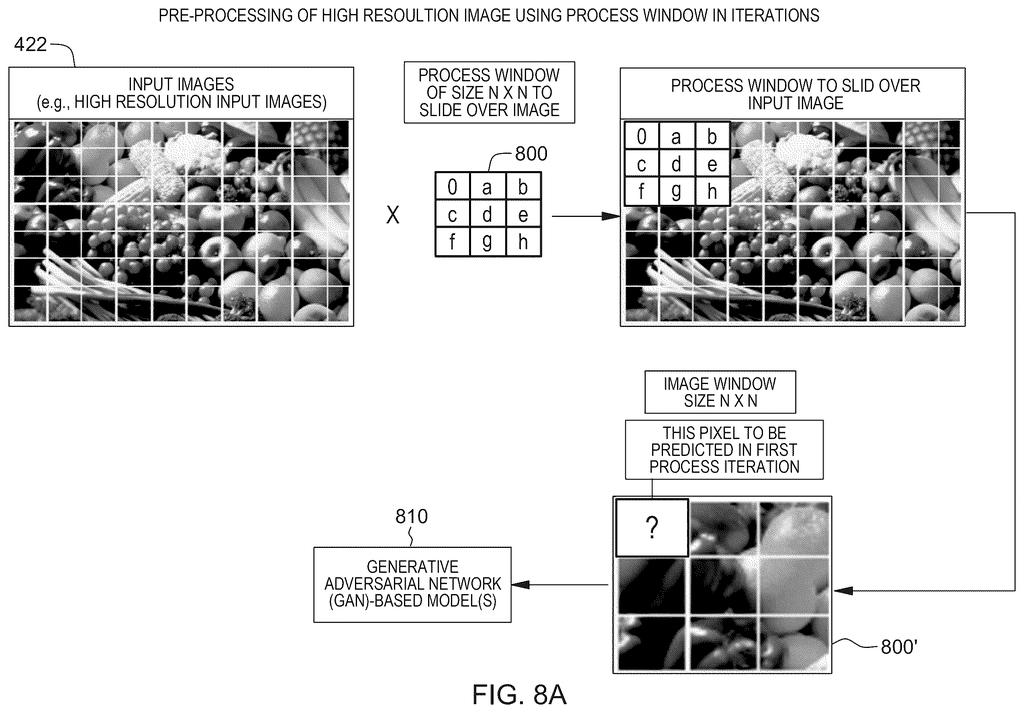
To find which pixels are safe to skip, the system slides a small process window (a square such as 2×2, 3×3 or 4×4 pixels) across the image. At each stop it hides one pixel, predicts it, and compares the prediction with the real one. If the similarity beats a tunable threshold (the filing's example is a score of 0.82 against an 80 percent bar), the pixel is flagged as a valid proxy pixel.
The flagged pixels are then masked, and the claims describe two ways to do that:
- Block them out as compressed latent data (a compact internal code the model works with).
- Swap each one for a default value.
The receiver runs the same model to refill the gaps. It works backward across the image, opposite to the sender's direction, because later pixels can help rebuild earlier ones. The window size can also be chosen based on image content, and the masked image can still go through an ordinary encoder before it is sent.
… generating a predicted pixel based on surrounding pixels of the masked pixel in a process window iteration over the image, and selecting the predicted pixel as a valid proxy pixel where a similarity comparison of the predicted pixel to a corresponding original pixel exceeds a similarity threshold …
Translation: The system guesses missing pixels using neighboring colors and keeps the guess if it matches the original closely enough.
Who gains when images get smaller on the wire
The practical payoff is less data to move. Photos, video frames and other large media files take time to upload and download, and the usual trade-off is that squeezing harder costs you quality. IBM's approach tries to skip only the pixels an AI can rebuild with high accuracy, so the savings come from the easy parts of the picture.
The filing says this can cut transmission costs significantly and also save storage, though it gives no figures for how much smaller files get. Both the sender and the receiver need the trained model, so this suits services that control both ends, such as a video platform or a company's internal systems.
IBM's fourth filing we've tracked on our AI photo editing race watchlist since July adds to earlier applications, including one that sharpens blurry images and one that rewrites video backgrounds.
If this works as described, you would notice it on your worst connection: a photo or video clip that uploads faster and still looks sharp when it lands. On a good home network you would never see a difference.
The filing's safeguard is sensible. A pixel is only skipped when the AI's guess scored above a set bar against the real one, so the pixels that get redrawn are the easy ones, like a patch of blue sky.
The catch is that both ends need the same trained model, and the redrawn pixels are still guesses. The filing also gives no numbers on file-size savings, so you cannot yet tell whether the trade is worth it. Until the apps on both sides agree to use it, you would never see it.
Get our take in your Top Stories
Liked this breakdown? Add Patentlyze as a preferred source on Google, and our plain-English take shows up more often in your Top Stories the next time IBM patent news breaks.
There are more where this came from
We read every patent application Big Tech publishes and send you the ones worth knowing. Plain English, free, every week.
The drawings
15 drawing sheets from US 2026/0330697 A1 · click any drawing to enlarge


Show the other 7 sheets


Want this weekly breakdown for a company we don't cover? Patentlyze Pro →
Be the first to weigh in