
Qualcomm Files Patent to Keep Phone-Trained AI Accurate Over Noisy Wireless Signals
Many phones can help train one AI model by sending their updates to a cell tower at the same moment. Qualcomm's filing uses a mathematical grid to filter out the radio static that would otherwise blur the result.
What Qualcomm's grid-snapping patent actually does
Imagine a crowd of phones helping teach one AI model, each learning from the data on its own device without ever sharing that data. The catch is that every phone still has to report what it learned over a busy, static-filled radio link, and every bit of noise nudges the results off course.
Qualcomm's patent application tackles that with a shared grid. The cell tower tells every phone to use the same scaling, the same pseudo-random nudge and the same grid of allowed values. Each phone rounds its update to the nearest grid point before sending. Because grid points add up to another grid point, the tower can let everyone's signals combine in the air, then snap the total back onto the grid, which wipes out small bursts of static.
For you, that could mean a shared AI model that learns more accurately from phones like yours, while your personal data stays put.
transmit, to a network entity based on a first gradient vector, first communication setup parameters for a lattice-based quantization and coding scheme for communication between the first UE and the network entity; …
Translation: The phone sends its initial machine learning training data setup to the network.
How phones round their updates onto a lattice
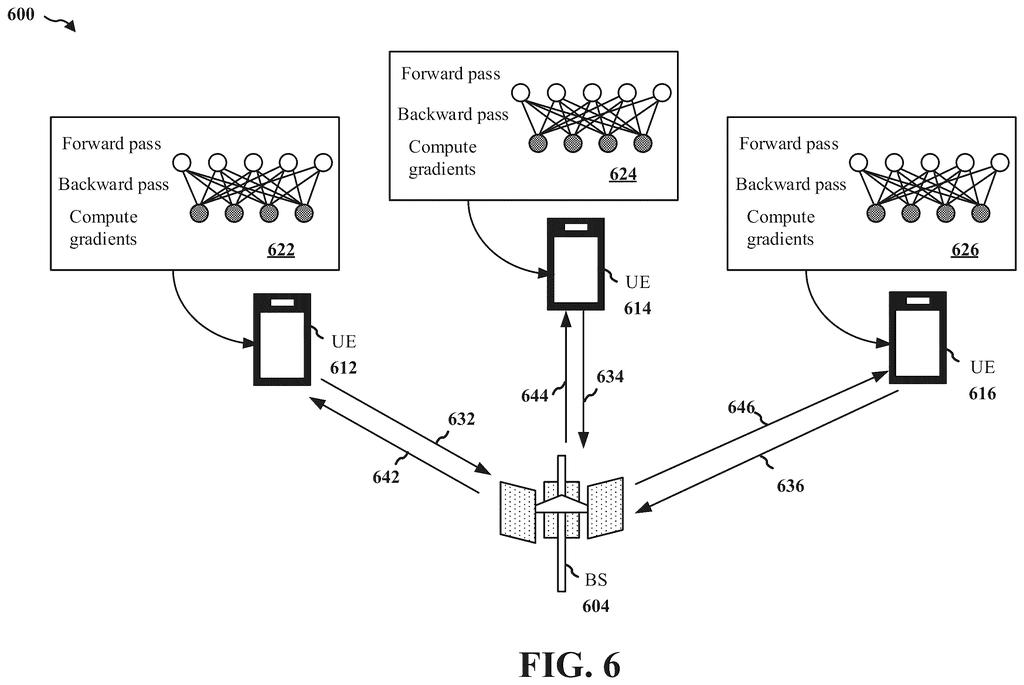
The filing covers federated learning, where many devices train one shared AI model and each keeps its data private, sending back only small updates called gradient vectors (lists of numbers showing how the model's settings should change). The claims cover both the phone side and the cell tower side.
First, each phone sends the tower a few summary numbers: the largest value in its update, how spread out its values are, and how noisy its radio link is. The tower combines everyone's numbers and replies with shared settings:
- A scaling factor that keeps each transmission within the phone's power limit
- A shared dithering seed (a starting number that produces a pseudo-random nudge, which keeps rounding errors from skewing the results)
- A lattice (a regular grid of allowed values in many dimensions, which rounds more accurately than rounding each number alone)
Each phone scales its update, adds the nudge, and snaps the result to the nearest lattice point. All phones transmit at once and the signals add up in the air. Because the sum of lattice points is another lattice point, the tower can snap the received signal back onto the grid and erase small amounts of noise.
If spare radio capacity exists, phones also send their own rounding errors so the tower can correct for them. The tower then sends back updated model settings, the phones train again, and the loop repeats until a stop signal arrives.
Why phone-trained AI could get more accurate
If you own a phone, you are a possible member of the crowd that trains these shared models. Wireless networks increasingly use AI for jobs like picking the best antenna beam, compressing signal reports and estimating position, and the filing lists these as uses. Training such models on real phones without collecting their data needs a dependable way to send updates over noisy radio.
Qualcomm says the grid approach cuts rounding error, which gives the tower a more accurate combined update and helps training settle faster. The filing also reports a coding gain at signal strengths above 12 decibels with a coding rate of one third, and says the tower can retune the settings as radio conditions change.
Qualcomm's 21st filing we've tracked since July in our on-device AI privacy watchlist adds to earlier work on catching garbled group AI data and AI backup when cell data drops.
You will almost never notice this one directly. If it works, nothing visible changes on your phone. The benefit would show up as a shared AI model that arrives a little more accurate or a little sooner, perhaps one that helps your phone hold a better connection.
The part a reader can care about is privacy. Your data stays on your device while your phone still helps improve the model, and the filing aims to keep radio noise from eating away at the accuracy of that arrangement. Reasonable people can like that trade.
The filing itself is radio plumbing with no named consumer feature attached. Expect any payoff to land inside future network upgrades, where you would feel it as steadier service rather than a new button to press.
Get our take in your Top Stories
Liked this breakdown? Add Patentlyze as a preferred source on Google, and our plain-English take shows up more often in your Top Stories the next time Qualcomm patent news breaks.
There are more where this came from
We read every patent application Big Tech publishes and send you the ones worth knowing. Plain English, free, every week.
The drawings
14 drawing sheets from US 2026/0332295 A1 · click any drawing to enlarge


Show the other 6 sheets


Want this weekly breakdown for a company we don't cover? Patentlyze Pro →
Be the first to weigh in