
Google Files Patent for Cloud Storage You Can Search but Google Can't Read
Search is the reason most cloud storage can read your files. A new Google patent application describes a way to keep keyword search working while the server holds only scrambled data it has no way to open.
What Google's searchable-encryption patent does
Every time you search your cloud storage for a name or a date, the service has to know what is in your files to find the answer. That convenience comes with a catch: a server that can search your stuff can usually read it too.
This Google patent application describes a way around that. You give the service a public key, a lock that only your private key can open. The service builds a keyword list of your documents, scrambles that list and your files using fresh one-time keys, then locks those keys with your public key. After that, it deletes every readable copy it was holding.
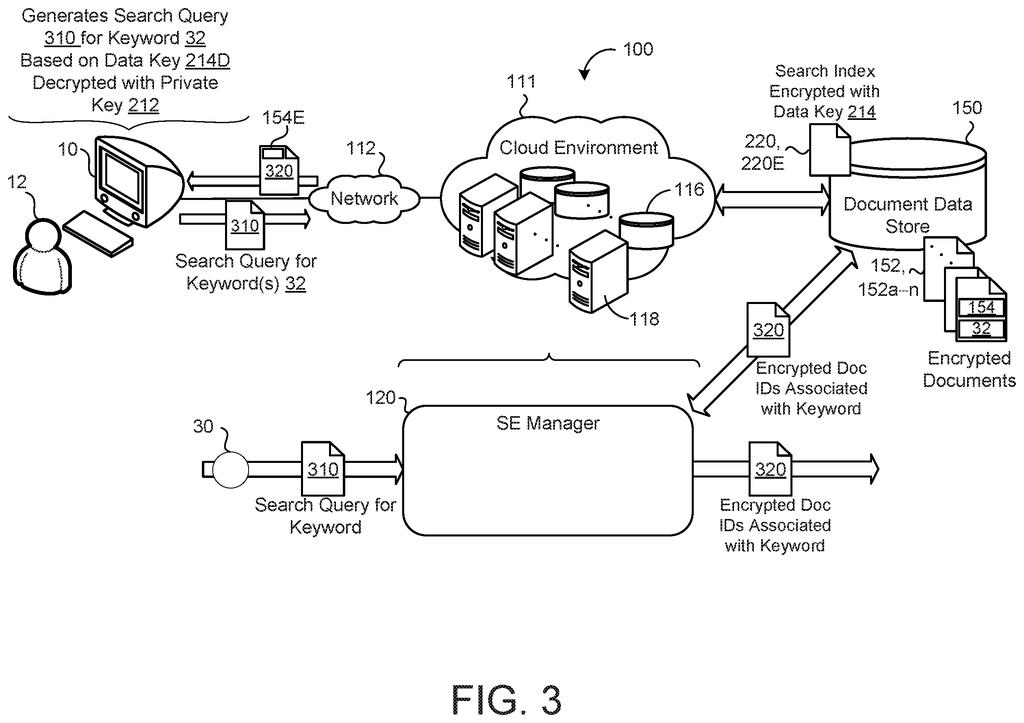
Later, your device unlocks the keys and sends a search request in scrambled form. The server finds matches in its scrambled list and sends back an answer only your device can read.
… encrypting, using the data key, a search index for the corpus of documents based on keywords within the corpus of documents.
Translation: It creates a special keyword index of your files so you can search them later without decrypting the actual documents.
How Google locks the index and the files
The filing covers a service that stores your documents on a remote server and then gives up the ability to read them. You send a request to encrypt your data along with your public key (one half of a matched pair of keys; the other half, the private key, stays on your device and out of the server's reach).
The server then creates two fresh symmetric keys (single keys that both lock and unlock data, and are fast even on big piles of files). Per the first claim, it works like this:
- The first key encrypts the search index, the keyword list that records which documents each word appears in.
- The second key encrypts the documents themselves.
- Both keys are then encrypted with your public key.
- The server discards the plaintext documents and both keys.
Mixing slow-but-private public-key encryption with fast symmetric encryption is called hybrid encryption. The filing says public-key encryption on large data is computationally expensive, so only the small keys get that treatment. One described option for the keys is AES-GCM, a widely used encryption standard.
To search, your device uses its private key to unlock the keys, builds a query for a keyword, and sends it over. The server runs it against the encrypted index and returns a result that your device turns into a list of matching document identifiers. The filing says that list is never shown to the server in plaintext.
Why your cloud backups could get more private
If you store emails, notes, photos or backups with an online service, you normally trust that company not to look and trust its defenses to hold. A design like this shrinks the amount of trust you have to hand over. A nosy insider or someone who breaks into the servers would find scrambled files and a scrambled index, with the keys locked behind something only you hold.
The filing also points out a practical benefit: your search still works, so you can pull back just the files you need, such as when restoring a backup. It also avoids asking you to give the service a password it could misuse. The patent application doesn't name a product, so treat it as a design idea for now.
Google's 62nd filing we've tracked since May in our on-device AI privacy watchlist builds on its earlier patents for letting your device pick ads and a two-lane ad system.
The benefit here is something you would almost never notice day to day, which is the point. Searching your files would feel the same, while a data leak at the storage company would expose far less of what you keep there.
There is a flip side that follows from the design. Since the server throws away its readable copies, the private key on your device becomes the only way back in, so any real product would need a very good plan for helping people keep that key safe.
For a person who stores sensitive files online, this is a sensible trade: a little more responsibility in exchange for much stronger privacy, with search kept intact.
Get our take in your Top Stories
Liked this breakdown? Add Patentlyze as a preferred source on Google, and our plain-English take shows up more often in your Top Stories the next time Google patent news breaks.
There are more where this came from
We read every patent application Big Tech publishes and send you the ones worth knowing. Plain English, free, every week.
The drawings
5 drawing sheets from US 2026/0332396 A1 · click any drawing to enlarge


Want this weekly breakdown for a company we don't cover? Patentlyze Pro →
Be the first to weigh in