
Google Files Patent to Let Your Own Device Pick Which Ads You See
Google's filing describes a way for your browser to decide which ad you see, using interest scores it computes and keeps on your own device.
What Google's on-device ad picking does
You're shopping for sneakers on a retailer's site. You add a size 11.5 to your cart, close the tab, and later open a news site that shows you an ad. Who decided which ad you got, and what did they know about you?
Google's filing describes a setup where your browser keeps a private list of interest groups you've been placed in, like "Shoe Size US 11.5" or "Age 20-35." Your device counts how often each guess about you shows up and turns that into a score. Those scores never leave your device.
When ads come back from Google's servers, each one carries a standard ranking number, a backup ranking number, and a rule such as "use the backup if this score is high enough." Your browser checks the rule against your scores, picks the winning ad, and shows it.
… evaluating, by the client device, the rule against the score for the particular user attribute to determine whether to apply the conditional selection value instead of the primary selection value for the particular digital component; …
Translation: Your phone applies its own internal rules to decide which ad values to use.
How your device scores its guesses about you
The system starts with a user group list stored on your device. Each entry is a label, sometimes a code instead of readable words, for a group you were added to based on a predicted attribute such as age range or shoe size. Websites guess these from your activity and ask your browser to add you, and your settings can refuse.
Next, your device computes a score for each attribute by counting how many groups on your list contain it. In the filing's example, attribute A appears in four groups, so it scores 4. A weight can scale the count, so an attribute with a weight of 0.9 scores 3.6.
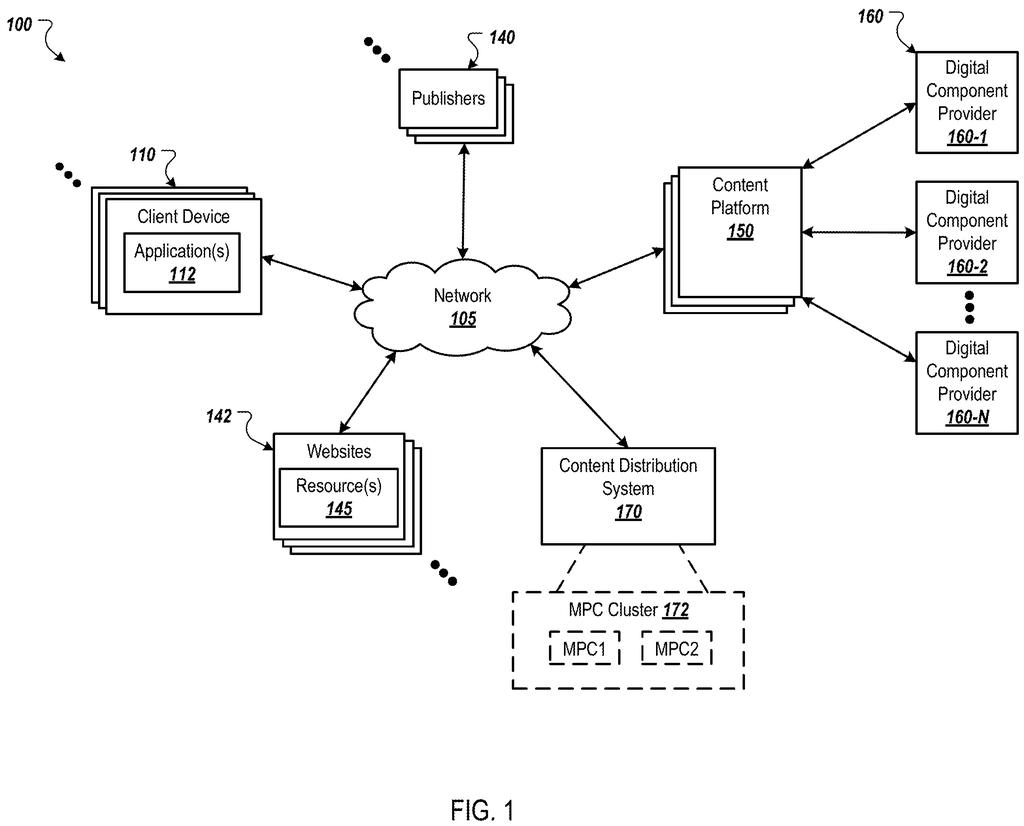
Your device then sends a request to a content distribution system carrying the group list, encrypted or split into secret shares (pieces that reveal nothing until they are recombined). What comes back is a set of ads, and each ad has:
- A primary selection value, a number used to rank it;
- A conditional selection value, an alternate ranking number;
- A rule saying when to use the alternate, such as when one attribute's score beats another's or passes a threshold.
Your device checks each rule against your scores, picks the ads that win, and displays them. The filing also describes hashing and merging groups to shrink the list in your device's memory.
A determination is made, for each user attribute of multiple user attributes, a score based on a quantity of user groups identified in the list of group identifiers for the user that include, as a membership attribute, the user attribute.
Translation: The device calculates scores for your personal traits based on which user groups you belong to.
Why this matters for cookie-based ad tracking
For you, the likely change is invisible: ads look the same, but the scoring of your interests happens on your device. The filing contrasts this with cookies, which it says can identify a device and carry information about you off of it.
For advertisers, the rule system keeps some control. An ad for size 11.5 sneakers can ask for a higher ranking when your size score is high, without that score being sent off your device. Keep in mind that the groups are predictions, and the filing admits a group can include people who don't actually have the attribute.
Google's 61st filing we've tracked since May in our on-device AI privacy push watchlist builds on an ad-picking privacy system and a phone AI that weighs answers to keep more data on your device.
Most people will never see this working. An ad appears, and nothing about it looks different. The benefit is the failure it prevents: a profile of your age, shoe size and hobbies sitting on someone else's server, tied to a cookie that follows you from site to site.
You would notice it mainly when the guess is wrong. The filing admits these groups are built on predictions, so you might still get ads for a shoe size you never wore. Scoring on your device keeps those guesses close to home, and it leaves their accuracy untouched.
The request still carries your group list to a server, in encrypted or split-up form. How much comfort that gives depends on who holds the keys. The filing relies on servers being trusted, or on several servers staying honest with each other.
Get our take in your Top Stories
Liked this breakdown? Add Patentlyze as a preferred source on Google, and our plain-English take shows up more often in your Top Stories the next time Google patent news breaks.
There are more where this came from
We read every patent application Big Tech publishes and send you the ones worth knowing. Plain English, free, every week.
The drawings
4 drawing sheets from US 2026/0332564 A1 · click any drawing to enlarge


Want this weekly breakdown for a company we don't cover? Patentlyze Pro →
Be the first to weigh in