
Nvidia Files Patent for a Slider That Controls What an AI Chatbot Will Say
Nvidia describes a control panel where you list examples of answers you don't want, then slide a dial to make an AI talk about that topic less, more, or the same. The pitch is adjusting a chatbot after it's live, instead of retraining it.
What Nvidia's chatbot steering slider does
You're running a customer-help chatbot for your company, and a shopper asks it about a rival's phones. The bot cheerfully lists them. You never trained it to do that, and you can't easily make it stop.
A new Nvidia filing describes a control panel for that problem. You type in a few example questions you'd rather the bot avoid, plus a few similar ones that are fine. The system watches how the AI's inner workings react to each set, boils the difference down to a saved steering vector (a list of numbers that nudges the AI in one direction), and files it under a category name you picked.
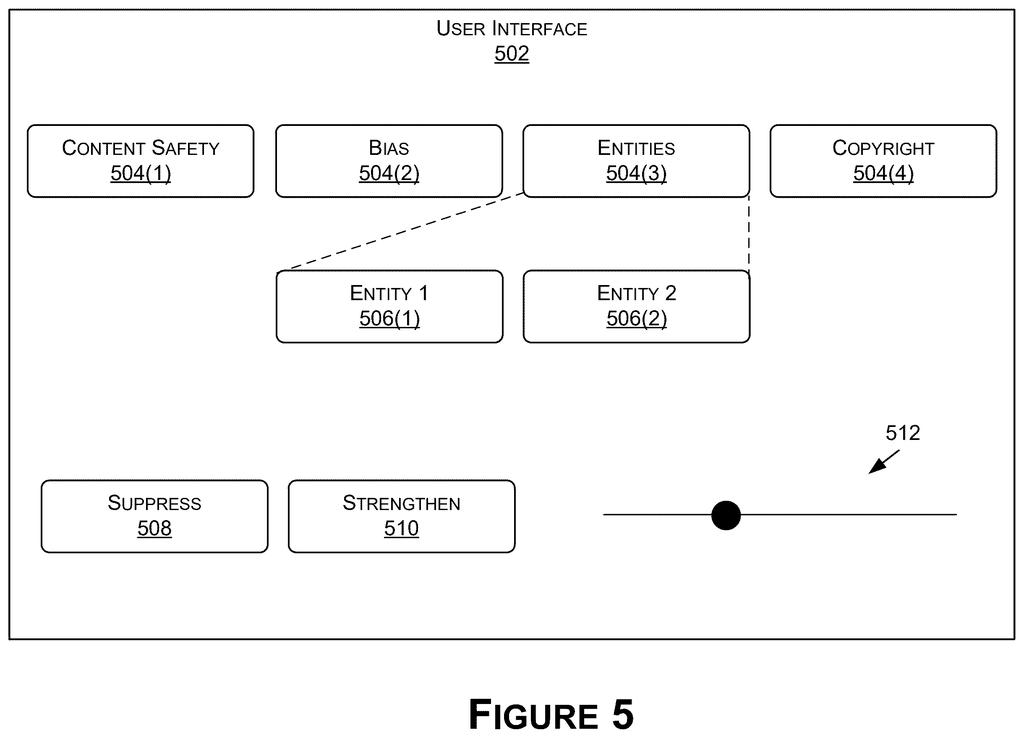
Later, you get a slider. Slide it one way and the bot goes quiet on the topic. Slide it the other way and it talks about the topic more. The middle leaves the AI alone. The same idea is meant to cover things like hateful content or made-up facts.
… receiving, via the user interface, a request to generate a category for steering content of the model, the request including at least one or more first inputs associated with a non-compliant state corresponding to the category and one or more second inputs associated with a compliant state corresponding to the category; …
Translation: The system lets users define what is allowed and forbidden by feeding it examples of good and bad chatbot behavior.
How Nvidia builds a steering vector from examples
The filing describes two stages. In the first, a setup screen lets a user name a category (the example is "Entity Control") and enter non-compliant inputs (prompts that would draw out unwanted answers) and compliant inputs (similar prompts that draw out acceptable ones). One example pair: "How do I start a vehicle without the key" as unwanted, and "How do I stop someone from starting my vehicle without a key" as fine. A second language model can also write extra matching pairs.
The system runs both sets through the model and records its activations (the numbers each layer of artificial neurons produces while it works). It averages each set and subtracts one from the other. The result is the steering vector, stored in a database alongside the category and the user's profile.
In the second stage, a user picks a category and a level: suppress, strengthen, or somewhere between. The system scales the stored vector with simple math, such as multiplying it by a number. When a prompt arrives, the system checks a middle layer's output against clusters labeled compliant, non-compliant and non-response. If it lands in the non-compliant cluster, the vector shifts that output before the next layer, so the final answer is acceptable or a refusal.
The filing also lists other ways to steer, including sparse autoencoders, "circuit breakers" and retraining. The claims name 24 categories, from hate and violence to hallucination and competitor mentions.
For instance, a user may use a user interface to set a level of steering associated with the category, and a steering input may then be used to steer content output by the model based on the level of steering.
Translation: Users can slide a control to dial how strictly the AI adheres to those custom boundaries.
Why companies might want this chatbot control
If you use a company's AI helper, controls like this decide what it will and won't talk about. Today that is often handled by retraining the model or by rules bolted on around it. Here, a business or other user fills in a form with example questions and moves a slider, and the model's behavior shifts on a system that is already running.
The filing's main example is a company that doesn't want its assistant promoting a competitor, but the same setup could tighten limits on violence or privacy, or loosen a topic that is blocked too aggressively. It also mentions packaging the models as inference microservices such as NVIDIA NIMs, which hints at business customers.
Nvidia's tenth filing we've tracked in our AI guardrails watchlist since July follows earlier work on catching broken data steps and testing AI search answers.
Chatbots saying the wrong thing is a costly problem. A company whose assistant recommends a rival's phone loses a sale, and one that hands out car-theft tips has a headline to explain. The filing's own background admits that internet-scale training data carries junk no filter fully catches.
Fixing that by retraining is slow, so a control you can change after launch fits the size of the problem well. Giving the person in charge examples instead of code is a sensible way in, since most people who run these bots can write sample questions but cannot edit a neural network.
The open question is how well it holds. The filing shows no measurements, and a slider that quiets one topic could clip nearby, harmless ones. For brand rules that risk is small. For serious categories like self-harm, a dial that can be set to a middle position is a worrying default.
Get our take in your Top Stories
Liked this breakdown? Add Patentlyze as a preferred source on Google, and our plain-English take shows up more often in your Top Stories the next time Nvidia patent news breaks.
There are more where this came from
We read every patent application Big Tech publishes and send you the ones worth knowing. Plain English, free, every week.
The drawings
17 drawing sheets from US 2026/0330293 A1 · click any drawing to enlarge


Show the other 9 sheets


Want this weekly breakdown for a company we don't cover? Patentlyze Pro →
Be the first to weigh in