
Qualcomm Files Patent to Clean Up Grainy Phone Photos Using a Shrunken Copy
Your phone's grain-fixing chip usually follows recipes set ahead of time. Qualcomm's filing has an AI look at a shrunken copy of your photo and write a custom recipe for each patch of it.
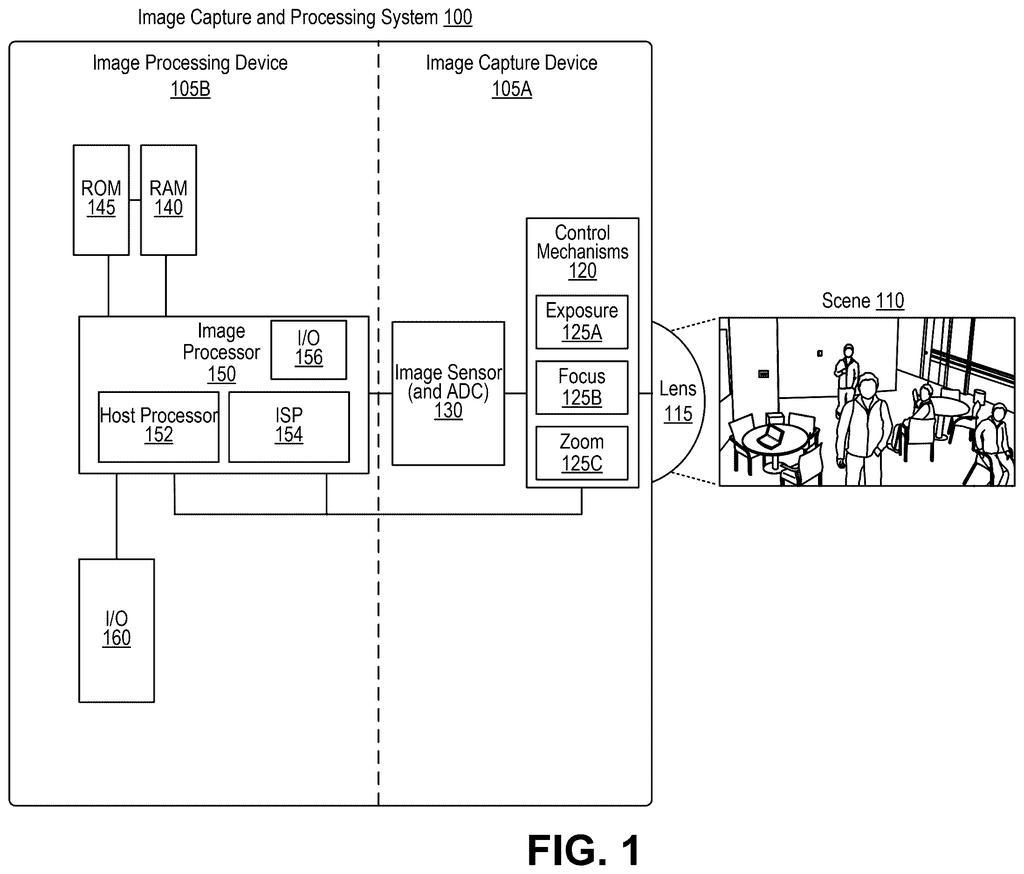
What Qualcomm's shrunken-photo cleanup does
A phone camera snaps a photo in a dim restaurant, and the picture comes out speckled with grain. Fixing that takes work, and your phone has to do it fast without eating the battery. Today, the camera hardware mostly applies fixed filter recipes to chosen regions of a photo.
Qualcomm's filing takes a shortcut. The phone first shrinks the photo to a much smaller copy (the example uses one quarter of the width and height). An AI model studies that small copy and works out a cleanup recipe for each area, since a smooth wall and a patterned sweater need different treatment.
Then a second chip blows the recipe back up to full size and applies it to the original photo. The AI does its thinking on far less data, so it costs less power, while the full-quality photo still gets the detailed treatment.
obtain a downscaled image of a scene, wherein the downscaled image is generated based on downscaling an image having a first resolution, the downscaled image including a second resolution that is lower than the first resolution …
Translation: The phone starts by shrinking the original high resolution photo down to a smaller size.
How the small copy becomes a full-size filter
A kernel is a small grid of numbers (called weights) that slides over every pixel in a photo and blends it with its neighbors. Different numbers give different effects, such as grain removal, sharpening, or blur. A kernel prediction network is an AI model whose job is to write those numbers based on what is in the picture.
The filing splits the work between two chips in the phone:
- The image signal processor (the camera's dedicated chip) shrinks the full photo. The example uses a quarter of the width and height.
- A neural processor (a chip built for AI) runs the network on that small copy. It outputs a small kernel map plus two extra settings, one tied to the kernel's size and one tied to how much the picture was shrunk.
- Back on the camera chip, those pieces are expanded into a full-size set of per-pixel kernels. In the example, each pixel gets nine weights, a 3 by 3 grid.
- The camera chip applies them to the original full-resolution photo.
Because the weights vary from pixel to pixel, a smooth wall and a detailed sweater can get different treatment. The filing says the same approach can serve denoising, sharpening, deblurring, blurring, and two raw-sensor color steps (mosaicing and de-mosaicing).
It also describes variations: one model call can produce kernels for several frames, kernels from shots with different exposure times can be merged into one, and a single model can predict kernels for several tasks at once.
… generate, using a kernel prediction network based on the downscaled image, kernel parameters and a downscaled kernel associated with the second resolution …
Translation: An AI network analyzes the tiny version to figure out how to process the pixels.
Why this could save battery on your phone camera
For your phone, the payoff is a cheaper way to get photo cleanup that adapts to each picture. The filing says running the AI on a shrunken copy means less data moving between chips and fewer calculations, which cuts delay and power use. That matters most for video and burst photos, where the filing describes one model call serving several frames instead of one call per frame.
It also shows a division of labor Qualcomm describes: a small AI decides how strongly to treat each part of a shot, and dedicated camera hardware does the heavy lifting. The filing lists phones, XR headsets, and wearables as places it could run. It gives no measured results, so how much sharper or longer-lasting it would make things is unknown.
Qualcomm's 14th filing we've tracked in our AI photo editing race since July follows patents like changing a photo's camera angle and keeping zoomed images sharp.
The design gives up some eyesight to save power. The AI judges the photo from a copy with a sixteenth of the pixels in the filing's example, so a thin strand of hair or small text could be misread, and the chip that expands the recipe has to guess the detail in between.
The filing also gives no figures for battery savings or image quality, so the trade is hard to price. Two chips must pass data back and forth too, which adds coordination work.
Still, the bet looks sensible. Recipes chosen ahead of time cannot react to what each photo contains, so letting a small AI pass pick the strength for each area looks like a fair swap for slightly coarser judgment. Whether it pays off depends on testing the filing does not show.
Get our take in your Top Stories
Liked this breakdown? Add Patentlyze as a preferred source on Google, and our plain-English take shows up more often in your Top Stories the next time Qualcomm patent news breaks.
There are more where this came from
We read every patent application Big Tech publishes and send you the ones worth knowing. Plain English, free, every week.
The drawings
14 drawing sheets from US 2026/0330595 A1 · click any drawing to enlarge


Show the other 6 sheets


Want this weekly breakdown for a company we don't cover? Patentlyze Pro →
Be the first to weigh in