
Nvidia Patents Camera Tuning That Fixes One Part of a Photo Without Wrecking the Rest
Fix the glare around a traffic light and the rest of your photo often gets worse. Nvidia's filing describes an AI that works out what is in the picture first, so each fix lands only where it belongs.
What Nvidia's region-by-region photo fix does
Imagine you take a photo of a street at dusk. A glowing halo surrounds the traffic light, so your camera turns down the glow. Now the rest of the picture looks off, with odd artifacts in places that looked fine a second ago.
That is the problem Nvidia is going after. A camera's image processor (the chip that turns raw sensor data into a finished photo) usually applies a fix to the entire image. Nvidia's filing adds an AI that first figures out what is in the shot, then tells the processor to treat the sky, the traffic light and everything else differently.
The filing also describes steering the result with your voice, a gesture or text. You could ask for a cartoon or sketch look. You could even ask the camera to help you find your keys by making the jacket lying on top of them partly see-through.
extracting, using a neural network, at least one of one or more attributes or one or more semantic features from the image to produce perception data; determining one or more image signal processor (ISP) controls to enhance a portion of the image based on the perception data; …
Translation: AI analyzes the picture to figure out what needs fixing in a specific area.
How the AI tells the camera chip where to look
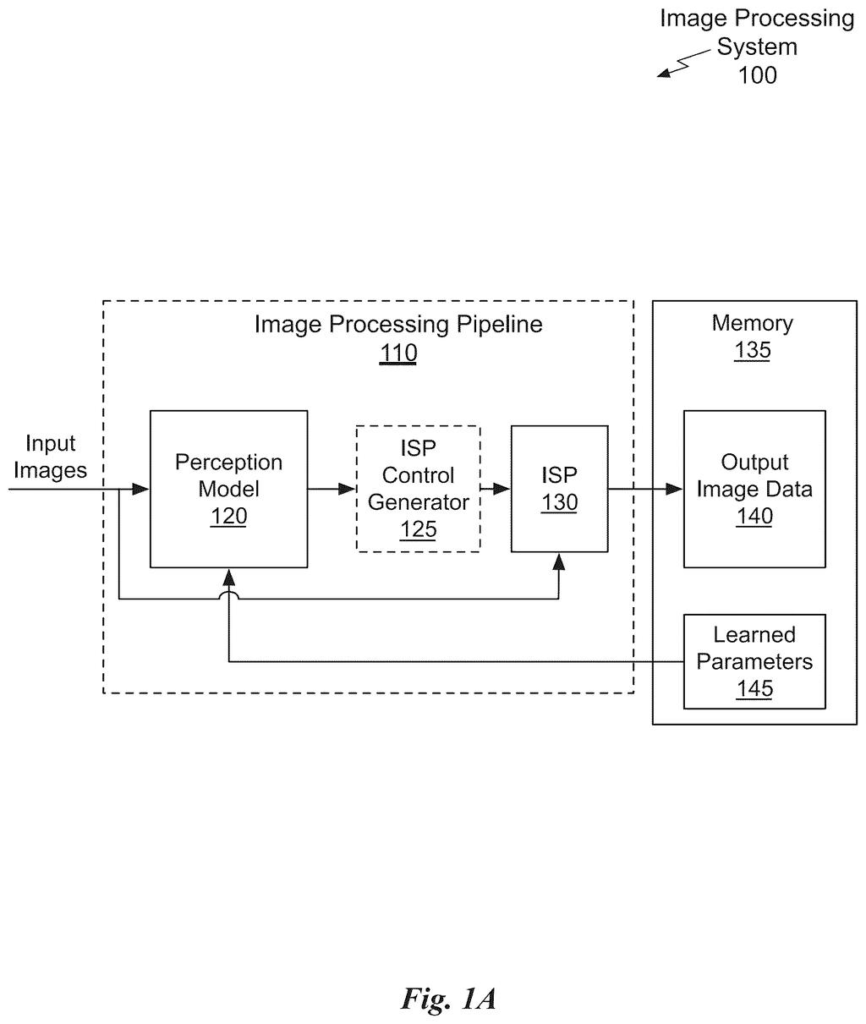
The system has three main parts. The first is a perception model, a neural network trained to recognize what is in a picture. The second is an optional control generator. The third is the camera's existing image signal processor, or ISP (the chip that turns raw sensor data into a finished photo). The perception model pulls out attributes and meaning from the image, such as objects, lighting, color and noise level, and where each one sits in the frame. The filing calls this output perception data.
From that data, the system picks ISP settings for specific regions instead of the whole frame. The filing's examples include:
- Flat areas like sky or water get stronger noise reduction, while detailed textures get less so they stay crisp.
- Traffic lights and brake lights get boosted red, orange and green hues, and halos or false colors around bright lights are cleaned up locally.
- Regions with moiré (wavy patterns) or zipper artifacts (jagged edges) get filtering tuned just for them.
- Areas lit by more than one kind of light get their white balance adjusted locally.
The control generator can turn perception data into settings using lookup tables (pre-calibrated charts of what each ISP setting does). Alternatively, the neural network can set the controls directly. The image can also be processed several ways into separate layers, then fused using the perception data.
For video, results from earlier frames can inform later ones. That is how the keys example works: the system remembers where the keys were, then uses alpha blending (mixing two images at an adjustable see-through level) to make the jacket partly transparent.
Apparatuses, systems, and techniques related to a perception neural network model determining controls for an image signal processor (ISP).
Translation: The system uses smart software to direct how the camera hardware processes the photo.
Why this matters for car cameras and your photos
For your photos, this points to cameras that fix a problem where it happens instead of trading one flaw for another. Less grain in a blue sky without smearing the texture of a brick wall is a small change you would notice every day.
The filing also leans toward machines that need to see well. Its examples include boosting traffic lights and brake lights, and it lists cars, robots, drones, game streaming and AR and VR headsets as places the approach could run. Because it adds to an existing image processor instead of replacing it, the idea could slot into camera designs that already exist.
Nvidia's 28th filing we've tracked since May in the AI photo editing race adds to a run that includes one on blocky video frames and one on multi-camera seams.
The part of this filing nearest to a product is the traffic-light halo example. It needs a trained recognition model plus a way to feed region-specific settings into an image chip, and the filing says outright that it adds to the existing chip instead of replacing it.
The catch sits in the hardware. Conventional image chips apply one setting to the whole frame, so the chip itself has to accept settings for individual regions, and someone has to calibrate what each setting does ahead of time. That favors a maker that controls both the chip and the software.
The voice-command styles and the see-through jacket are further out. They need the system to track objects across video frames and understand what you are asking for, and the filing offers no results or measurements showing any of this working yet.
Get our take in your Top Stories
Liked this breakdown? Add Patentlyze as a preferred source on Google, and our plain-English take shows up more often in your Top Stories the next time Nvidia patent news breaks.
There are more where this came from
We read every patent application Big Tech publishes and send you the ones worth knowing. Plain English, free, every week.
The drawings
9 drawing sheets from US 2026/0311300 A1 · click any drawing to enlarge


Want this weekly breakdown for a company we don't cover? Patentlyze Pro →
Be the first to weigh in