
Sony Files Patent to Speed Up the Compression of Video Game Graphics
A Sony patent filing describes a small trained model that guesses the best way to shrink a game's graphics, so the software no longer has to test every option on every tiny square of an image.
What Sony's game-graphics compression patent does
Imagine a game that has to show a sprawling forest. Every leaf, rock and patch of bark wears a painted skin called a texture, and those skins have to be shrunk so they fit in memory and travel quickly to your screen.
The shrinking happens in tiny 4 by 4 pixel squares, and each square needs a recipe for storing its colors with the least visible damage. Today the usual approach is to try every recipe and keep the winner, which is a lot of repeated work.
Sony's filing proposes a shortcut. It looks at how much the colors vary inside each square, and a small trained model guesses the best recipe without trying them all. A second trick checks which direction the picture changes least, so the encoder tests only a handful of ways to split the square into color zones instead of all 64.
… inputting the at least one feature to a trained machine learning (ML) model to predict a per-mode compression error; and selecting the block compression mode based on an output of the trained ML model …
Translation: An artificial intelligence model evaluates the data block to predict which compression method will work best.
How the model guesses a block's best setting
Game textures are commonly shrunk with a format called BC7 (block compression 7). It cuts an image into 4 by 4 pixel blocks and stores each one in a fixed 128 bits. Each block must pick one of eight modes, which trade color precision against how smoothly shades blend. Today, encoders typically try every mode and keep the one with the least error.
The claimed approach skips that search. It measures the range of each color channel in the block (the gap between the highest and lowest value), then feeds a few numbers to a trained model that predicts the error each mode would produce. The claims name the largest of the red, green and blue ranges, their sum and, where transparency is supported, the alpha range. One claim specifies a simple linear model (a weighted sum), and the description prints a small table of weights.
The dependent claims add a second shortcut for choosing a partition, a split of the block into color zones. BC7 allows 64 patterns, and the filing narrows them like this:
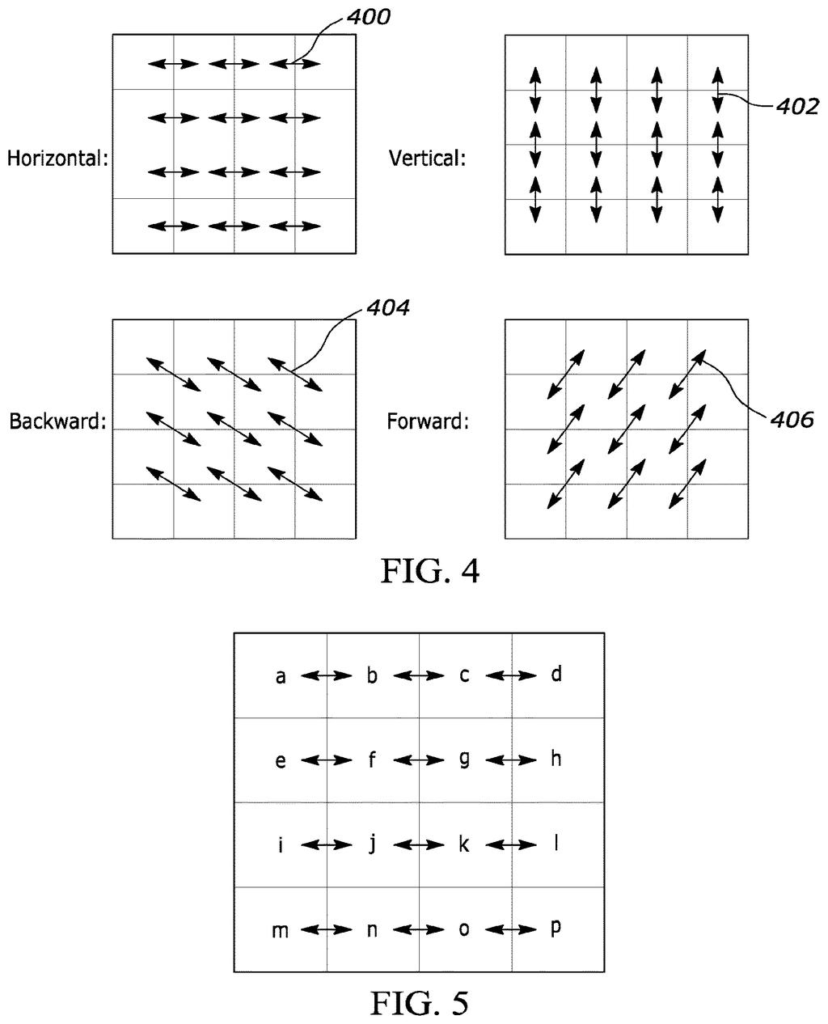
- Measure how much neighboring pixels differ along rows, columns and two diagonals, scaled to account for the different number of pixel pairs in each direction.
- Shortlist the partitions that follow the direction with the least change.
- Score each candidate by the color range in each zone, weighted by zone size, and keep the lowest score.
The description adds that min and max calculations are reused across candidates, and that transparency is ignored for fully opaque blocks.
Alpha contributions may be omitted for blocks in which all pixels are fully opaque.
Translation: Transparency data is skipped entirely when every single pixel in the image block is completely solid.
Why faster graphics compression matters to Sony
Most players will never see this, and that is the point. A faster compressor means less work to get a scene's graphics into a form that fits in memory and travels quickly, and the filing says keeping texture files small for transmission is the underlying goal.
The filing names game consoles such as PlayStation, VR and AR headsets and phones as example devices, and says the same method applies to related formats like BC6. Whether you ever notice depends on how good the model's guesses look next to a full search. The filing gives no quality numbers, so for now it is a promising speedup on paper.
Sony's 19th filing we've tracked since July in the GPU rendering race builds on work like cutting cloud lag and selective sharpening.
On the ship-path question, this one sits close to the finish line. It needs no new hardware. The output is still ordinary BC7 data, which graphics chips already know how to read, so only the compressing software changes. The filing even prints a working scoring snippet with a small table of weights.
What has to exist first is the homework: a large set of sample image blocks to train the model, and tuned shortlists of partitions for each direction. The shortest route to a product is a drop-in speedup inside an existing texture compression tool.
The open question is quality. The filing gives no numbers on how much worse a guess looks than a full search, so the verdict hangs on tests Sony has not shown here. As a pure software speedup, it is about as shippable as patents get.
Get our take in your Top Stories
Liked this breakdown? Add Patentlyze as a preferred source on Google, and our plain-English take shows up more often in your Top Stories the next time Sony patent news breaks.
There are more where this came from
We read every patent application Big Tech publishes and send you the ones worth knowing. Plain English, free, every week.
The drawings
15 drawing sheets from US 2026/0330690 A1 · click any drawing to enlarge


Show the other 7 sheets


Want this weekly breakdown for a company we don't cover? Patentlyze Pro →
Be the first to weigh in