
AMD Patents an AI-Driven Method for Compressing Game Textures
Game textures eat a surprising amount of GPU memory, and the compression methods the industry relies on are decades old. AMD is now exploring whether small neural networks can do that job better.
What AMD's texture compression patent actually does
Every texture you see in a game, a brick wall, a character's skin, a grassy hillside, has to be stored somewhere on your GPU. The industry has long squeezed those images down using fixed mathematical formulas to save space, but those formulas make tradeoffs that can blur or distort fine details. AMD wants to replace that fixed formula with a pair of small AI models that learn a smarter compression strategy for each texture.
The idea is that two lightweight neural networks work together. One predicts the outer bounds of the color range in a small patch of an image. The other predicts what the original colors in that patch actually looked like. Together they figure out the most efficient way to encode that patch without storing every pixel individually.
The result still saves storage, but AMD is betting the AI-learned approach preserves more visual quality than the old math-based rules, especially as textures get more complex and higher resolution.
Systems and methods for Neural Texture Block Compression (NTBC) of graphics textures using neural networks are disclosed. NTBC employs multi-layer perceptron (MLP) networks to map uncompressed textures to block-compressed formats, such as BC1 and BC4, achieving storage reductions while maintaining reasonable visual quality.
Translation: The system shrinks game textures using AI neural networks to save storage space without ruining the graphics.
How the two neural networks split the compression work
Standard GPU texture compression, like the BC1 and BC4 formats this patent targets, works by breaking an image into small blocks of pixels and finding a compact way to represent the colors in each block. It picks two color endpoints and then assigns each pixel an index saying how far along the line between those two endpoints it sits. The math is fast but rigid.
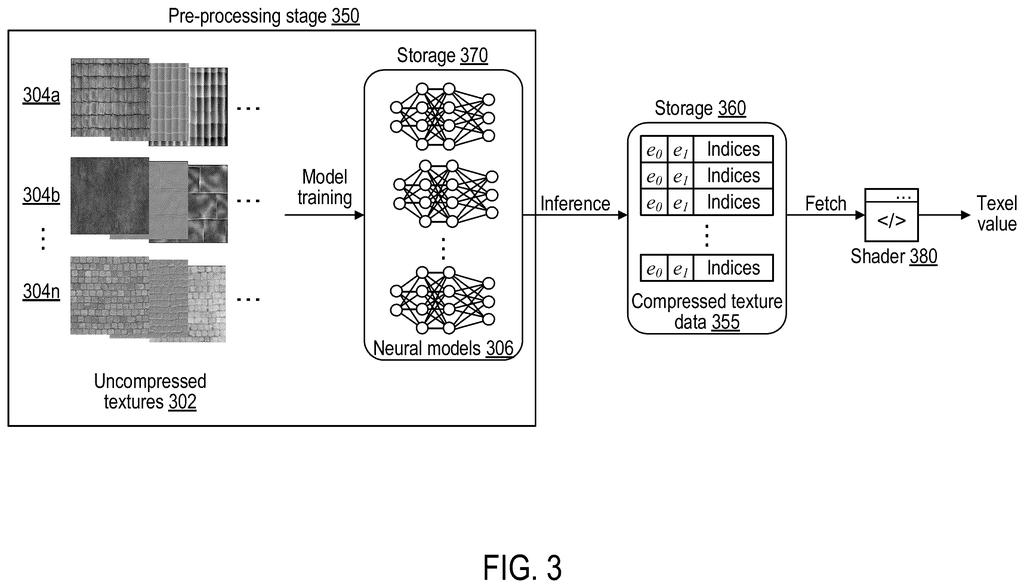
AMD's system swaps that rigid math for two multi-layer perceptrons (MLPs, meaning small neural networks made of stacked layers of simple arithmetic). The first, called the endpoint network, looks at a block of texture data and predicts the best two color endpoints for that block. The second, called the color network, predicts what the original uncompressed color at each pixel position should look like.
With both predictions in hand, the system calculates weight indices, which are the per-pixel codes that say how to reconstruct each color from the endpoints. Those indices are what actually gets stored as the compressed file, in a format any existing GPU can already read and decode.
To keep the neural networks small enough to be practical, AMD uses multi-resolution feature grids, a technique where the same scene is encoded at several levels of detail simultaneously, letting a tiny network punch above its weight by looking up pre-organized spatial information rather than learning everything from scratch.
executing, by processing circuitry, a first neural network configured to output a set of predicted endpoints for a given block of uncompressed data, the given block comprising a plurality of data points; executing, by the processing circuitry, a second neural network configured to output a predicted uncompressed value for each data point of the given block; …
Translation: Two separate AI networks analyze the data blocks to guess their original values and endpoints before compression.
What this means for GPU memory and game visuals
Texture memory is one of the tighter constraints in modern GPU design, and the compression standards that manage it, BC1, BC4, and their siblings, date back to the early 2000s. Games and applications keep pushing higher resolutions and more complex materials, so anything that extracts better visual quality from the same number of bytes is genuinely useful.
For you as a player or a developer, a better compression method could mean sharper textures at the same file size, or the same quality at a smaller download. The bigger question is speed: neural compression has historically been too slow to run in real time. AMD's use of very small networks and precomputed grids is an attempt to make the math fast enough to matter in practice, though the patent does not commit to specific performance numbers.
AMD's 12th filing we've tracked since June in the GPU rendering race follows earlier work on wrapping 3D objects for lighting and fast tasks waiting on slow ones.
Blurry textures, slow load times, and surfaces that look muddy up close are not minor annoyances. They are the visible cost of a decades-old compression standard that squeezes image data into a fixed box, trading quality for speed, because the alternative was running out of memory entirely.
AMD's approach uses two small, focused neural networks to do what that old standard does, but with better judgment about what the eye actually notices. The technical constraint of keeping the networks small matters here: a bloated system that takes minutes to process an image would solve nothing.
The meaningful question is whether this works fast enough to fit into how games are actually built and shipped, where asset pipelines are already long and any new bottleneck draws complaints. If it does, the payoff lands directly on players who notice when a game looks sharp.
There are more where this came from
We read every patent application Big Tech publishes and send you the ones worth knowing. Plain English, free, every week.
The drawings
6 drawing sheets from US 2026/0292217 A1 · click any drawing to enlarge


Want this weekly breakdown for a company we don't cover? Patentlyze Pro →
Be the first to weigh in