
Microsoft Files Patent for a Spreadsheet Checker That Flags Bad Entries Without Setup
Spot 'febuary' in a column of months and you've done what any person does by instinct. Microsoft's patent application describes software that learns that same instinct from other people's tables, so nobody has to write rules for yours.
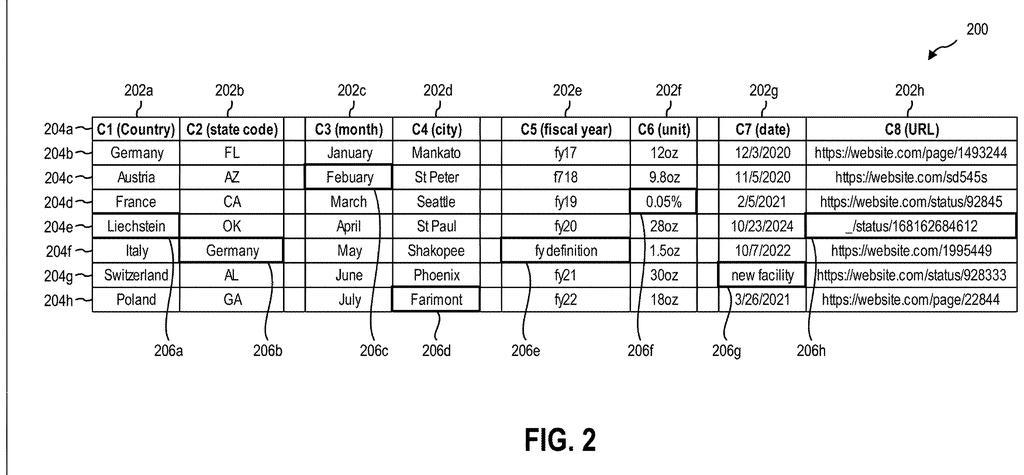
What Microsoft's spreadsheet error checker does
Ever scrolled down a column of months and spotted 'febuary' sitting in the middle? You caught it instantly, because you know what a month looks like.
Software usually needs someone to write that knowledge down as rules, one table at a time. A Microsoft patent application describes a way to skip that step. The system studies a huge pile of existing tables and works out what kinds of things usually live in a column: months, cities, dates, web addresses. Along the way it learns which values look out of place.
Later, when you open your own table, it checks each column against those lessons and highlights the suspicious cells. The filing also describes a small pop-up card next to a flagged cell that can offer a one-click fix, such as correcting a spelling.
generate a plurality of semantic-domain constraint candidates by applying one or more semantic column-type detection methods to columns of a plurality of training data tables, each semantic-domain constraint candidate specifying a domain type, a pre-condition, and a post-condition for identifying errors within an unlabeled column domain …
Translation: It automatically creates testing rules by analyzing columns in existing tables.
How it learns rules from tables across the web
The system works in two stages. First, offline, it studies a large collection of tables (the filing mentions spreadsheets, business-intelligence tables and CSV files, and assumes they are mostly error-free). It works out what each column holds, such as a city, a date or a URL, using up to four methods: trained classifiers, embeddings (numeric fingerprints of words, so 'January' and 'February' land close together), text patterns, and validation functions (like the checksum on a credit card number).
From this it builds candidate rules with three parts: a type, a pre-condition and a post-condition. The pre-condition says when the rule applies, for example when at least 80% of a column's values look like city names. The post-condition says what counts as an error, such as a value far from that type, like 'farimont'.
Most candidates are weak, so the system filters them:
- Drop rules that cause too many false alarms, judged by a statistical confidence estimate.
- Drop rules that trigger about as often on columns they cover as on columns they don't.
- Trim the rest, which can top 50,000 rules, to a set that applies to enough columns and stays under a false-positive limit.
Online, the surviving rules run against your table and rule-breaking cells are highlighted, with optional repair cards.
… generate a semantic-domain constraint corpus that detects data errors within columns of any data table, without requiring domain-experts to manually specify constraints on a per-table basis …
Translation: The system finds spreadsheet errors instantly without needing human setup.
Why cleaner spreadsheets need no expert setup
If you work with spreadsheets or dashboards, bad entries are a daily nuisance: misspelled cities, a country in a state column, half a web address. The filing's pitch is that error checking could work on a table you just opened, with no data expert writing rules for it first.
The design also aims for explanations you can follow. Each flag ties back to a plain idea, such as 'this column looks like months, and this value doesn't fit.' That is easier to trust than a verdict from a black box. The filing names spreadsheet and business-intelligence applications as the places where this kind of checking would live, though a patent filing is not a product announcement.
Microsoft's 555th filing in our Microsoft coverage since May continues a run that includes a patent on filtering dead-end searches and one on auto-titling meeting recordings.
Claim 1 leaves the detection technique open. It says 'one or more' methods for working out what type a column holds, and the dependent claims list four: classifiers, word-similarity, text patterns and validation checks. That gives the claim room to cover many different builds.
The narrowing comes from two filters and a visible result. A rule only makes the cut if it applies to at least a threshold number of training columns and its estimated false-alarm rate stays below a limit. The claim then ends with flagged cells shown differently from clean ones.
As written, the claim would cover a tool that learns rules from many tables, trims them on both counts, and highlights the culprits. A checker built purely on hand-written rules, or one that simply asks a chatbot to eyeball each cell, does not match the claim text. Verdict: a sensible, fairly specific recipe for a very common annoyance.
Get our take in your Top Stories
Liked this breakdown? Add Patentlyze as a preferred source on Google, and our plain-English take shows up more often in your Top Stories the next time Microsoft patent news breaks.
There are more where this came from
We read every patent application Big Tech publishes and send you the ones worth knowing. Plain English, free, every week.
The drawings
9 drawing sheets from US 2026/0329827 A1 · click any drawing to enlarge


Show the other 1 sheets

Want this weekly breakdown for a company we don't cover? Patentlyze Pro →
Be the first to weigh in