
Sony Files Patent to Keep Cloud Game Text Sharp on a Bad Connection
When your cloud game stream gets choppy, Sony's patent application would keep the words crisp and let only the picture go blurry. It splits text from scenery before the video is ever compressed.
What Sony's text-splitting patent does for streams
Every time your cloud game connection gets shaky, the whole screen goes soft, and that includes the words. Your health bar, the quest prompt, the subtitle explaining what a character just said: all squashed along with the scenery until you can't read any of it.
Sony's patent application describes a fix. Instead of treating the picture and the text as one blob, the game server builds them separately. The scenery gets squeezed hard to fit your slow connection. The text is sent untouched, or nearly so, as its own stream.
Your device then puts the two back together, laying the crisp text over the blurry picture. You'd still see a fuzzy game, but you could still read it. That matters a lot for players who rely on captions.
… identifying a first set of commands of the plurality of draw calls directed to rendering text for the image frame; identifying a second set of commands of the plurality of draw calls directed to rendering a scene for the image frame; …
Translation: The server separates instructions for drawing text from the instructions used to draw the background graphics.
How the server sorts text draw calls from scenery
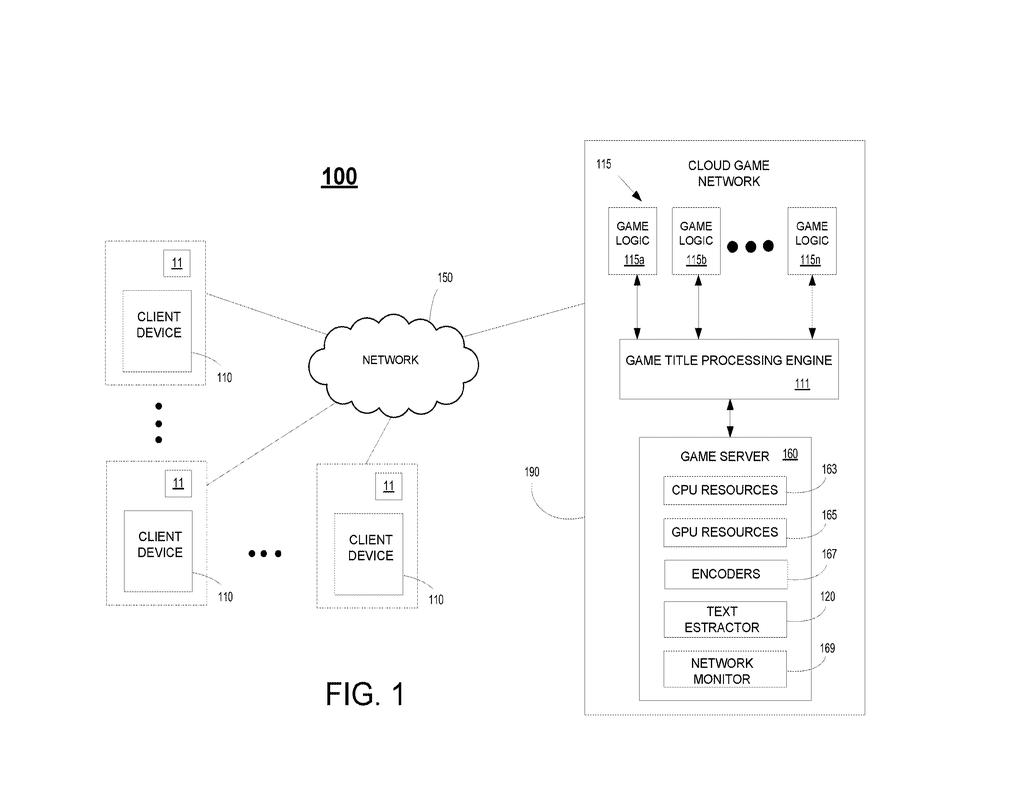
The patent covers a way to split one video game frame into two pieces on the server. When a game runs in the cloud, the game's main processor issues draw calls (instructions telling the graphics chips what to paint on screen). Some of those instructions paint the scene. Others paint text, such as a menu or status panel with words in it.
The system sorts those commands into two groups and renders each group on its own. They wait in separate lists, a text command buffer and an image command buffer. Only the rendered scene goes through the encoder (the software that compresses video so it can travel over the internet). The rendered text skips that step and stays unencoded.
The two are then streamed separately. The claims add several details:
- The system can watch connection quality and switch this mode on when a quality score falls below a threshold.
- Timing information, such as timestamps or frame labels, travels with both streams so the right text lands on the right frame.
- Your device decodes the scene and overlays the text on top.
The filing also describes training an AI model to spot which commands are drawing text. It says lightly compressed text is another option, and that the same idea could apply to any streamed video with on-screen text, including movies.
… generating an encoded scene by encoding the rendered scene. The method including separately streaming to a client device the text and the encoded scene.
Translation: The background video is compressed for streaming, but the text is sent separately without that lossy compression.
Why this matters for cloud gaming on bad Wi-Fi
On a shaky connection, a soft background rarely stops you from playing. Unreadable text does: you miss the objective, the item name, the warning. Sony's filing aims to protect that information first. Players who rely on captions, including the hearing-impaired players the description names, would benefit most.
The description frames this around cloud gaming, and it names PlayStation Remote Play as one way streamed images reach a phone or tablet. It also says the idea could apply to other streamed content with on-screen text, such as movies. The trade is extra work for the server, which has to sort and render two streams for each frame instead of one.
Claim 1 reaches wide. It covers any "application" running on a server, and it never mentions a weak connection. Any service that draws text apart from the scene and sends that text raw would match the wording. The bad-connection trigger shows up only in the follow-up claims.
The claim also draws a tight line with the phrase "remains unencoded." The description floats lightly compressed text as an option, yet claim 1 covers only text sent with no encoding at all. A server that lightly compresses its text would fall outside that sentence.
If granted, it would fence off one simple trick for cloud streaming: keep the words readable while the picture suffers. The idea is sensible and easy to picture. How much it would block depends on how many streaming services draw their text separately in the first place, and the filing doesn't say.
Get our take in your Top Stories
Liked this breakdown? Add Patentlyze as a preferred source on Google, and our plain-English take shows up more often in your Top Stories the next time Sony patent news breaks.
There are more where this came from
We read every patent application Big Tech publishes and send you the ones worth knowing. Plain English, free, every week.
The drawings
7 drawing sheets from US 2026/0315917 A1 · click any drawing to enlarge


Want this weekly breakdown for a company we don't cover? Patentlyze Pro →
Be the first to weigh in