
Samsung Files Patent for an AI Chip That Double-Checks a Car's Warning Alerts
When a car or robot flashes a warning and sounds an alarm, who confirms the alert actually showed up right? Samsung's filing hands that job to an AI chip already on board, instead of building a second copy of the warning hardware.
What Samsung's warning-alert checker actually does
A dashboard lights up with a red warning symbol and a loud chime. Somewhere inside the car, a small chip drew that symbol and played that sound. If that chip glitches, the symbol could go missing or show up in the wrong spot, and nobody would know.
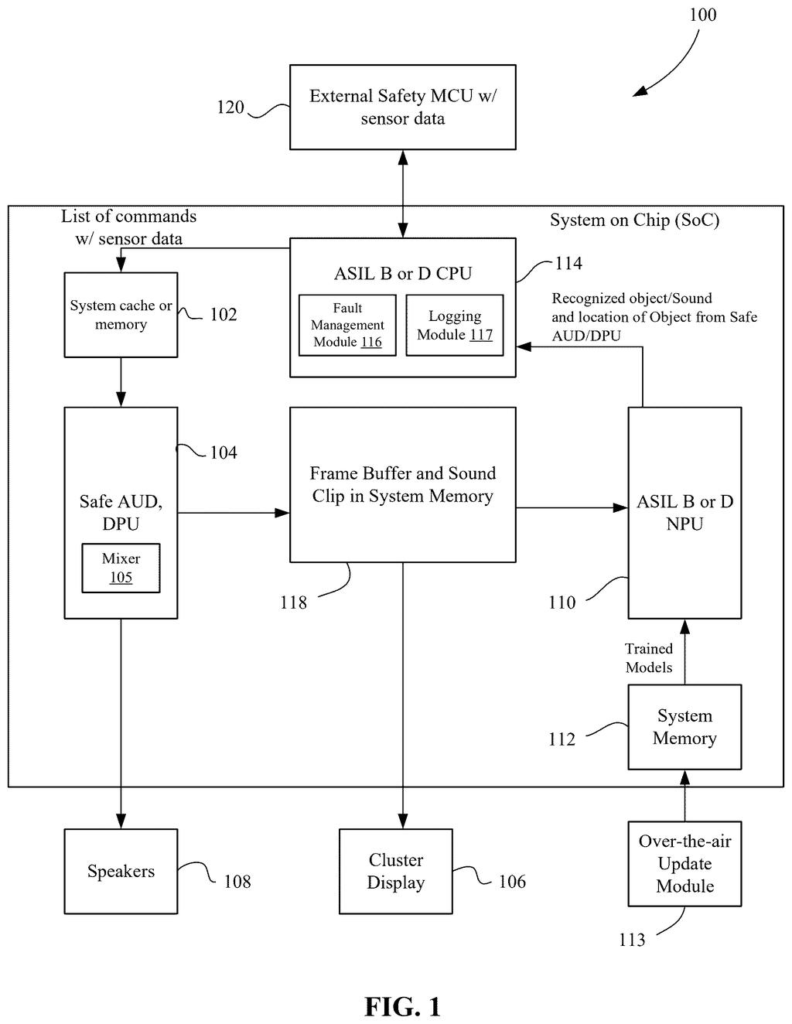
Samsung's filing describes a way to check the work. After the warning is drawn and played, the car captures a snapshot of the screen and a clip of the sound. An AI chip already inside the vehicle looks at them and decides what it sees and hears. A regular processor then compares that against what should have appeared.
If something is missing, extra or wrong, the system reports a fault and restarts the warning hardware. Samsung says this avoids the usual fix, which is building the whole warning system twice. That costs chip space, power and a lot of testing time.
… capturing output data, the output data including an output frame of the displayed safety warning sign and a corresponding sound clip of the safety warning sound from the safety warning sign and sound hardware; …
Translation: The system records what the car's screens and speakers actually put out.
How the AI chip and CPU catch a bad warning
The filing covers a method and a matching system for checking that a safety warning sign and sound came out correctly. It targets ASIL B and ASIL D, the two upper tiers of a car-industry safety rating (ASIL stands for Automotive Safety Integrity Level, and D is the strictest). Samsung also names robots, including humanoid ones, as a use.
The flow runs like this:
- A processor orders the display unit (DPU) and audio unit (AUD) to show a warning from a fixed, pre-approved set of symbols and sounds.
- The screen frame and the sound clip are captured into memory.
- A neural processing unit (NPU, a chip built to run AI models) runs a pre-trained model to recognize what appeared and what was heard.
- The CPU compares that result with what the outside sensors said should be shown. A mismatch triggers an error report and a reset of the display and audio hardware.
Because the symbols and sounds are fixed and clean, the filing says the model can be about 99.9% accurate, versus roughly 90% for recognizing real-world objects. The set and the model can be updated together over the air, and the filing suggests retraining while a car is parked or a robot is charging. The check is meant to finish within a single video frame gap (33.3 milliseconds at 30 frames per second).
A neural processing unit (NPU) processes the captured data using a pre-trained inference model generated from the safety warning set and valid sensor data.
Translation: An AI chip analyzes the recorded sights and sounds using pre-approved safety standards.
Why Samsung's checker could cut safety-chip costs
For you, the payoff is indirect: the warning that matters, like a collision alert or low energy light, is less likely to fail silently. For Samsung, the pitch is mostly cost. The filing says ASIL D can need roughly 100% extra chip area if you duplicate the hardware, and this approach adds none.
The filing is early in its life. The examiner's first review rejected the claims as filed, which is routine at this stage and usually followed by amendments. The idea mostly speaks to carmakers and robot builders choosing chips, and it shows how Samsung wants its automotive chips to meet strict safety rules cheaply.
Samsung's 12th filing we've tracked in the AI safety guardrails race since June follows voice assistant fact-checking and one checking its own health advice, adding another layer to the same idea.
Samsung's design skips a duplicate set of warning hardware and replaces it with an AI model that watches what the screen and speakers actually produce. That saves physical space and certification cost, but it means the safety check is only as trustworthy as the checking model itself.
The design hedges against that risk by keeping the library of warnings small and fixed, giving the model a narrow, well-defined job. A conventional processor holds the reference answers and makes the final call, which keeps the most critical judgment away from the AI layer.
The real cost shows up when a new warning symbol needs to be added. That triggers retraining, re-testing, and a software update pushed to vehicles already on the road. For a design meant to reduce complexity, that update path introduces meaningful new ways for things to go wrong, and whether the trade holds depends entirely on how rarely that library needs to change.
Get our take in your Top Stories
Liked this breakdown? Add Patentlyze as a preferred source on Google, and our plain-English take shows up more often in your Top Stories the next time Samsung patent news breaks.
There are more where this came from
We read every patent application Big Tech publishes and send you the ones worth knowing. Plain English, free, every week.
The drawings
6 drawing sheets from US 2026/0330474 A1 · click any drawing to enlarge


Want this weekly breakdown for a company we don't cover? Patentlyze Pro →
Be the first to weigh in