
Intrinsic's New Patent Covers Robots That Plan Their Own Calibration Paths
Before a robot arm can handle a load precisely, someone has to teach it a set of poses so it can figure out how heavy that load is. Intrinsic's patent application hands that chore to software and adds a promise: no wasted moves, and no collisions.
What Intrinsic's robot self-measuring patent does
Before a factory robot can handle a part precisely, it needs to know things like how heavy its load is and where that weight is centered. Today, finding out usually means a person nudges the robot around by hand and teaches it each pose to visit. The filing calls that process tedious, slow, and dependent on expertise.
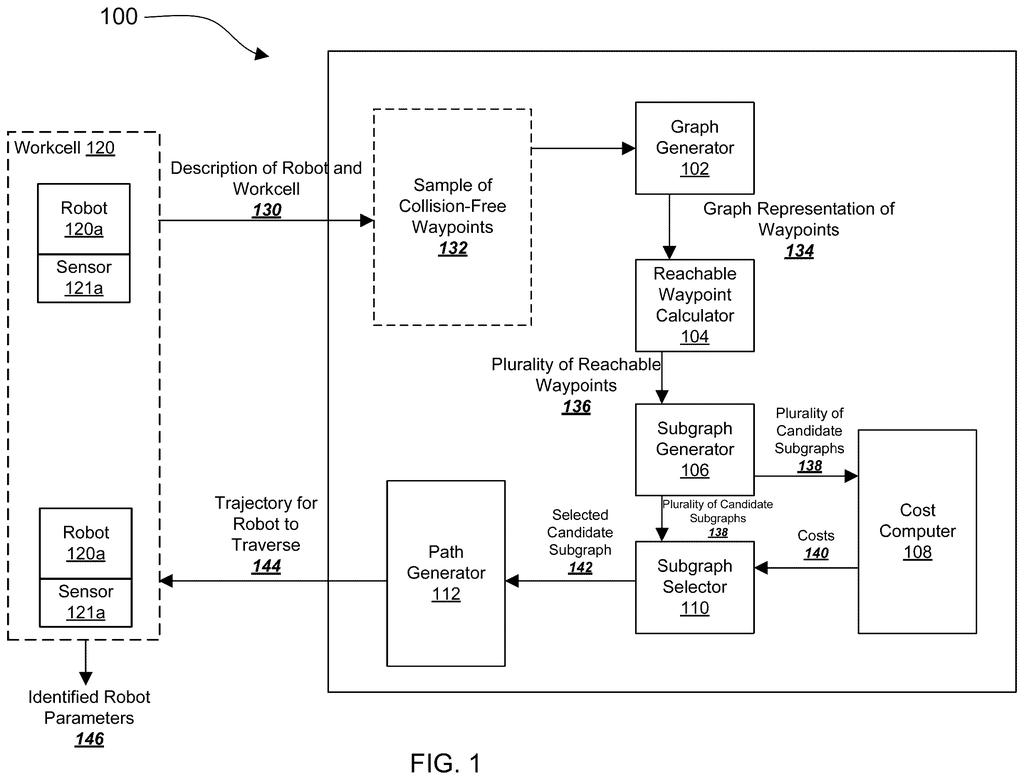
Intrinsic's patent application aims to automate the job. The software works out a long list of poses the robot can safely strike, then picks a short route through them that still gives enough information to do the math. The robot walks the route while measurements are taken, and its physical properties can be worked out afterward.
The short route matters. Visiting the same pose twice teaches the robot nothing new, so the plan aims to hit each pose once. It also accounts for the robot's surroundings, which the filing says earlier automatic tools could not do.
… computing a respective cost for each candidate subgraph of the plurality of candidate subgraphs, wherein the cost for each candidate subgraph is based on a measure of how informative the waypoints of the candidate subgraph are for solving for a plurality of robot parameters of the robot; …
Translation: The system scores each potential route based on how well its poses will help calibrate the robot.
How the system prunes and picks a robot path
The system starts by randomly sampling joint configurations (the angle of every motor in the arm, which together describe one pose) that do not hit anything. A user can add rules, such as keeping the tool inside a box in space. Poses that break a rule get nudged back into the allowed zone, or thrown out if that causes a collision. The filing's example sample is 100 poses.
Next it builds a graph: each pose is a dot, and two dots are linked if the robot can move between them without a collision or a rule violation. The system keeps only dots reachable from the starting pose within a maximum number of hops (the example uses three).
Then it prunes. It repeatedly drops the least-connected dot until a limit remains (15 in one example), and it checks quick conditions that must hold if a route can visit every dot exactly once:
- Every dot has at least two links;
- The graph is one connected piece;
- No single dot, if removed, would split the graph apart.
Each surviving candidate gets a cost: how far its size exceeds a minimum (the number of unknowns, such as four for mass plus center of mass), plus a score for how well its poses separate those unknowns (the log of a regressor matrix's condition number). The cheapest candidate goes to a traveling-salesperson-style solver. If no route exists, the next cheapest is tried.
… performing one or more pruning processes to generate a plurality of candidate subgraphs that each satisfy one or more linear-time solvability checks; …
Translation: It trims down the options quickly to find paths that are mathematically practical to compute.
Why this matters for factory robot setup time
For anyone setting up robot arms, the practical win is time. Working out a robot's load properties currently depends on a skilled person choosing the right poses. If software can do that choosing, with collisions already ruled out, setup could take less hands-on effort, and a smaller trip through poses means less time spent on the measuring itself.
The filing describes a measurement step that happens before a robot does its real work, which makes it plumbing for factories rather than a feature anyone would see. It is also early: the examiner's first review rejected the claims as filed, which is routine and usually followed by amendments, so the final scope could look different.
Google files its sixth patent we've tracked on our robot grasping and moving watchlist since August, adding to earlier work like a faster AI training approach and auto-programming factory robots.
Claim 1 is a long chain, and every link has to be present. It requires collision-free poses that satisfy the rules, a graph of those poses, a limit on how many hops away from the start a pose can be, pruning into candidate subgraphs that pass quick solvability checks, a cost based on how informative the poses are, a selection, and a final route. A rival that skips any one of those steps would sit outside this claim.
The broad part is the word choice. The claim says "robot parameters" in general, not just mass, and it sets no number for poses, hops, or candidates. The specifics, such as the three connectivity checks or the matrix-based score, only appear in the dependent claims.
If granted, it would cover automatic route planning for robot self-measurement that follows this exact recipe. It would not touch the manual teaching methods the filing complains about. It reads as a solid engineering filing with a well-defined target, useful for factory teams and unlikely to matter to anyone else.
Get our take in your Top Stories
Liked this breakdown? Add Patentlyze as a preferred source on Google, and our plain-English take shows up more often in your Top Stories the next time Google patent news breaks.
There are more where this came from
We read every patent application Big Tech publishes and send you the ones worth knowing. Plain English, free, every week.
The drawings
4 drawing sheets from US 2026/0316270 A1 · click any drawing to enlarge


Want this weekly breakdown for a company we don't cover? Patentlyze Pro →
Be the first to weigh in