
Samsung Files Patent for a Voice Assistant That Fact-Checks Its Answers Against Your Apps
Ask a voice assistant for the weather and it can show you one city while describing another. Samsung's patent application splits the job between two AI models and adds a checker so the words and the data agree.
What Samsung's two-model voice assistant does
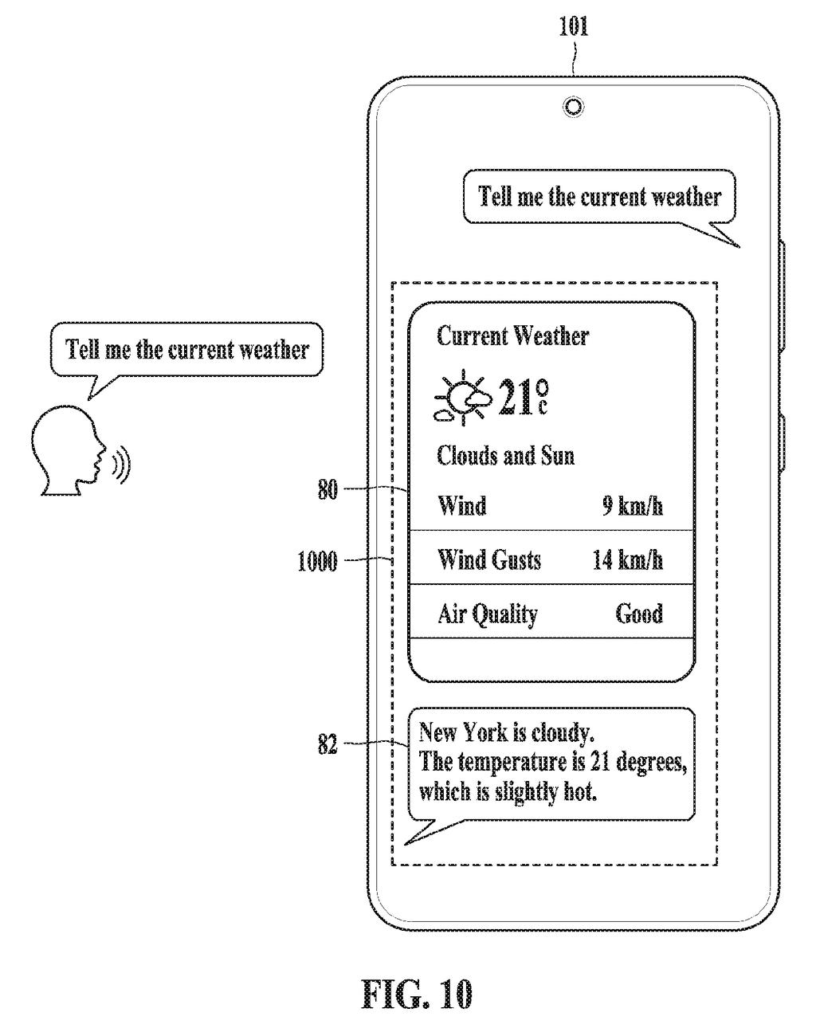
You ask your phone for today's weather. A forecast card pops up for Seoul, while the assistant's spoken answer describes Columbus, Ohio. One question, two answers, and they disagree.
Samsung's patent application describes a fix for exactly that. Instead of one AI doing everything at once, one model first works out which app to call and fetches the real information, such as a weather card. A second model then reads a text description of that card and writes the reply in plain words.
Because the wording is built from the app's actual data, the two halves should agree. A final checker compares them before you see anything, and sends the answer back for another try if they don't line up.
… generate a second prompt based on first data for invoking a function of an application related to the first prompt; and generate a natural language-based response to the user utterance by processing the second prompt using a first generative model …
Translation: The AI builds its reply by combining your voice command with information pulled directly from your device apps.
How the weather card becomes a spoken answer
The system starts with your request, either spoken or typed. Spoken requests are turned into text first. The software then builds a first prompt (the written instructions fed to an AI model) from your request, plus details about the apps it can call: each function's name, a description of its purpose, and instructions for when to use it.
One generative model (an AI that writes new text or data) reads that prompt and produces the data needed to call the right app function, such as a weather lookup. The app returns real information, for example a weather card image.
Next comes a neural network-based encoder (a trained AI component that converts one kind of data into another). It turns the app's image or audio into a text description. That description goes into a second prompt, along with format rules such as "two sentences or less." A model then writes the spoken or written reply from this prompt.
Finally, a verifier scores how well the reply matches the app's data and compares the score to a threshold. If it passes, you get the reply together with the app's data. If it fails, the model is told about the mismatch and tries again. The filing says the two models can differ in size, run in the cloud or on the device, or be sub-models of one larger model.
Why mismatched assistant answers are a real problem
Voice assistants are only useful if you can trust what they say without double-checking the screen. This filing goes after one specific failure: the spoken answer and the information from the app disagreeing. Its calendar example has the assistant reading back your actual schedule from your calendar app, instead of inventing plausible-sounding appointments, a failure the filing calls hallucination.
The filing does not name a product. It describes the pieces as software that can run on a phone, on a server, or split between them. It also says the model that writes your answer can be smaller than the one that picks the app, so it could run on the device itself while heavier work happens in the cloud. The filing leaves that design choice open.
Samsung's 11th filing we've tracked since July in AI models working in teams follows one on routing AI tasks and one on two-AI object training.
You would notice this fix by not noticing anything: the assistant's sentence and the card underneath it tell the same story. Anyone who has watched a voice assistant read out one city while showing another knows how fast trust drains after a mismatch like that.
The design adds work to every answer: a second model, a description step and a check. For a weather question that is a lot of machinery. Your calendar is where it pays off, since a wrong answer there can make you miss a meeting. The filing's own examples stay small, and it gives no numbers on how often the check catches errors or how much slower replies become.
The idea is sound and the benefit is easy to picture. Whether you ever feel it depends on whether Samsung can run all those steps fast enough that you never notice them.
Get our take in your Top Stories
Liked this breakdown? Add Patentlyze as a preferred source on Google, and our plain-English take shows up more often in your Top Stories the next time Samsung patent news breaks.
There are more where this came from
We read every patent application Big Tech publishes and send you the ones worth knowing. Plain English, free, every week.
The drawings
14 drawing sheets from US 2026/0310699 A1 · click any drawing to enlarge


Show the other 6 sheets


Want this weekly breakdown for a company we don't cover? Patentlyze Pro →
Be the first to weigh in