
AMD Patents a Tool That Turns AI Into Game Code Developers Can Edit
AI features inside games usually reach developers as a sealed box. This AMD filing covers a compiler that hands back readable, editable code instead.
What AMD's editable-code AI compiler does
Imagine you bought a sealed appliance and it started making a strange noise. You can't open the case, so all you can do is shake it and hope. The filing describes a similar situation for AI inside games: other AI compilers, it says, turn a trained model straight into opaque, locked-up data that nobody can review.
AMD's patent application describes a tool that opens the case. It takes a trained AI model and converts it into ordinary written code, in a language developers already use for game graphics.
Developers can then read that code, fix bugs, tune it for particular hardware, or make it work with other graphics code, all before it gets packaged into the game. Along the way, the tool also reshapes the model so it runs efficiently for how it will be used, such as live gameplay versus images created offline.
… generate user-modifiable source code representing the ML model based on the transformed representation.
Translation: It builds human-editable code out of the machine learning model's internal data.
How the compiler reshapes a model for games
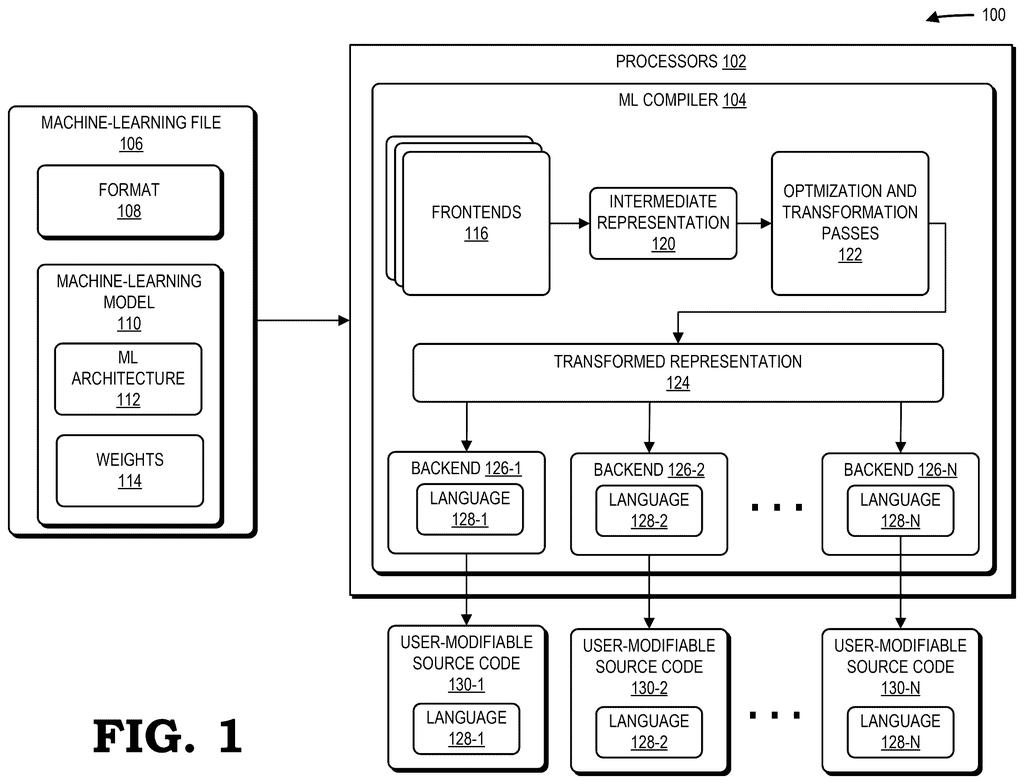
The tool is an ML compiler (a program that translates one form of a program into another). It starts with a file describing a trained AI model: its structure and its learned numbers, called weights. Different frontends handle different file formats, such as ONNX, a common open format for sharing AI models.
The compiler first builds an intermediate representation (a neutral, in-between version of the model). It lists the model's operators (math steps like addition, convolution and pooling) and its tensors (the grids of numbers passed between those steps). The claims say this step depends on the context where the model will run, and real-time graphics for games is the named example.
Next come optimization passes, which can include:
- Switching number types to smaller ones (like int8 or fp16) to save memory and processing
- Fusing two or more operators into one, so there are fewer trips to memory
- Setting aside memory buffers for the model's weights and temporary results
Finally, a backend writes human-readable source code from the result, for example in a high-level shader language (HLSL, a language for graphics programs). The filing also lists C, C++, GLSL and HIP, and one model can be output in several languages. A standard shader compiler then turns the edited code into the machine code that ships inside the game.
… performs one or more optimization and transformation passes on the intermediate representation to produce a transformed representation of the ML model.
Translation: It refines the model's inner structure so it can be converted into standard code.
Why readable AI code matters for game studios
If a tool like this reached developers, the practical effect would be more control. Some games use AI models to help draw frames, and the filing's examples include neural-network ambient occlusion (shading for places where light is blocked) and Gaussian splatting (a way to render 3D scenes). When one of those behaves badly, readable code lets a studio hunt down the problem instead of guessing at a sealed file.
For AMD, there is a hardware angle too. The compiler can tailor a model to the graphics chip it will run on, and developers can adjust the code further for specific hardware. That could make it easier for studios to get solid performance on AMD graphics chips, though the filing does not say whether AMD plans to release the tool.
AMD's ninth filing in the Enterprise AI work we've tracked since June follows earlier applications like one fixing audio gaps and one shrinking AI math headers.
This one sits close to shipping, because it needs no new hardware. It is all software: a program that reads a standard model file and writes ordinary code. The pieces it plugs into, including ONNX files, shader languages and the shader compilers that finish the job, already exist.
The shortest route to a product is a developer tool that studios run during game production, long before you ever press play. The hard work would be polish: handling many model types, producing code that people actually enjoy reading, and proving the optimized output matches the original model.
You would never see this directly. If it works, you might notice AI-assisted graphics that run well on more kinds of hardware and get fixed faster when they glitch. That is a modest payoff, but it is a believable one.
Get our take in your Top Stories
Liked this breakdown? Add Patentlyze as a preferred source on Google, and our plain-English take shows up more often in your Top Stories the next time AMD patent news breaks.
There are more where this came from
We read every patent application Big Tech publishes and send you the ones worth knowing. Plain English, free, every week.
The drawings
5 drawing sheets from US 2026/0349690 A1 · click any drawing to enlarge


Want this weekly breakdown for a company we don't cover? Patentlyze Pro →
Be the first to weigh in