
AMD Files Patent to Swap Out Audio Glitches With Freshly Generated Sound
A crackle in the middle of a song is over in a blink, yet your ear catches it every time. AMD's new filing describes AI that spots the glitch and swaps in made-up sound before it reaches your speaker.
What AMD's audio glitch patcher actually does
A song is streaming to a pair of earbuds, and for a split second the sound crackles. You barely register what happened, but you notice it. Tiny glitches like that can ruin a movie scene or make a word in a call impossible to understand.
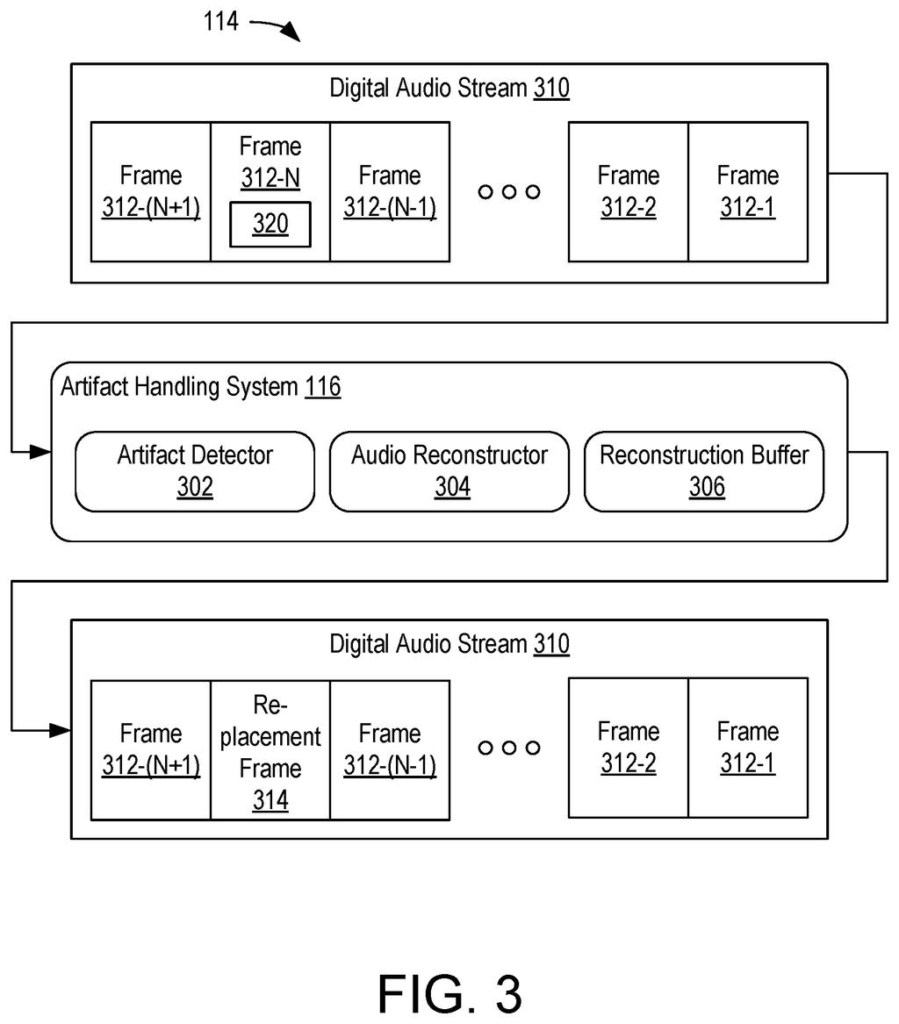
AMD's filing describes a fix that works while the audio plays. One AI model listens to each tiny slice of sound, about 5 milliseconds long, and flags the ones with a glitch. A second AI model looks at the roughly 20 milliseconds that came just before and writes a stand-in slice that carries on the same tone.
The bad slice gets swapped out before it reaches your speaker. The filing says the whole thing is built to run on small, low-power chips, so it wouldn't drain a battery or need a big computer behind it.
… detecting an audio artifact within the selected frame by processing the plurality of artifact detection features through a first machine learning model trained to detect audio artifacts; …
Translation: An artificial intelligence model scans the audio to spot glitches and unwanted noises.
How two AI models find and replace a bad slice
The claims describe a two-model loop that runs on audio as it streams. Audio arrives as a series of frames (short chunks of sound, about 5 milliseconds each in the filing's example). For every frame, the system pulls out two sets of numbers: detection features from the frame itself, and generation features from the audio that came just before it.
- The detector is a convolutional neural network (a model that is good at spotting patterns). It reads features such as MFCCs (a summary of sound shaped to how human ears hear), magnitude and phase spectra (how strong each pitch is, and how the sound waves line up in time), and entropies (how erratic the signal is). It outputs two probabilities: glitch or clean.
- The rebuilder is a generative LSTM (long short-term memory, a model that predicts what comes next in a sequence). It works from about 20 milliseconds of buffered audio, sometimes up to 40, and writes a frame that continues the same sound.
Whatever frame goes out, clean or replacement, is added to the buffer (the short memory of recent sound), so the next guess builds on what you actually heard.
The filing also covers where this runs. It can sit at the end of the audio chain or after individual steps, and copies can be switched on and off while audio plays. That lets the system track down which step is causing the glitches.
… a replacement frame is generated by processing the audio generation features through a second machine learning model trained to generate replacement frames.
Translation: A second AI model creates brand new sound to take the place of the glitchy audio.
Why glitch-free streaming audio matters to you
Audio glitches are easy to hear and hard to fix once sound is already streaming. The filing says the usual remedy, asking the source to resend a lost packet, can itself cause an audible hiccup, and hand editing by an audio engineer can't happen live. A fix that patches the sound on your own device could help streamed movies, music and calls on earbuds, speakers, TVs and laptops.
The detail AMD stresses is cost. The models are meant to need fewer clock cycles and less memory than older statistical methods, so they could fit on a small audio chip and spare battery life. For a chip company, that makes this a feature to build into hardware and drivers.
That makes this the eighth AMD filing in our Enterprise AI coverage since June, joining one on trimming AI data headers and one on screen-watching code writing.
The road from this filing to a working feature is short. The description treats it as a software step that slots into an existing audio chain and runs on the small audio processor many devices already have. On paper, no new hardware is needed.
What has to exist first is the training. Both models need plenty of recorded glitches and clean audio, and the filing gives no accuracy figures or listening tests. A repair that misfires and rewrites clean sound would be worse than the glitch it was meant to fix.
The shortest route to a product is a driver update or audio plugin on a computer that already hands sound to a separate audio chip. That looks doable. The open question is whether the patched sound holds up across the messy range of real music, speech and background noise.
Get our take in your Top Stories
Liked this breakdown? Add Patentlyze as a preferred source on Google, and our plain-English take shows up more often in your Top Stories the next time AMD patent news breaks.
There are more where this came from
We read every patent application Big Tech publishes and send you the ones worth knowing. Plain English, free, every week.
The drawings
5 drawing sheets from US 2026/0341292 A1 · click any drawing to enlarge


Want this weekly breakdown for a company we don't cover? Patentlyze Pro →
Be the first to weigh in