
Salesforce Files Patent for AI Assistants That Learn to Use Websites From Flawed Examples
Salesforce's patent application describes a way to teach AI assistants to use websites while ignoring the bad examples in their training data, including their own failed attempts. The goal is an assistant that can end up better than the examples it learned from.
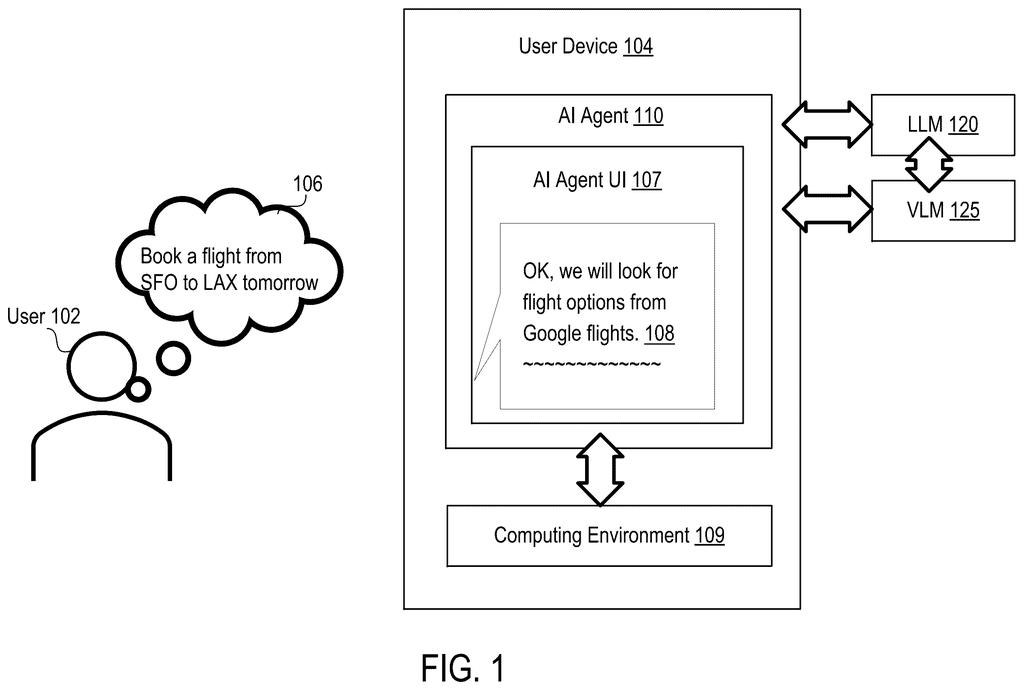
How Salesforce trains AI agents to click better
Right now, an AI that can look at a screenshot and click around a website has a surprisingly basic problem: it often can't phrase its move in the exact format the computer expects. Teaching it properly usually takes expert demonstrations, which are slow and expensive to produce.
Salesforce's patent application describes a different way to train these assistants. Instead of copying every example it sees, the AI gets a built-in second opinion that scores how well each choice is likely to turn out. Examples that look like bad moves get ignored, and the good ones get imitated.
That means the training pile can include sloppy attempts, even random ones, and the assistant can still end up better than the examples it learned from. When the examples are already excellent, the method behaves like ordinary training.
… computing a first loss based on a token distribution of the next-turn action and a filter that that masks action tokens according to the estimated return; iteratively updating the vision-language model based at least in part on a gradient of the first loss at the current turn …
Translation: The system updates its AI model by measuring mistakes and filtering out bad steps based on expected outcomes.
How the critic filters out bad clicks
The claims cover an AI agent that works in loops. You give it a task, such as booking a flight. On each turn it looks at a screenshot plus a text description of the current subtask, picks an action, and carries it out. The screen changes, and the loop repeats until the task is done.
Inside, a vision-language model (an AI that reads images and text together) encodes the screenshot and text into numbers, and a decoder turns those into hidden states, its internal working notes. The filing describes the decoder as a low-rank adapted Transformer (a big model tweaked by training only a small add-on). Two output heads sit on top:
- Actor head: proposes the next action, one token (a small chunk of text) at a time.
- Critic head: estimates the return, meaning how much reward the agent can expect after that action.
Training is where the filtering happens. The loss (the score of how far off the model was) counts only action tokens that the critic rates as better than average. Worse ones are masked out. A second loss teaches the critic using the real reward at the next turn plus an estimate for later turns.
Unlike standard offline RL methods, the training framework uses FSFT to surpass its demonstrations while remaining identical to SFT when data quality is high.
Translation: This training technique allows the AI to perform better than the human examples it learns from without failing when data is good.
Why cheaper agent training matters to Salesforce
If you've tried an AI assistant that fills out forms or navigates websites, you know the failure mode: it clicks the wrong thing, or answers in a format the software can't read. This patent application goes after that weak spot using cheap, messy training data, failed attempts included, in place of costly expert demonstrations. For a company selling AI agents to businesses, cheaper training could matter a lot.
The filing points to uses like customer service, IT support and healthcare, including an agent that spots a router failure and blocks suspicious traffic. A training method is invisible to you. What you would notice is an assistant that makes fewer wrong clicks. The filing's test results come from small research benchmarks, so real products are a separate question.
Salesforce's 26th filing we've tracked since May in our AI agents acting for you watchlist follows one letting AI inherit robot tasks and one flagging tasks running slow.
Screen-driving AI assistants have a costly problem: they learn from examples, and good examples take human experts a long time to produce. If every bad click in the training pile teaches the model to repeat it, collecting data gets expensive fast. Filtering out the bad moves attacks that cost directly.
The fix matches the size of the problem. The scoring step is a small addition to the model, and the filing says one base model is enough. When the examples are already excellent, the method behaves like standard training, so little is lost by trying it.
Scale is the open question. The filing's results come from small models and toy browser tasks, so it says little about how this holds up on a messy, real company website.
Get our take in your Top Stories
Liked this breakdown? Add Patentlyze as a preferred source on Google, and our plain-English take shows up more often in your Top Stories the next time Salesforce patent news breaks.
There are more where this came from
We read every patent application Big Tech publishes and send you the ones worth knowing. Plain English, free, every week.
The drawings
12 drawing sheets from US 2026/0350361 A1 · click any drawing to enlarge


Show the other 4 sheets


Want this weekly breakdown for a company we don't cover? Patentlyze Pro →
Be the first to weigh in