
IBM
IBM · AI / ML · Filed Apr 2, 2025 · USPTO published Oct 8, 2026 · Oct 8 release
IBM Patents an AI Assistant That Builds a New Tool for Every Request
IBM's patent has an AI assistant build a brand-new tool for every request, hide your login details from it, and double-check risky moves before they happen.
- Publication number
- US 2026/0310525 A1(US20260310525A1)
- Applicant
- International Business Machines Corporation
- Filed · Published
- Apr 2, 2025 · Oct 8, 2026
- Inventors
- Arn Hyndman, Nicholas Sauriol, John Christopher Lynk
- Status when we published
- Waiting for an examiner
- Document
- 20 claims
- US classification
- 719/328
What IBM's build-a-tool-per-request AI does
You ask your AI assistant to cancel a streaming subscription you stopped using. Behind the scenes, the assistant has to find the right company system, fill out a request in exactly the right format, and log in on your behalf. That's where things tend to go sideways: when an assistant has a huge number of tools to choose from, it can grab the wrong one or scramble the details.
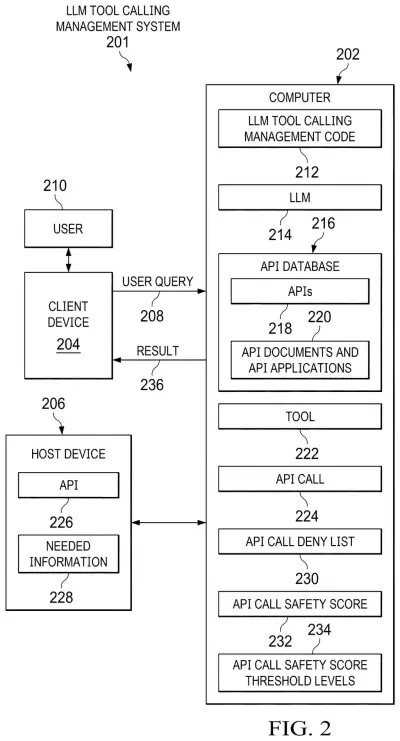
IBM's patent takes a different route. Instead of handing the assistant a giant toolbox, the system looks up the one service that fits your request and builds a single custom tool for just that job. The assistant never gets to see the login details. The system keeps those aside and adds them back only after a safety check passes.
If the request looks risky, the system stops and checks with you first. Cancel my subscription, for example, would trigger a quick confirmation before anything happens.
… generating, by the computer, a tool for a Large Language Model (LLM) to perform LLM tool calling based on the API specification corresponding to the specific API endpoint and method to achieve the goal of the user query and the API document that supports the API specification …
Translation: The system automatically creates a custom software tool for the AI based on the user request and technical documents.
How the tool gets built and safety-checked
When you ask an AI chatbot for something that needs live data or an action, the model has to call an API (a standard way for one piece of software to ask another for information or to do something). That process is called tool calling. Today each API usually needs a hand-written tool, and models get confused when the list of tools is long or complicated. They mix up parameters or format calls badly.
This patent swaps the hand-written tools for one generated on the fly for each request:
- The system searches a database of API specifications and documentation, using an embedding model (software that turns text into numbers so similar meanings can be matched), and the LLM ranks the candidates.
- It narrows the winner down to one endpoint and method (a specific address and action inside that API).
- It strips out login details and other confidential information from the specification.
- It generates a tool from that specification and its supporting document. The tool limits the model's output to match the specification.
Before anything runs, the generated call is checked against a deny list. If it isn't on the list, it gets a safety score: sensitive data types add set amounts, and the model's predicted chance of data loss adds more. A high score means rejection, a middle score means asking you, and a low score lets it proceed.
Only then does ordinary code put the login details back and make the call. The result is filtered for sensitive data before it reaches you.
What this means for AI assistants that act for you
If AI assistants are going to cancel accounts, look up records, or change settings for you, two things have to hold up: they must pick the right service, and they must not do damage when they get something wrong. Hand-writing a tool for every service limits how many an assistant can reach. Generating tools from the published instructions each service already has points toward assistants that can connect to far more of them.
The safety layer is the part you would feel most. Hiding your credentials from the model, scoring each call for risk, and pausing to ask you before a risky step all aim at the fear people have about assistants acting on their own. The filing doesn't name a product, so treat it as IBM's description of a design rather than a feature you can expect to see.
IBM's 60th filing we've tracked since May in the AI guardrails race, following one on speeding up gene analysis and one on tracing AI text origins, adds another patent application to the group.
Source: US 2026/0310525 A1 at the USPTO (PDF). Full patent text and figures are in the official publication.
Get our take in your Top Stories
Liked this breakdown? Add Patentlyze as a preferred source on Google, and our plain-English take shows up more often in your Top Stories the next time IBM patent news breaks.
Add Patentlyze on Google
One click.
There are more where this came from
We read the new patents from Big Tech, carmakers and more and send you the ones worth knowing. Plain English, free, every week.
The drawings · 8 sheets
8 drawing sheets from US 2026/0310525 A1 · click any drawing to enlarge


More from IBM
All 481 IBM patents →
More in AI assistant & agent
All 436 AI assistant & agent patents →
Microsoft
Microsoft Patents a System That Assembles AI Agents From a Plain-English Request
Nvidia
Nvidia Patents a System That Lets AI Assistants Organize and Run Their Own Tasks
Google
Google Patents an AI Assistant That Takes Photos When the Moment Is Right
Google
No comments yet