
IBM Patents an AI That Writes the Error-Catching Code Analysts Build by Hand
Checking a company's data for errors usually means paying an expert to write the checks by hand. IBM's patent describes an AI that drafts them from a plain description of what the data should look like.
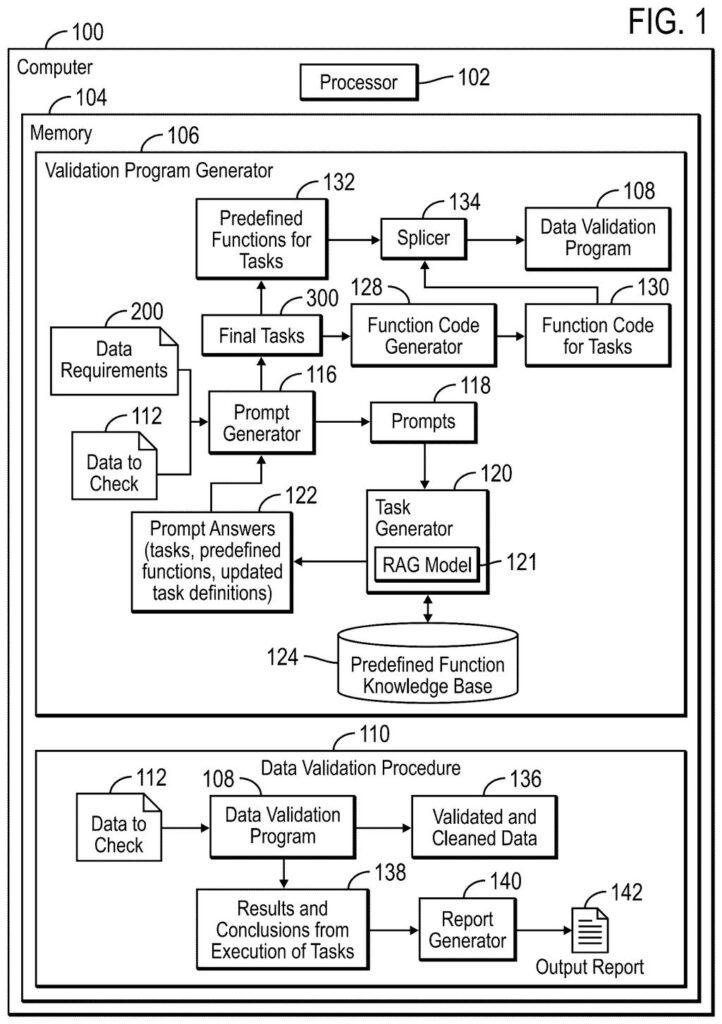
What IBM's AI data-checking program builder does
Right now, when a company wants to know its data is clean, it usually has to bring in a data scientist or a specialist in that type of data. That person studies the records, decides what needs checking, and builds a program to find and fix the mistakes. It takes time and expert help.
IBM's patent describes handing most of that job to AI. You tell the system what your data should look like: which fields are required, what format a name or address takes, what range a value can fall in. The AI turns that description into a to-do list of checks.
For each check, it looks in a library of ready-made tools first. If one fits, it uses it. If none does, a second AI writes the missing piece of code on the spot. Everything gets stitched into one program that runs on your data and produces a plain-language report.
… in response to determining that there is no predefined function in the predefined function knowledge base to perform the data validation operations of the second task plan, processing, by a function code generator, implementing artificial intelligence, the second task plan to generate function code to perform the data validation operations defined in the second task plan …
Translation: When existing code cannot handle a specific data check, the system uses artificial intelligence to write a brand new program to do the job.
How IBM's AI picks tools or writes new code
The system starts with data requirements: a description of the data to be checked, such as field names and types, required fields, encoding formats and logical value ranges. The filing's example covers an account name and an address, each with a name, type and short description.
A generative AI model (the same family as large language models, which write text from prompts) turns those requirements into task plans. Each plan has a task name, a description of how to run it, and its inputs and outputs. A prompt generator then asks the model a series of questions:
- Create task plans from the requirements.
- Check whether a ready-made function in a predefined function knowledge base can do each task. Retrieval augmented generation (RAG, where the AI looks things up in reference material instead of relying on memory) fetches those function descriptions.
- Update the plans to match the functions found.
- Merge plans that do the same thing, split plans that do several things into subtasks, and repeat until nothing changes.
Tasks with no matching ready-made function go to a separate function code generator, a second AI model trained on programming, which writes the code. A splicer then combines the ready-made functions and the new code, in order, into one validation program.
When run, the program checks and cleans the records, and a report generator writes a readable summary of whether each requirement was met and where the gaps are. The program can be saved and reused.
Why IBM's patent targets costly data cleanup
If this works as described, the people who own a messy pile of customer or account records could describe the rules in everyday terms and get a working checker back, without waiting on a specialist. The filing also mentions natural language interfaces meant to make it easier for non-technical users to work with the validation process, plus a report that spells out where the data falls short.
For IBM, it fits the business software world, where companies keep records in many formats and need them checked. Because the finished program is saved and reusable, one setup could check the same kind of data again and again. As a patent application, though, it describes a design, not a product you can buy.
IBM lands its 57th filing in the Enterprise AI patents we cover since May, adding to work like explaining AI word choices and grading a small AI's code.
Messy records are a daily headache for any large organization, and the filing itself says the usual fix is hiring a specialist to study the data and write the checks by hand. That costs time and expert hours, and it repeats whenever the data changes shape.
The approach fits the size of that problem well. Letting AI draft the checklist while proven ready-made tools handle what they already cover keeps the newly written code limited to the gaps. Saving the finished program for reuse and producing a plain report also match how companies actually work with their data.
The open question is trust. The filing does not say how anyone confirms that AI-written code catches every error. For a chore this routine, the idea is sensible and practical, and modest in ambition.
Get our take in your Top Stories
Liked this breakdown? Add Patentlyze as a preferred source on Google, and our plain-English take shows up more often in your Top Stories the next time IBM patent news breaks.
There are more where this came from
We read every patent application Big Tech publishes and send you the ones worth knowing. Plain English, free, every week.
The drawings
7 drawing sheets from US 2026/0349977 A1 · click any drawing to enlarge


Want this weekly breakdown for a company we don't cover? Patentlyze Pro →
Be the first to weigh in