
Nvidia · Filed Jul 14, 2026 · Published Nov 5, 2026

Nvidia Files Patent for Games That Watch Your Face and Adjust the Difficulty

Nvidia has filed a patent application for a game that watches your face, listens to your voice and checks your heart rate, then changes itself to match your mood. The twist is that it judges the same feeling differently depending on the type of game.
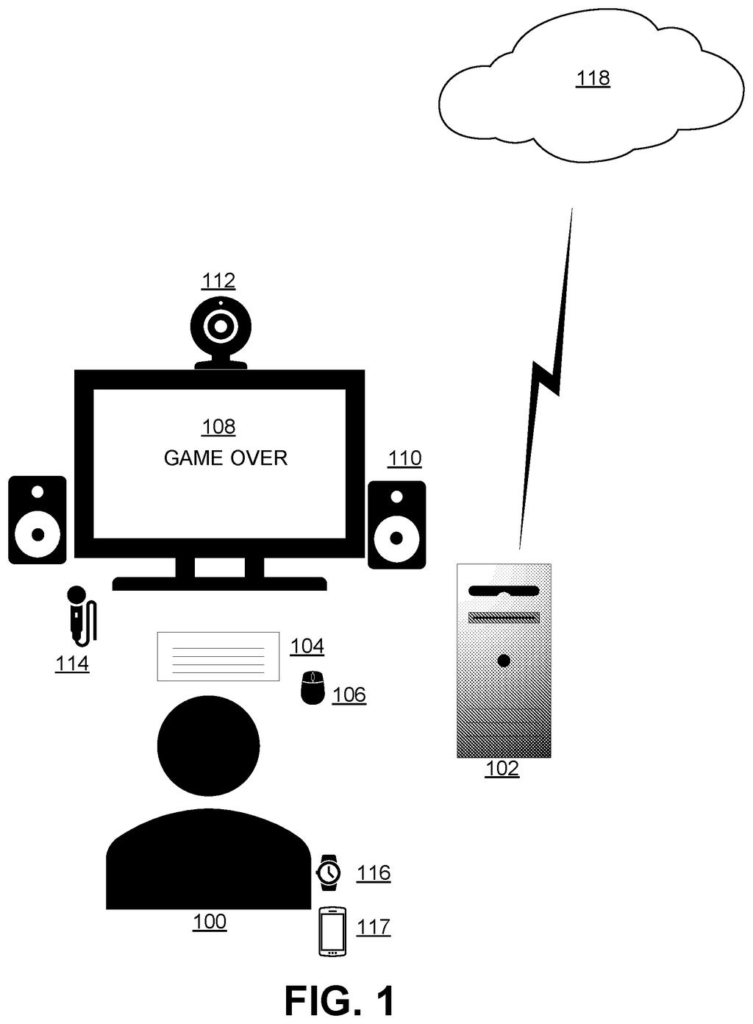
A player sitting at a computer setup with cameras and body trackers that monitor facial expressions to adapt a game in real time. Drawing from patent filing US 2026/0346145 A1.
A player sitting at a computer setup with cameras and body trackers that monitor facial expressions to adapt a game in real time.
See all 55 drawings from this filing ↓
Publication number US 2026/0346145 A1 US20260346145A1
Applicant NVIDIA Corporation
Filing date Jul 14, 2026
Publication date Nov 5, 2026
Inventors Jason Mawdsley, Nyle Usmani, Michael Janusz Woods
US classification 463/23
Status when we published Waiting for an examiner (Jul 31, 2026)
Parent application is a Continuation of 18225501 (filed 2023-07-24)
Document 20 claims

What Nvidia's mood-reading game patent does

Every time you die at the same spot in a game for the fifth time, the game stays exactly as hard as it was. It has no idea you are gritting your teeth.

Nvidia's patent application describes a way for a game to notice. A webcam can read your face, a microphone can pick up your muttering, and a fitness watch can report your heart rate. Software uses all of that to guess whether you are frustrated, bored or scared, then eases the difficulty or raises it.

The twist is that the same feeling gets judged differently depending on the game. Fear in a horror game is the point. Fear in a puzzle game is a problem, and the system is supposed to know the difference.

From the filing · CLAIM 1
use one or more neural networks to infer an emotional state of a user based, at least in part, on sensor data collected for the user during interaction with an output of one or more applications …

Translation: AI reads your facial expressions or bodily signals while you use software to guess how you feel.

How the system judges fear in different genres

The claims describe a processor that uses neural networks (software models trained on many examples) to infer a person's emotional state from sensor data collected while they use a game or other application. The filing lists facial expressions, sounds the person makes, and vital signs such as heart rate and breathing rate. It also mentions how fast and hard you press keys and move the mouse, plus gameplay history such as repeated failures at one spot.

Next, the system works out what type of application it is dealing with. That can come from metadata (a label naming the genre) or from a video or audio clip run through another neural network trained to tell types apart. The filing's examples are first-person shooter, adventure, puzzle and horror, each with its own emotion-reading network.

Then it changes the experience, differently for each type:

  • Frustration: lower the difficulty, possibly only after a set number of failures.
  • Boredom: raise the difficulty.
  • Too much fear: for example, turn up the light level so hidden enemies are visible and less startling.

Each emotion can get an intensity score that is compared with a threshold. The threshold can be set by genre, by the player's own preference, or by a neural network. Changes can happen with or without telling the player, and the work can run on the PC, a console or a server.

From the filing · THE ABSTRACT
… adjust one or more properties of one or more games based on an emotional state of a user …

Translation: The game automatically changes its behavior depending on your current mood.

What this means for how games get tuned to you

If this ever reaches a game, the practical result is a difficulty setting that adjusts itself to you. You get an easier stretch when you are stuck, more challenge when you are cruising, and scares left alone when scares are what you came for. For people who quit games over one brutal boss, that could be a real improvement.

It also raises questions. A camera, a microphone and a wearable would all need to feed a game while you play, so many players will want clear control over what is collected. Remember too that this is a patent application, so it describes an idea and not a product, and the filing gives no accuracy figures or test results.

Nvidia's 26th filing in voice and speech AI we've tracked since May follows one keeping text memory during speech learning and one cloning a sender's voice for texts.

Editorial take

The sensors this idea needs already exist in most homes: a webcam, a microphone, a fitness watch. The software side, like easing a game's difficulty when a player keeps failing, is something studios already build.

The hard part is a model that reads feelings accurately from a face and a heartbeat, and the filing offers no numbers on how well that works. A studio would also have to rebuild its game so that lighting, music, and challenge level can all shift automatically on cue.

The shortest path to a real product is probably an optional tool a player switches on by choice, running on their own computer. Nvidia makes the chips that would power those models, so the idea fits their business even if this document alone promises nothing you can buy.

Get our take in your Top Stories

Liked this breakdown? Add Patentlyze as a preferred source on Google, and our plain-English take shows up more often in your Top Stories the next time Nvidia patent news breaks.

There are more where this came from

We read every patent application Big Tech publishes and send you the ones worth knowing. Plain English, free, every week.

The drawings

55 drawing sheets from US 2026/0346145 A1 · click any drawing to enlarge

Sensors tracking a gamer to read their mood while playing, drawing sheet 1 from US 2026/0346145 A1
Sheet 1 Sensors tracking a gamer to read their mood while playing
Connecting facial cues to AI models matched to game styles, drawing sheet 2 from US 2026/0346145 A1
Sheet 2 Connecting facial cues to AI models matched to game styles
Steps for reading a player's emotions and adapting the game, drawing sheet 3 from US 2026/0346145 A1
Sheet 3 Steps for reading a player's emotions and adapting the game
Deciding whether a player's reaction warrants a difficulty change, drawing sheet 4 from US 2026/0346145 A1
Sheet 4 Deciding whether a player's reaction warrants a difficulty change
Chip components that handle gameplay and evaluate facial expressions, drawing sheet 5 from US 2026/0346145 A1
Sheet 5 Chip components that handle gameplay and evaluate facial expressions
Hardware setups for storing and processing emotional sensor data, drawing sheet 6 from US 2026/0346145 A1
Sheet 6 Hardware setups for storing and processing emotional sensor data
Teaching an AI model to recognize player emotions, drawing sheet 7 from US 2026/0346145 A1
Sheet 7 Teaching an AI model to recognize player emotions
Cloud servers that can run emotion analysis for online gaming, drawing sheet 8 from US 2026/0346145 A1
Sheet 8 Cloud servers that can run emotion analysis for online gaming
Show the other 47 sheets
Sensors placed around a self-driving car to track the environment, drawing sheet 9 from US 2026/0346145 A1
Sheet 9 Sensors placed around a self-driving car to track the environment
Fields of view covered by a self-driving car's cameras, drawing sheet 10 from US 2026/0346145 A1
Sheet 10 Fields of view covered by a self-driving car's cameras
Computing parts inside a vehicle that process sensor data, drawing sheet 11 from US 2026/0346145 A1
Sheet 11 Computing parts inside a vehicle that process sensor data
Cloud servers updating vehicle maps and AI driving models, drawing sheet 12 from US 2026/0346145 A1
Sheet 12 Cloud servers updating vehicle maps and AI driving models
Core hardware parts of a desktop computer, drawing sheet 13 from US 2026/0346145 A1
Sheet 13 Core hardware parts of a desktop computer
Internal chip layout for a touchscreen laptop or tablet, drawing sheet 14 from US 2026/0346145 A1
Sheet 14 Internal chip layout for a touchscreen laptop or tablet
Multiple parallel processors linked together to share memory, drawing sheet 15 from US 2026/0346145 A1
Sheet 15 Multiple parallel processors linked together to share memory
Plug-in USB accessory providing extra AI processing power, drawing sheet 16 from US 2026/0346145 A1
Sheet 16 Plug-in USB accessory providing extra AI processing power
Connecting multiple central processors and graphics chips together, drawing sheet 17 from US 2026/0346145 A1
Sheet 17 Connecting multiple central processors and graphics chips together
How an off-chip graphics accelerator hooks into the main processor, drawing sheet 18 from US 2026/0346145 A1
Sheet 18 How an off-chip graphics accelerator hooks into the main processor
Moving the graphics bridge inside the main processor chip, drawing sheet 19 from US 2026/0346145 A1
Sheet 19 Moving the graphics bridge inside the main processor chip
Routing graphics jobs directly from software into hardware, drawing sheet 20 from US 2026/0346145 A1
Sheet 20 Routing graphics jobs directly from software into hardware
Managing shared graphics jobs across multiple virtual machines, drawing sheet 21 from US 2026/0346145 A1
Sheet 21 Managing shared graphics jobs across multiple virtual machines
Letting multiple graphics chips access one unified memory pool, drawing sheet 22 from US 2026/0346145 A1
Sheet 22 Letting multiple graphics chips access one unified memory pool
All-in-one chip that combines cameras, video, and AI logic, drawing sheet 23 from US 2026/0346145 A1
Sheet 23 All-in-one chip that combines cameras, video, and AI logic
Internal layout of a graphics processor that renders 3D images, drawing sheet 24 from US 2026/0346145 A1
Sheet 24 Internal layout of a graphics processor that renders 3D images
Multiple graphics cores coordinated to divide up visual rendering work, drawing sheet 25 from US 2026/0346145 A1
Sheet 25 Multiple graphics cores coordinated to divide up visual rendering work
Graphics chip parts that render fine visual detail, drawing sheet 26 from US 2026/0346145 A1
Sheet 26 Graphics chip parts that render fine visual detail
Clustered processing sections linked together to run general computing jobs, drawing sheet 27 from US 2026/0346145 A1
Sheet 27 Clustered processing sections linked together to run general computing jobs
Connected components forming an entire computer to run adaptive software, drawing sheet 28 from US 2026/0346145 A1
Sheet 28 Connected components forming an entire computer to run adaptive software
Memory connections that feed visual data into parallel computing arrays, drawing sheet 29 from US 2026/0346145 A1
Sheet 29 Memory connections that feed visual data into parallel computing arrays
Memory buffer parts that finalize rendered visual frames for display, drawing sheet 30 from US 2026/0346145 A1
Sheet 30 Memory buffer parts that finalize rendered visual frames for display
Grouped rendering units that process scene geometry and surfaces together, drawing sheet 31 from US 2026/0346145 A1
Sheet 31 Grouped rendering units that process scene geometry and surfaces together
Internal layout of a processor that executes complex gaming calculations, drawing sheet 32 from US 2026/0346145 A1
Sheet 32 Internal layout of a processor that executes complex gaming calculations
Connecting multiple graphics chips directly to share heavy AI work, drawing sheet 33 from US 2026/0346145 A1
Sheet 33 Connecting multiple graphics chips directly to share heavy AI work
Internal engines that handle video decoding and rendering, drawing sheet 34 from US 2026/0346145 A1
Sheet 34 Internal engines that handle video decoding and rendering
Inside a processor that reorganizes instructions to run faster, drawing sheet 35 from US 2026/0346145 A1
Sheet 35 Inside a processor that reorganizes instructions to run faster
High-speed memory stacked around clusters of AI compute cores, drawing sheet 36 from US 2026/0346145 A1
Sheet 36 High-speed memory stacked around clusters of AI compute cores
Silicon circuits designed to mimic connected brain cells, drawing sheet 37 from US 2026/0346145 A1
Sheet 37 Silicon circuits designed to mimic connected brain cells
Complete computer setup linking the camera, sensors, and graphics chip, drawing sheet 38 from US 2026/0346145 A1
Sheet 38 Complete computer setup linking the camera, sensors, and graphics chip
Combining processor cores and graphics onto a single silicon chip, drawing sheet 39 from US 2026/0346145 A1
Sheet 39 Combining processor cores and graphics onto a single silicon chip
Specialized chips sending game images to a screen, drawing sheet 40 from US 2026/0346145 A1
Sheet 40 Specialized chips sending game images to a screen
Graphics chip parts that render 3D scenes and video, drawing sheet 41 from US 2026/0346145 A1
Sheet 41 Graphics chip parts that render 3D scenes and video
Multiple processing cores grouped inside a graphics chip, drawing sheet 42 from US 2026/0346145 A1
Sheet 42 Multiple processing cores grouped inside a graphics chip
Internal layout of an individual graphics execution block, drawing sheet 43 from US 2026/0346145 A1
Sheet 43 Internal layout of an individual graphics execution block
Components inside an execution unit running math calculations, drawing sheet 44 from US 2026/0346145 A1
Sheet 44 Components inside an execution unit running math calculations
Main processor routing tasks across multiple parallel clusters, drawing sheet 45 from US 2026/0346145 A1
Sheet 45 Main processor routing tasks across multiple parallel clusters
A processing cluster organizing shapes and visual effects, drawing sheet 46 from US 2026/0346145 A1
Sheet 46 A processing cluster organizing shapes and visual effects
Memory unit managing pixel data and high speed storage, drawing sheet 47 from US 2026/0346145 A1
Sheet 47 Memory unit managing pixel data and high speed storage
Inside the multiprocessor that executes parallel game instructions, drawing sheet 48 from US 2026/0346145 A1
Sheet 48 Inside the multiprocessor that executes parallel game instructions
Training and deploying medical AI from hospital image records, drawing sheet 49 from US 2026/0346145 A1
Sheet 49 Training and deploying medical AI from hospital image records
Software layers that manage AI models across chips and servers, drawing sheet 50 from US 2026/0346145 A1
Sheet 50 Software layers that manage AI models across chips and servers
Converting CT scan data into labeled anatomical images, drawing sheet 51 from US 2026/0346145 A1
Sheet 51 Converting CT scan data into labeled anatomical images
How live ultrasound data turns into screen images, drawing sheet 52 from US 2026/0346145 A1
Sheet 52 How live ultrasound data turns into screen images
Using AI to detect patient motion during scanner operation, drawing sheet 53 from US 2026/0346145 A1
Sheet 53 Using AI to detect patient motion during scanner operation
Refining pre-trained models with custom datasets and human review, drawing sheet 54 from US 2026/0346145 A1
Sheet 54 Refining pre-trained models with custom datasets and human review
Preparing raw scans into labeled training data using AI tools, drawing sheet 55 from US 2026/0346145 A1
Sheet 55 Preparing raw scans into labeled training data using AI tools
Browse all the drawings 55 drawing sheets
Patent filing page

Source. Full patent text and figures from the official USPTO publication PDF.
Reader comments

Be the first to weigh in

Start the discussion

Real name or a handle, either is fine. Comments are read by a person before they appear, so allow a little time. Keep it about the filing.