
Samsung Files Patent for a Voice Assistant That Checks the Weather Before Cooling Your Home
Tell your phone to 'make the house comfortable' and, under this Samsung filing, it first checks the weather outside, your usual settings and what 'comfortable' means before touching a single appliance.
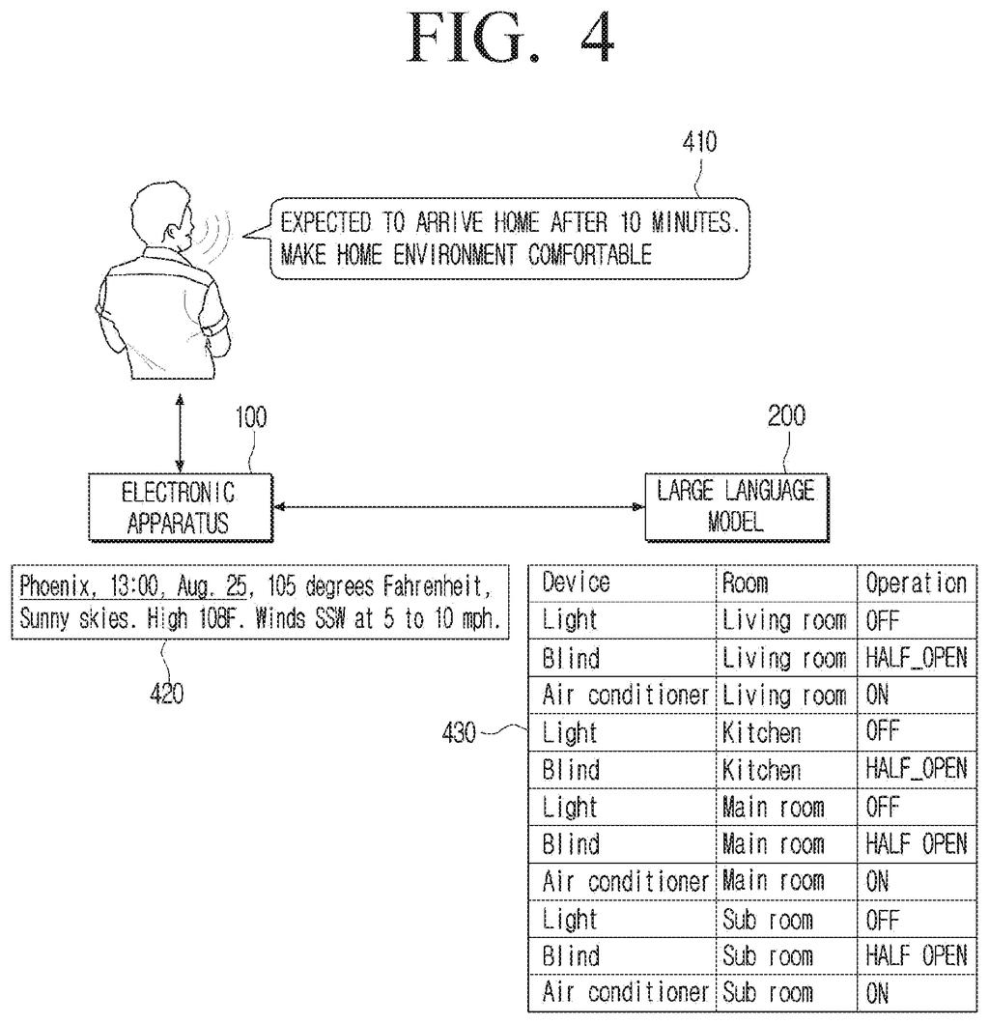
What Samsung's weather-aware home command does
Today, getting your smart home to do something useful usually means setting it up yourself. If you want the air conditioner to come on when it's hot, you open an app and type in the exact temperature that switches it on and off, then repeat the chore for every other device.
Samsung's filing describes a different route. You would just say something loose, like 'I'll be home in 10 minutes. Make it comfortable.' An AI model of the chatbot kind (a large language model) works out that it can't act on that alone, so your phone goes and gathers clues: the weather outside, what 'comfortable' usually means, and what you've chosen in the past.
With those clues in hand, the AI decides which devices to adjust and sends the commands. In Samsung's example, the weather lookup returns 105 degrees Fahrenheit in Phoenix, and that detail shapes what your home does before you walk in.
… acquire additional information related to the user speech when it is determined that the additional information required for performing an operation related to the user speech exists by inputting information about the user speech into a large language model …
Translation: The system figures out what extra details it needs by running your voice command through an AI model.
How Samsung's AI gathers clues, then acts
The claims cover a device with a microphone, a communication interface and a processor. In Samsung's drawings it is a smartphone, though a PC or wearable would also fit. When you speak a command, it first collects information about the relevant appliances, including a device list and each device's current state (such as on or off) from the home IoT server (the cloud service that manages your registered gadgets).
The device then sends your words to a large language model (the AI behind chatbots) to decide whether a specific command is possible. 'Set the house to 20 degrees' is. 'Make the home comfortable' is not, so the model asks for more information, which can come from three places:
- The model's own common sense, such as 23 to 25 degrees and 40 to 60 percent humidity counting as comfortable.
- The Internet, for outside conditions like the local weather.
- A user database, holding your preferred and recent settings.
The description says this lookup can repeat until nothing more is needed. The device then fills your words, the extra details and the devices' current states into a prompt template (a fill-in-the-blank instruction), sends that prompt back to the model, and gets a control command. The command is mapped onto an API (the standard way software talks to a home service) and sent out. The device can also show or speak a message telling you what it did.
… acquire a control command for controlling the at least one external device by inputting the prompt into the large language model, and transmit the control command to the at least one external device through the communication interface …
Translation: The AI then generates the final command to adjust your smart home gadget.
Why vague voice commands matter for your home
If this ever reached a product, you could skip building rules for every gadget in an app. You would say how you want the house to feel and let the system decide which air conditioner, humidifier or blind to adjust. The filing also says that pulling weather and history from the Internet and your own records removes the need for extra sensors.
Voice assistants have long handled exact commands well and fuzzy ones poorly, and this filing is built around the fuzzy ones. Samsung's drawings show an air conditioner, refrigerator and washing machine, and the text also lists robot vacuums, TVs, blinds and automatic windows. It is a patent application, so nothing here says a product is coming.
This is the 15th Samsung filing we've tracked since July in our AI agents watchlist, following virtual world fridge fix and screenshot coupon routing.
The cost here is control. A fixed rule does the same thing every time. A system that asks an AI to improvise from a vague sentence can guess wrong, and the filing offers only a message telling you what it did.
It also gives up some privacy and speed. To decide, the system looks up your local weather, reads your settings history and makes at least two trips to an AI model, which may sit on a remote server. That means more of your home's habits leaving the house, and more waiting between your words and a cooler room.
For everyday comfort tasks, where a wrong guess costs a few degrees, the trade looks worth it. It gets riskier for anything involving ovens or automatic doors, which the description lists as possible devices, and the claims do not say how those would be handled. The message back to you is the right safety valve, so the design earns a cautious yes.
Get our take in your Top Stories
Liked this breakdown? Add Patentlyze as a preferred source on Google, and our plain-English take shows up more often in your Top Stories the next time Samsung patent news breaks.
There are more where this came from
We read every patent application Big Tech publishes and send you the ones worth knowing. Plain English, free, every week.
The drawings
5 drawing sheets from US 2026/0341277 A1 · click any drawing to enlarge


Want this weekly breakdown for a company we don't cover? Patentlyze Pro →
Be the first to weigh in