
IBM Files Patent for Chatbots That Write to Suit Your Reader's Personality
IBM has filed a patent application for a chatbot that changes how it writes depending on who will read the message. In the filing's example, a conference invitation gets a different personality for recent graduates than for seasoned professionals.
What IBM's personality-matching chatbot does
Every time you send an email, you pick a voice for the person reading it. You are breezy with a friend, careful with your boss, and extra gentle with a coworker who takes feedback hard. Most AI writing tools skip that step and give everyone the same polished, middle-of-the-road tone.
IBM's patent application describes a way to teach a chatbot to make that call. You describe what you want written, and the system works out who it is for. It then matches that audience to personality traits such as openness or agreeableness, and each trait switches on a different style of writing.
The memory is the interesting part. If you tell the system a draft came out too bubbly or too stiff, it turns that trait up or down for next time, so the writing slowly drifts toward what you actually wanted.
… a trait component that identifies an at least one trait associated with a user profile and maps a trait to a corresponding parameter …
Translation: The system reads a user profile to figure out their personality traits and turns those into chatbot settings.
How IBM turns personality traits into dials
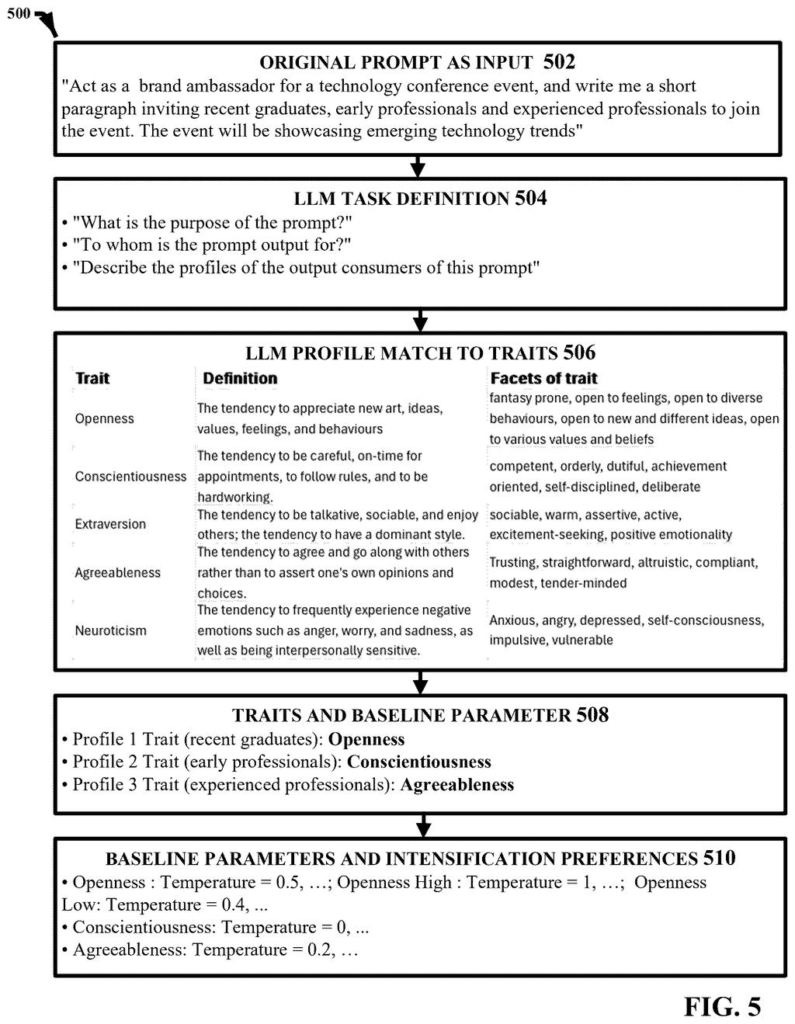
The system starts with a prompt that describes a task, usually in plain language. In some versions, the language model (the AI that writes the text) first turns that request into a task definition: what the task is, the background, who the message is for, and how strongly each trait should show.
Next, a trait component looks at a user profile, which can hold communication preferences, personality traits, and habits inferred from past use. It picks traits from a predefined list and maps each one to a parameter, a value that shapes tone, formality, wordiness, or sentiment. The filing says these parameters can be model settings such as temperature (a dial for how predictable or adventurous the word choices are), top-p and top-k sampling, or a repetition penalty.
The filing's worked example is an invitation to a technology conference aimed at three groups:
- Recent graduates: mapped to openness, with a default temperature of 0.5 for imaginative language.
- Early professionals: mapped to conscientiousness, with a temperature of 0 for structured, goal-focused writing.
- Experienced professionals: mapped to agreeableness, with a temperature of 0.2 for a warmer, cooperative tone.
Finally, a feedback component collects ratings, behavior signals, or corrections. The customization component uses them to intensify or reduce a trait, and the filing says it can even adjust settings mid-response to keep the writing consistent.
… a generation component that provides the prompt and a parameter to a large language model to generate an output …
Translation: It feeds your request and those personality settings into the AI to create a tailored response.
Why IBM's patent matters for your inbox
If this ever shows up in a writing assistant, you could stop rewriting AI drafts so they sound like a person who knows the room. One request, such as an invitation, could come out in different versions for different readers. The filing does not name a product, so that is a picture of the idea, not a plan.
For any company that sells writing tools, the draw is easy to see: customer emails, memos, and announcements that adapt to who is reading. The filing also says a profile can build up from past interactions, which means the system would be learning things about you over time. That makes the personalization useful and the privacy question real.
IBM's 49th filing we've tracked in AI assistant & agent patents since May adds to a run that includes scoring how you prompt and controlling search depth before answering.
The big trade here is nuance for simplicity. Boiling a person down to a trait, and a trait down to one dial, is easy to build and easy to explain, but people are messier than that. The filing's own example pairs recent graduates with openness and experienced professionals with agreeableness, a tidy assumption that plenty of real readers would break.
The main dial the filing names, temperature, controls how predictable word choices are, and it is a leap to assume that reliably produces warmth or formality. The feedback loop has to fix whatever the first guess gets wrong.
There is also a data cost. A profile that tracks your personality and habits is useful and also sensitive. The trade reads as worth making for low-stakes writing like invitations, and shakier anywhere a wrong guess about a person could sting.
Get our take in your Top Stories
Liked this breakdown? Add Patentlyze as a preferred source on Google, and our plain-English take shows up more often in your Top Stories the next time IBM patent news breaks.
There are more where this came from
We read every patent application Big Tech publishes and send you the ones worth knowing. Plain English, free, every week.
The drawings
6 drawing sheets from US 2026/0349810 A1 · click any drawing to enlarge


Want this weekly breakdown for a company we don't cover? Patentlyze Pro →
Be the first to weigh in