
Microsoft Files Patent for Storing Idle Chatbot Conversations on Lower-Cost Hardware
Microsoft has been granted a patent on a way to shelve your paused AI chat in cheaper storage instead of throwing it away, so the AI can pick up where you left off.
What Microsoft's chat-memory shelving does
Ever left a long chat with an AI assistant, then come back an hour later? Behind the scenes, the computer has to decide what to do with everything you've said so far. Microsoft has now been granted a patent on one answer to that question.
Normally, to reply, the AI first reads your whole conversation and builds a set of working notes (the filing calls it a KV cache). Those notes sit in the fastest, priciest memory on the server chip. When you go quiet, that space gets reclaimed and the notes are lost. Come back, and the AI has to rebuild them from scratch before it can answer.
Microsoft's fix: after you've been idle for a set wait time, move your notes to cheaper, slower storage instead of deleting them. When you return, copy them back. Only if they're gone everywhere does the system redo the work.
… determine whether a key-value (KV) cache corresponding to a user associated with a session exists in the lower tier memory, and (2) if the KV cache, or a portion thereof, does not exist in the lower tier memory, upon determining that at least a portion of the KV cache exists in the higher tier memory, load at least the portion of the KV cache into the lower tier memory.
Translation: It checks if past chat data is in cheap storage and moves it to fast memory when a user returns.
How a returning chat gets its notes back
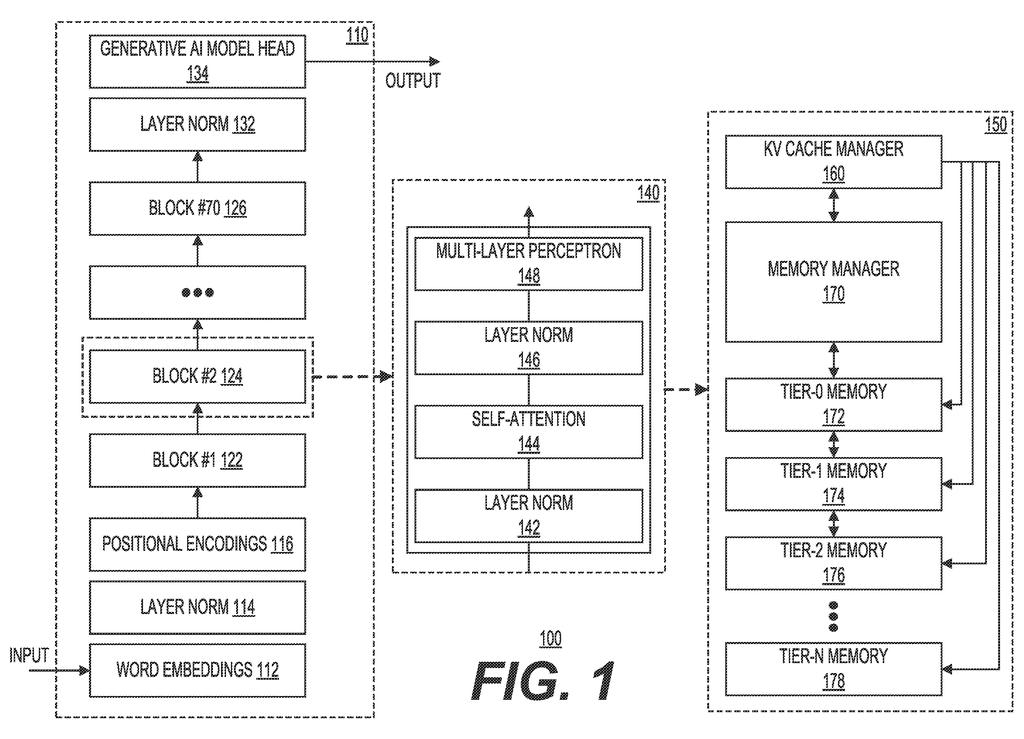
The patent covers a manager program that looks after a conversation's KV cache (short for key-value cache: the working notes an AI model builds from your messages so it doesn't reread everything for each new word). These notes grow as the chat gets longer, and they take up space in high-bandwidth memory (HBM, the very fast and costly memory sitting next to the AI chip).
When you resume a session, the system follows a checklist:
- Look for your notes in the fast memory.
- If they're missing, look in the slower, cheaper tiers (such as ordinary server RAM or a shared pool) and copy whatever is found back.
- If nothing is saved anywhere, run an extended prefill (reprocessing the earlier conversation to rebuild the notes), then produce the reply one small piece of text (a token) at a time until a stopping point is reached.
After you go quiet for a set wait time, your notes are off-loaded to a cheaper tier. The filing's examples go up to four tiers, ending with shared solid-state drives. Bookkeeping tables track which blocks of notes belong to which user, only blocks missing from the cheaper tier get copied (which saves bandwidth), and when you return, the tables for every tier are searched at the same time. Standard rules like least recently used decide what gets pushed out first.
Why Microsoft's idle-chat storage matters
If you use an AI assistant, the pause before the first word appears is the delay you feel. Rebuilding a long conversation from scratch makes that wait longer, and keeping every idle chat in premium memory is wasteful. Shelving sessions in cheaper storage could let a service answer returning users faster while handing the costly memory to people typing right now. The filing mentions chatbots, programming assistants and copilots, and says the same idea works for image and video sessions.
This is already a granted patent, and the final granted claims may read a little differently from the published application described here.
This is the 19th Microsoft filing we've tracked since June in our AI assistants that remember you watch, following the late-meeting briefer and the screenshot Q&A.
Every shortcut here has a price. Cheaper memory is slower, so a returning user gets their notes back faster than a full rebuild but not as fast as if the chat had never been shelved. The system also needs extra bookkeeping: tables for each tier, updates whenever blocks move, and a search across all of them when someone comes back. More moving parts means more places for a mix-up to slow a reply.
There is also a plain storage cost. Your saved notes are a working record of your conversation, and they now sit around on cheaper drives for longer than they would have before. The filing says nothing about how long they stay, so that remains an open question.
Still, the trade looks worth it. Waiting through a rebuild every time someone returns to a chat is a bigger cost than a little extra copying and tracking, and the idea is simple enough to apply to any chat service that serves many people at once.
Get our take in your Top Stories
Liked this breakdown? Add Patentlyze as a preferred source on Google, and our plain-English take shows up more often in your Top Stories the next time Microsoft patent news breaks.
There are more where this came from
We read every patent application Big Tech publishes and send you the ones worth knowing. Plain English, free, every week.
The drawings
11 drawing sheets from US 2026/0339841 A1 · click any drawing to enlarge


Show the other 3 sheets


Want this weekly breakdown for a company we don't cover? Patentlyze Pro →
Be the first to weigh in