
Google Patents an AI Assistant That Reschedules Your Smart Home Routines to Save Energy
Google is patenting a version of its AI assistant that watches your smart home routines and proactively suggests better times to run them — not for your convenience, but to lower your energy bill.
What Google's energy-aware assistant actually does
Imagine you've set up a Google Home routine that runs your dishwasher, turns on the porch lights, and cranks the thermostat every evening at 6 p.m. That's convenient, but it might also be hitting your power grid — and your wallet — at the worst possible time.
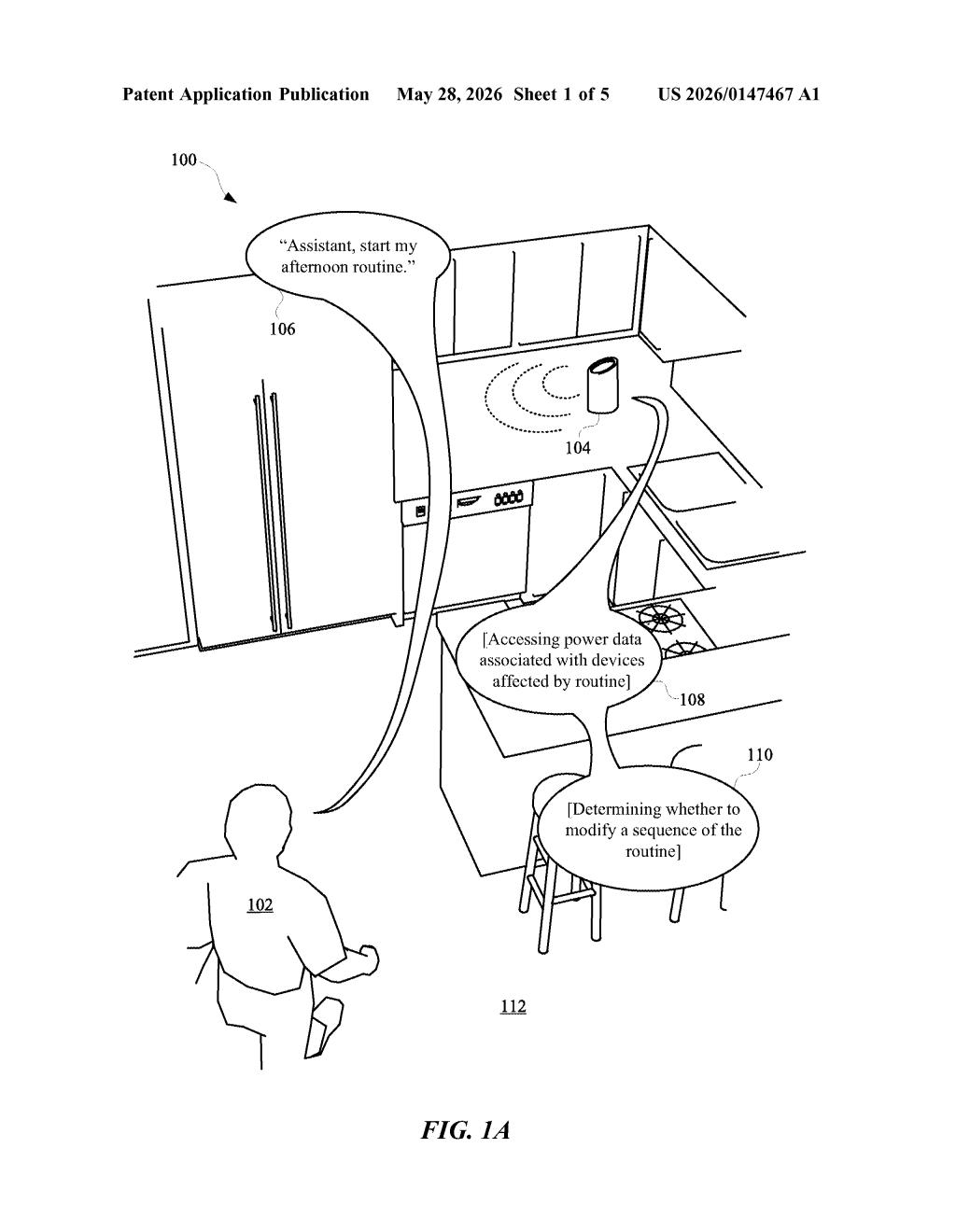
This patent describes an assistant that monitors available power data (think real-time electricity pricing or grid load) and figures out that running those same tasks at 9 p.m. would cost you less. Instead of silently rescheduling things on its own, it surfaces a plain-language suggestion: "Hey, running the dishwasher at 9 p.m. tonight would use less energy — want me to shift it?"
The key idea is that you stay in control. The assistant does the legwork of spotting the cheaper window and explains it in everyday language, but you decide whether to act on it. No digging through energy dashboards or manually setting timers required.
How the assistant picks the lowest-energy time to act
The patent describes a three-step process running on one or more processors:
- Identify the operations: The assistant first figures out which smart networked devices (lights, thermostats, appliances, etc.) are involved in a given routine and what commands control them.
- Estimate energy consumption: For each operation, it calculates an anticipated energy consumption — a forward-looking estimate of how much power that action will draw. This is based on available power data, which could mean real-time utility pricing signals, time-of-use tariff schedules, or grid demand metrics.
- Find the lower-cost window: It then determines whether initializing that operation at a different time would result in lower anticipated energy consumption.
- Suggest it in plain language: If a better window exists, the assistant generates a natural language suggestion — a human-readable nudge telling you what to do and when — and renders it as an output (likely a voice prompt or a notification).
The patent also covers the assistant inferring that a user cares about saving energy based on prior behavior, and using that to proactively surface relevant routines or triggering conditions, even ones the user hasn't explicitly set up.
What this means for smart home energy bills
For most people, smart home automations are set-and-forget. The problem is that electricity prices aren't static — time-of-use pricing is increasingly common, and running a dishwasher at peak demand hours can cost meaningfully more than running it at midnight. This patent is Google's attempt to make its assistant close that gap without requiring users to become amateur energy analysts.
If this ships into Google Home or a future Gemini-powered assistant, it could give utility-connected smart homes a genuine cost-saving edge. It also positions Google's assistant layer as a kind of energy broker sitting between you, your devices, and your power company — a role that has real strategic value as smart grid integrations become more common.
This is a practical, well-scoped idea that solves a real problem: people have smart home devices but lack the time or knowledge to optimize them for energy savings. The natural-language suggestion layer is the right call — autonomous rescheduling without consent would frustrate users fast. Whether this actually ships in a meaningful way depends on how broadly Google can pull in real-time utility pricing data, which is the hard part.
There are more where this came from
We read every patent application Big Tech publishes and send you the ones worth knowing. Plain English, free, every week.
Want this weekly breakdown for a company we don't cover? Patentlyze Pro →