
Google Patents a Faster AI Text Editor That Keeps What Works and Fills In the Rest
Most AI writing tools throw out your sentence and write a new one from scratch. Google's latest patent describes a system that decides which words are worth keeping first, then fills in the gaps, cutting the time it takes to rewrite text.
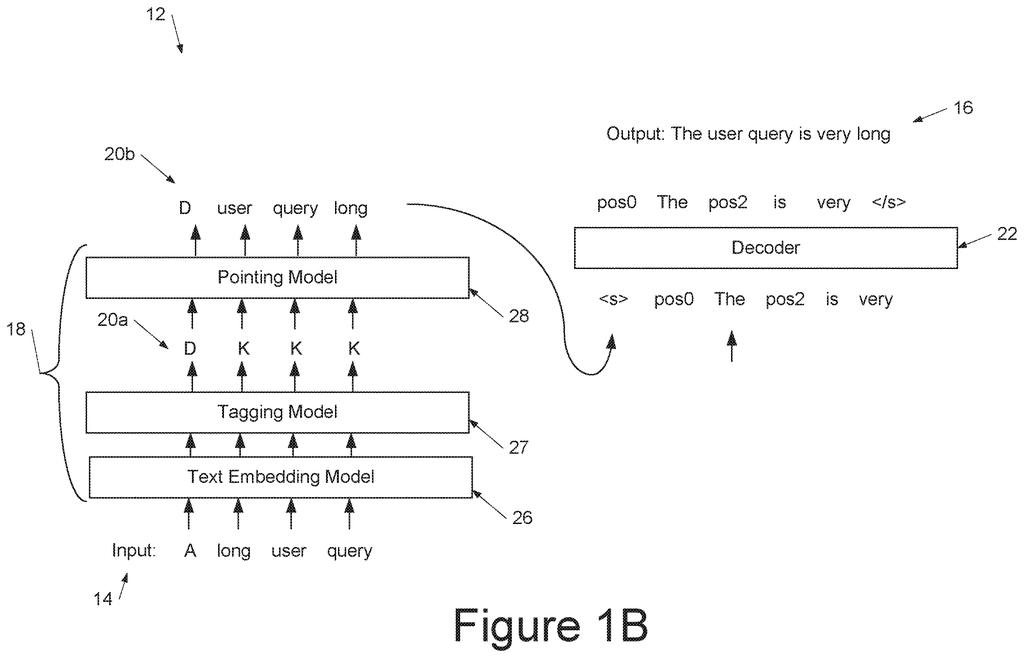
What Google's hybrid text-editing AI actually does
Imagine you hand an AI a rough sentence and ask it to clean it up. Most AI systems today essentially ignore what you wrote and generate a brand-new sentence word by word, which takes time. Google's patent describes a different approach: the AI first scans your original sentence and picks out which words are actually useful to keep, then slots in whatever new words are needed to complete the edited version.
Think of it like editing a manuscript with a highlighter and a pen. The highlighter marks the keepers; the pen fills in the blanks. That two-step process is faster than rewriting everything from scratch, and it stays closer to your original text.
The practical upside is speed. By not generating every single word from nothing, this kind of system can produce edited text more quickly, which matters a lot when an AI tool is handling thousands of edits or needs to respond in real time.
How the encoder-decoder pipeline edits text in two passes
The patent describes a machine-learned text editing model built from two connected components: an encoder and a decoder.
The encoder takes the original (source) text and produces an intermediate representation, essentially a structured plan. That plan does two things: it identifies which words (called "tokens") from the original sentence should survive into the edited output, and it decides what order those surviving words should appear in.
The decoder then takes that plan and inserts whatever new words are needed to complete the edited sentence. This fill-in step uses autoregressive decoding (generating one word at a time, each informed by what came before), but only for the new words being added, not the whole sentence.
This hybrid design is called semi-autoregressive: non-autoregressive (parallel, fast) for deciding which original words to keep, and autoregressive (sequential, flexible) only where new text needs to be generated. The patent contrasts this with standard sequence-to-sequence (seq2seq) models, which generate the entire output word by word from scratch and are slower at inference time (when the model is actually being used, as opposed to when it's being trained).
What this means for AI writing tools and speed
Speed is the core argument here. Rewriting text word by word is computationally expensive, and that cost multiplies fast when you're running millions of edits across a product like Google Docs, Gmail's Smart Compose, or Search-based text suggestions. A model that only generates the genuinely new parts of a sentence could handle more requests at lower cost.
There's also a quality angle. By anchoring edits to the original text rather than regenerating everything, the system is less likely to drift away from the user's intent. If you write "The meeting is at 3pm on Thursday" and ask for a shorter version, a keeper-first model is more likely to preserve the actual time and day rather than paraphrase them into something vaguer.
This is solid, practical AI infrastructure work rather than a headline-grabbing product feature. The semi-autoregressive framing is a well-established research direction in NLP, so Google isn't claiming uncharted territory. What the patent does signal is that Google is serious about baking faster, more efficient text editing into products that handle text at scale, which is essentially all of them.
There are more where this came from
We read every patent application Big Tech publishes and send you the ones worth knowing. Plain English, free, every week.
The drawings
7 drawing sheets from US 2026/0220358 A1 · click any drawing to enlarge


Want this weekly breakdown for a company we don't cover? Patentlyze Pro →
Be the first to weigh in