
Adobe Patents a Hybrid Neural Rendering System for Large-Scale Novel View Synthesis
Adobe is patenting a rendering approach that lets software synthesize entirely new camera angles of a scene — angles that were never actually photographed — by intelligently selecting which existing views are most similar to the target viewpoint and blending them together using both neural networks and traditional image-based methods.
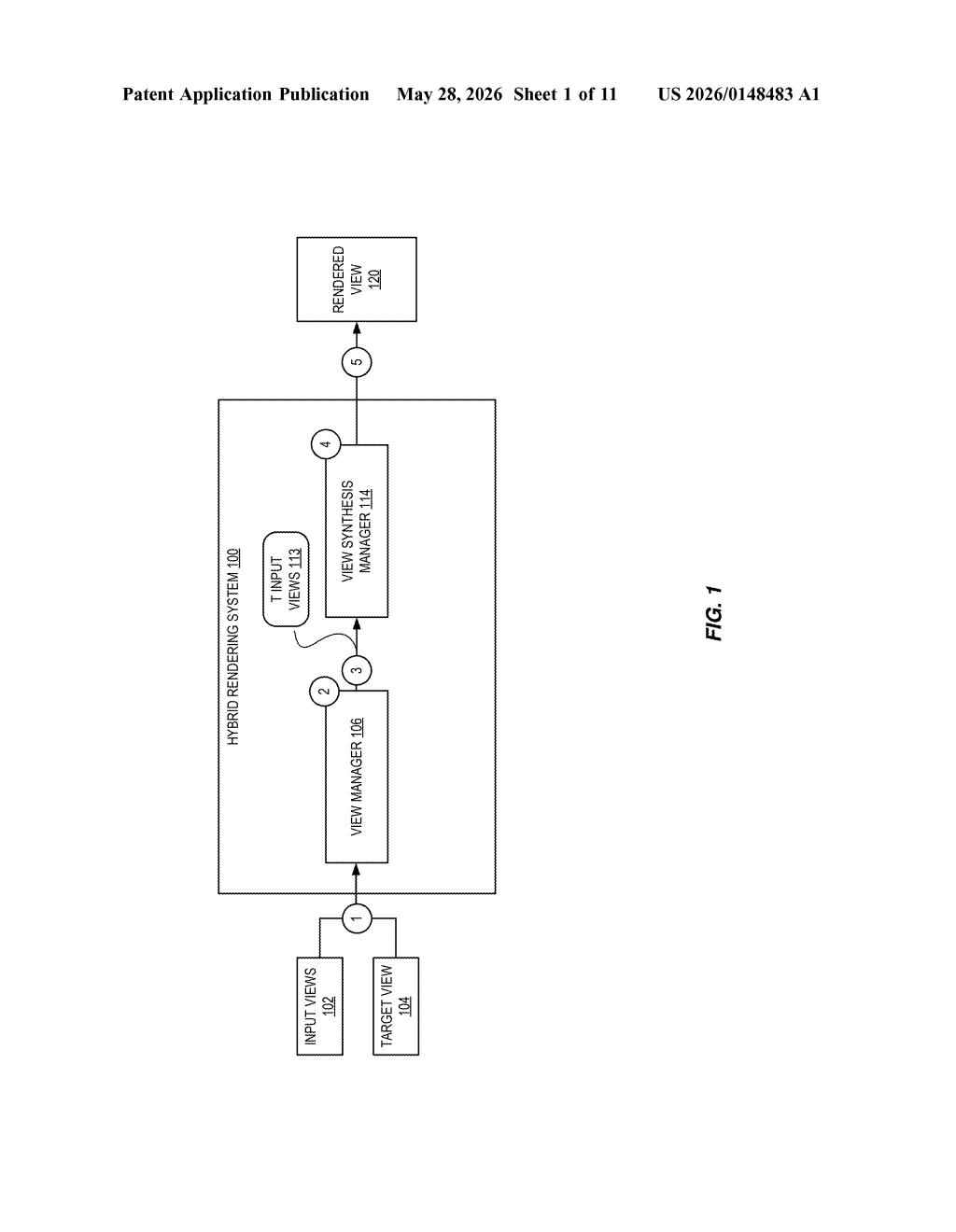
What Adobe's hybrid view synthesis actually does
Imagine you've photographed a city block from a dozen different spots, but now you need a view from somewhere you never stood. Normally you'd have to go back and shoot it. Adobe's patent describes a system that can construct that missing angle from the photos you already have.
The system looks at all your existing photos, figures out which ones are most visually similar to the angle you want, and uses just that relevant subset to synthesize the new view. By narrowing down to the most useful inputs rather than processing everything at once, it keeps the task manageable even for large, complex scenes.
The clever part is the "hybrid" piece: it combines classical image-based rendering (essentially warping and stitching real pixels) with neural rendering (a learned model that fills in gaps and fixes artifacts). Together, they produce a result that's more accurate and photorealistic than either approach alone.
How Adobe picks and blends input views for rendering
At its core, the patent describes a novel view synthesis pipeline — a system that generates camera perspectives that don't exist as real photographs.
When a request comes in, the system receives two things: a collection of input views (real photographs or renders of a scene from various angles) and a target view (the desired new camera position/orientation). Rather than feeding all input views into the synthesis process, the system first runs a view selection step that identifies a subset based on similarity to the target — think of it as finding the photos most "geometrically close" to where you want to end up.
From there, the selected subset feeds into a hybrid rendering pipeline that mixes two techniques:
- Image-based rendering (IBR): directly warping and reprojecting real pixel data from source photos into the target viewpoint
- Neural rendering: a learned model (likely a neural network) that synthesizes plausible pixels for regions where real pixel data is missing, occluded, or inconsistent
The combination matters because IBR preserves sharpness and photographic fidelity where source data is good, while the neural component handles disocclusions (areas newly visible in the target view that were hidden in source views) and blending seams — the classic weak spots of purely geometric approaches.
What this means for 3D content and creative tools
For Adobe's creative suite, this kind of technology points toward tools that let photographers, filmmakers, and 3D artists generate virtual camera moves or fill in missing angles from a shot set — without needing a 3D artist to manually reconstruct geometry. Think of virtual production workflows, AI-assisted video editing, or generative features inside products like Adobe Substance or After Effects.
The "large scene" framing in the title is also significant. Many neural rendering techniques (like NeRF) struggle or become prohibitively slow on large outdoor scenes. By trimming down to a relevant view subset first, this approach appears designed to stay practical at scale — which is exactly the kind of limitation that's kept neural rendering out of real production pipelines.
This is a competent engineering patent solving a known bottleneck in neural rendering — view selection overhead for large scenes — rather than a conceptual leap. The hybrid IBR-plus-neural framing is fairly well-trodden in academic literature, so the defensibility here likely depends on implementation specifics buried deeper in the claims. Worth tracking as a signal that Adobe is building production-ready novel view synthesis into its tools, but not a fundamental shift in how the technology works.
There are more where this came from
We read every patent application Big Tech publishes and send you the ones worth knowing. Plain English, free, every week.
Want this weekly breakdown for a company we don't cover? Patentlyze Pro →