
Samsung Patent Ranks AI-Generated Daily Summary Cards Across Multiple Apps
Samsung is patenting a system that watches your apps throughout the day, then uses an AI model to generate ranked image-and-text summary cards, all displayed at once when the clock hits a set time.
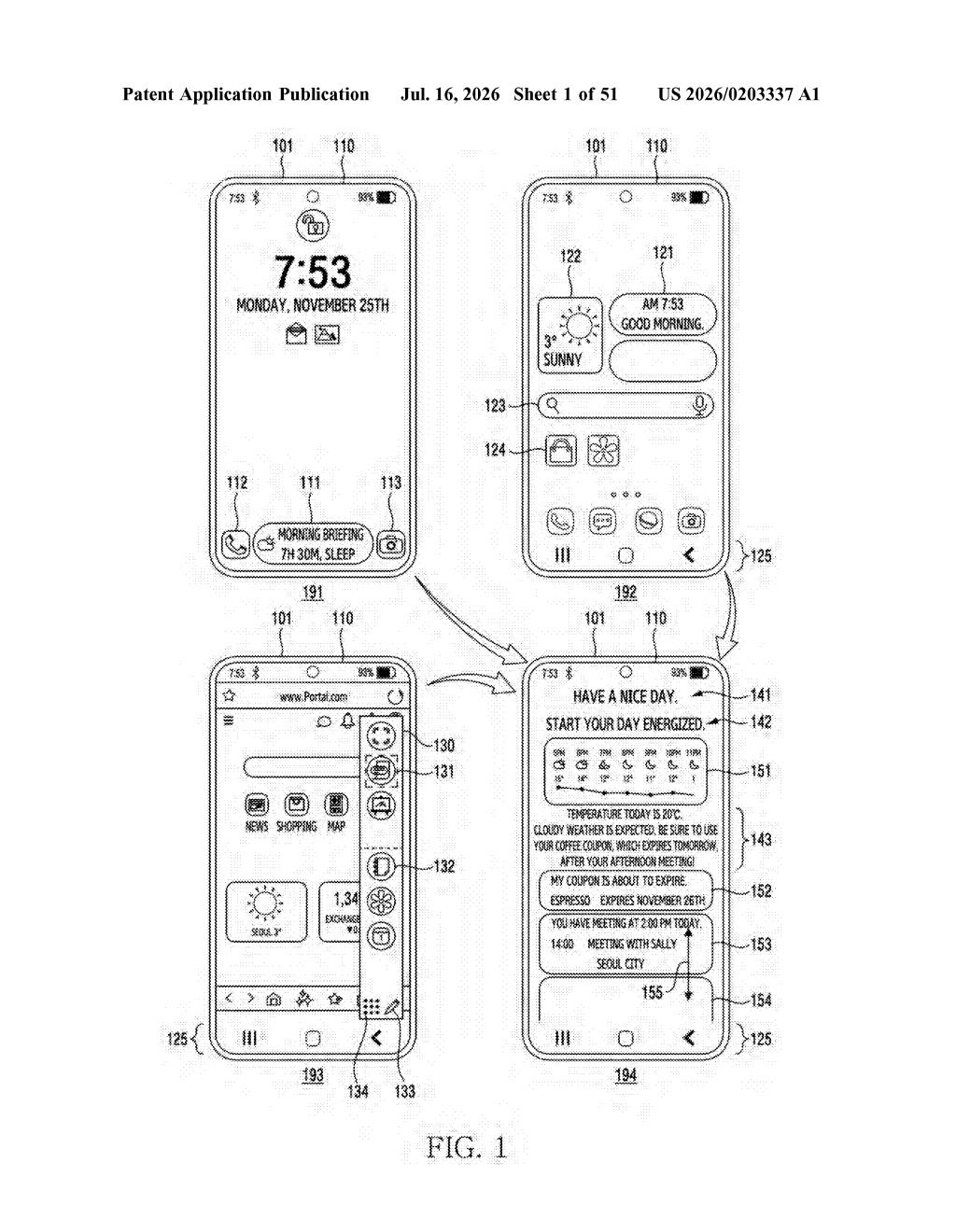
What Samsung's timed app-summary system actually does
Imagine it's the end of your workday and your phone automatically shows you a side-by-side recap: your fitness app's step count on one card, your calendar's completed meetings on another, all neatly laid out without you tapping a thing. That's essentially what Samsung is building toward here.
The system monitors several apps over a specific window of time, say the past eight hours, and when a preset time arrives (think 6 p.m. or bedtime), it hands all that collected data to an AI model. The model then builds small summary cards, each with an image and a short text blurb, for each app.
The cards aren't shown in random order either. Samsung's patent describes a ranking system tied to the time of day, so the summaries most relevant to that moment appear more prominently. You'd see everything at once on your screen, ranked by what the phone thinks matters most right now.
How the ML model ranks and assembles each summary card
At a technical level, the device monitors data from multiple installed apps simultaneously. When the device's clock reaches a pre-configured time, it collects the data each app gathered during a corresponding period (for example, all activity since the last summary). That data is then fed into an on-device machine learning model, which generates what the patent calls "content" for each app: a pairing of an image and a short text description.
The ML model doesn't just transcribe raw data. It synthesizes it into a digestible visual card, similar in concept to how AI assistants today can write short recaps of your calendar or messages.
- Time-triggered activation: the whole pipeline fires based on a clock condition, not user input.
- Per-app content generation: each app's data produces its own image-plus-text card independently.
- Rank determination: the system scores each card based on the current time information, then orders them on screen accordingly.
- Concurrent display: all ranked cards appear on the touchscreen at once, rather than in a scrollable list or notification stack.
The patent doesn't name a specific ML model architecture, but the framing suggests a generative or summarization model running on the device itself, consistent with Samsung's recent push toward on-device AI in its Galaxy line.
What this means for Samsung's home screen and AI ambitions
For users, this is essentially an automatic daily briefing built into the phone's operating system, without opening a single app. If Samsung ships something close to what this patent describes, it would compete directly with Apple's AI notification summaries and Google's "At a Glance" widget, but with a more structured, time-aware, multi-app layout.
For Samsung's broader strategy, the patent fits neatly into the Galaxy AI push the company has been making since early 2024. Building a system that ranks and surfaces app data at the OS level gives Samsung a way to make AI feel present without requiring users to actively prompt it, which is the harder and more valuable problem to solve.
This is a genuinely useful idea that addresses a real friction point: most people never open their fitness, finance, or productivity apps to review their day, but they would glance at a well-designed summary card. The ranking mechanism is the interesting wrinkle here, because time-aware prioritization is what separates a useful digest from a cluttered widget dump. Whether Samsung can execute on the card quality is the real question.
Which company should we read for you?
We track 17 companies here. Pro is the same weekly breakdown for any company you choose, delivered privately. Type a name and we'll scope it and send you a quote.
Get one Big Tech patent every Sunday
Plain English, intelligent commentary, no hype. Free.
Editorial commentary on a publicly published patent application. Not legal advice.