
Tesla Files Patent for Ethernet Ring Network to Replace Traditional Car Wiring
Car wiring harnesses are among the heaviest, most expensive, and most failure-prone components in a modern vehicle. Tesla is patenting a way to route all that traffic over a single Ethernet ring instead.
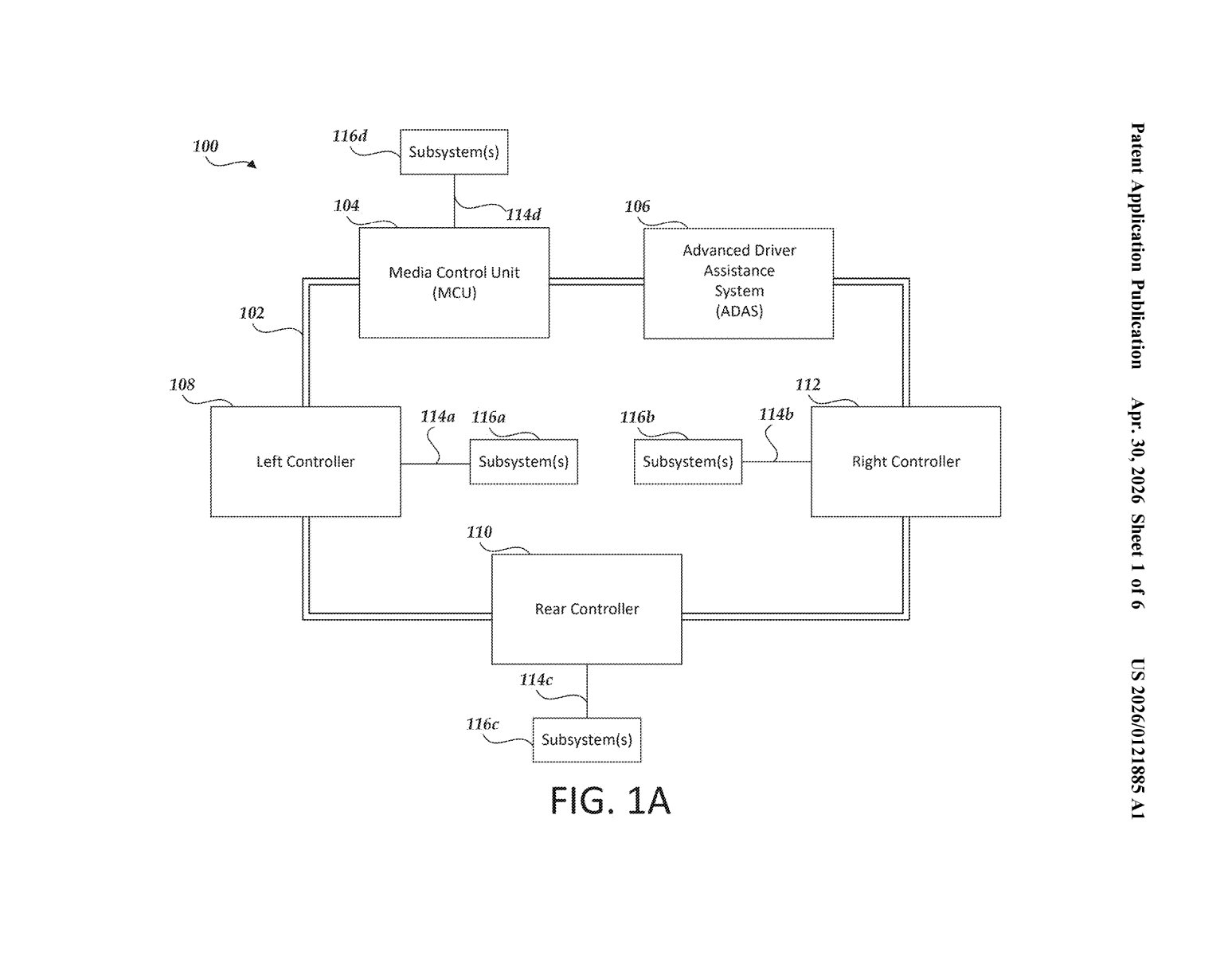
What Tesla's Ethernet ring wiring system actually does
Imagine your home router: instead of running a separate cable from every device to every other device, everything connects to one network and packets find their way. Tesla is applying that same logic to your car.
Right now, most vehicles use a web of dedicated wires — called a wiring harness — to connect hundreds of components. In some cars, this harness weighs over 60 lbs and costs thousands of dollars to manufacture. Tesla's patent describes replacing much of that point-to-point wiring with a single Ethernet loop that all the car's controllers share.
The clever part is that the system speaks two languages at once. Legacy car components still talk their old CAN bus protocol (think of it as the automotive world's dial-up modem), but gateway controllers on the ring translate those messages into Ethernet packets — and back again — so nothing has to be redesigned from scratch.
How Tesla's loop routes CAN messages over Ethernet
The patent describes a ring topology — a loop of controllers daisy-chained together — where each node can both send and receive Ethernet messages traveling in both directions simultaneously. That bidirectional design is important: if one segment of the ring is cut or fails, traffic can route the other way around, making the network inherently fault-tolerant.
The bridge between old and new is the CAN bus (Controller Area Network — the 30-year-old messaging standard used by virtually every car subsystem, from brakes to climate control). The patent's first controller picks up CAN messages from one subsystem, wraps them inside a standard Ethernet data frame, and fires that packet around the ring in both directions. A second controller on the ring receives the Ethernet packet, checks whether its attached subsystem is the intended recipient, unwraps the CAN message, and delivers it locally.
Key components of the system include:
- Loop controllers — nodes that encode and decode packets bidirectionally
- CAN bus bridges — translators between legacy automotive protocols and Ethernet
- Bidirectional routing — simultaneous transmission in both directions for redundancy
The architecture means existing subsystems (sensors, actuators, ECUs) don't need to be rewritten to support Ethernet natively — the ring handles translation at the edges.
What this means for EV wiring costs and reliability
Wiring harnesses are a genuine pain point in automotive manufacturing. They're hand-assembled, difficult to route, heavy, and a common source of warranty claims. Consolidating backbone communication onto a single Ethernet ring could trim weight, reduce assembly complexity, and give Tesla more flexibility in how it lays out future vehicle platforms.
For you as a driver, the most tangible benefit would be reliability — fewer individual wire runs means fewer points of failure, and the ring's built-in redundancy means a damaged cable doesn't necessarily kill a subsystem. It also signals Tesla's longer-term push toward treating a car less like a bundle of mechanical parts and more like a networked computing platform.
This is unglamorous but strategically smart work. Ethernet-based vehicle networks are already a direction the industry is moving (see: automotive Ethernet standards like 100BASE-T1), but Tesla wrapping legacy CAN traffic inside the ring — rather than forcing a clean-break redesign — shows a pragmatic engineering path that could actually ship. It's the kind of patent that quietly shows up in the next-generation platform before anyone notices.
There are more where this came from
We read every patent application Big Tech publishes and send you the ones worth knowing. Plain English, free, every week.
Want this weekly breakdown for a company we don't cover? Patentlyze Pro →